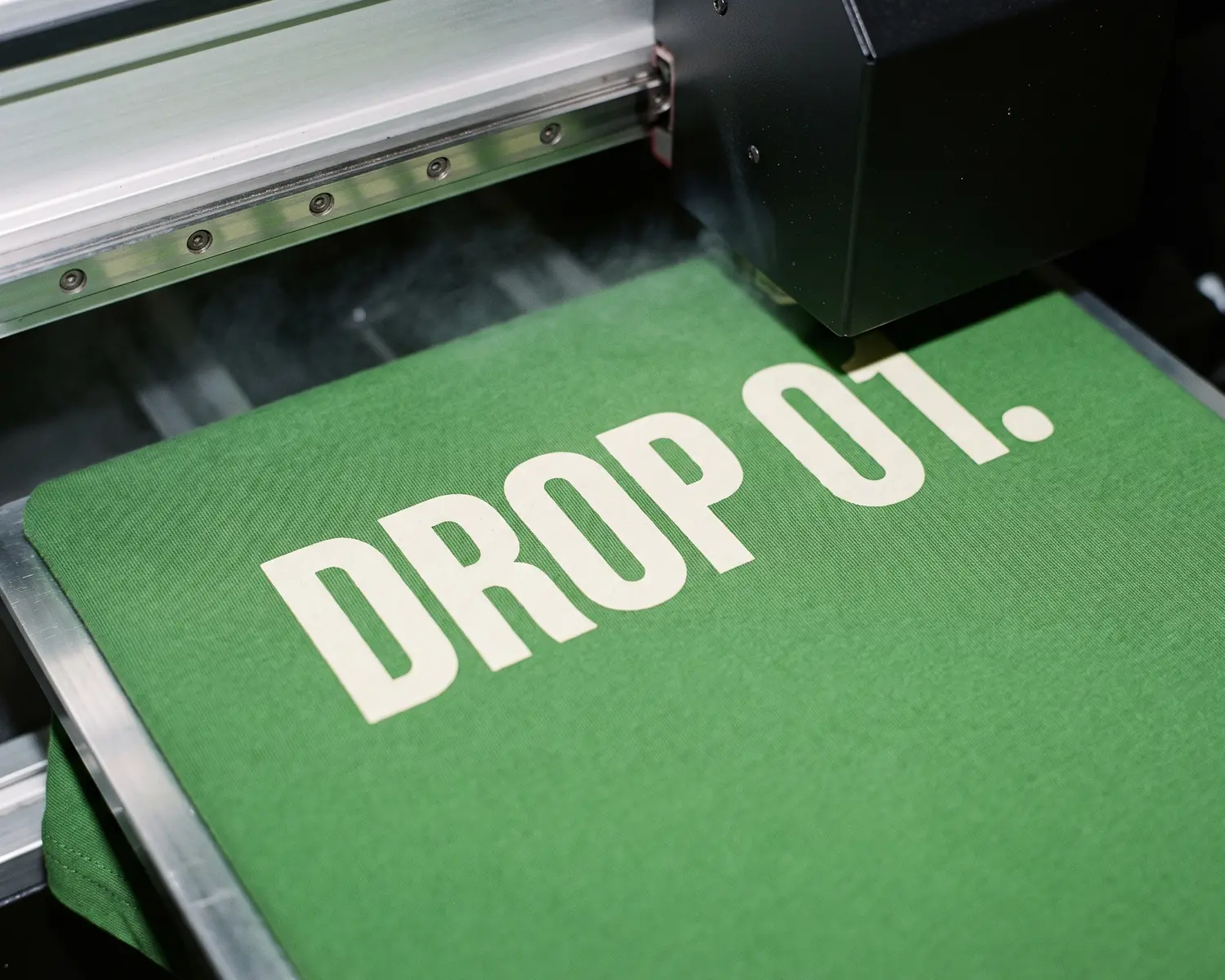
Print on demand makes the garment once it is sold, with no stock paid upfront. At tknp.io, the smallest decorated run is 10 t-shirts per model: the Creator 2.0 costs €12.64 excluding VAT per piece with a DTF transfer, and €8.77 at 100, at 5 November 2026 prices.
The essentials in 4 points:
- Nothing is produced until something is sold: no stock, no cash upfront, no leftovers.
- At tknp.io, marking starts at 10 units per model, and the Store pre-sale adds up everyone's orders to form the run.
- The trade-off: a small run costs more per piece. The Creator 2.0 t-shirt with a DTF transfer goes from €12.64 excluding VAT at 10 units to €9.46 at 50.
- Print on demand is not dropshipping: you sell your own creation, not somebody else's catalogue.
Search for print on demand and you land on the same story repeated ten times over: build a brand, sell designs to strangers, make money while you sleep. That is a real use of the model, but it is not yours if you already have a community around you, a club, a graduating class, an association, an audience, a team.
In that case, print on demand is not there to find you customers: it is there to let you dress the people you already have without putting money up front. Here is how it works, what it costs, and when it is not the right tool. To pick a platform, read print on demand in France and its platforms instead.
What print on demand means
Print on demand means printing only when there is an order. The principle fits in one sentence: production is triggered by the order, not before. You do not make a hundred sweatshirts hoping to sell them, you sell twelve and you produce twelve.
How does print on demand work, step by step?
Print on demand at tknp.io runs through the Store and its pre-order campaigns, in four steps.
- You create. Your logo, your artwork, placed on existing catalogue products: t-shirts, hoodies, caps, accessories. Nothing to invest at this stage.
- You publish. Your products live in your Store, at an address you share in a group chat, a story or a newsletter. The Store is reserved for verified organisations, and each of its campaigns stays open for one to three weeks.
- Everyone orders and pays. This is the part that changes everything: the money comes in before anything is made. You can also collect the money yourself at the club: the run is then invoiced to you.
- Production starts, then shipping. When the campaign closes, every garment that reaches its threshold goes into production, and the delivery date, about three weeks later, is shown before anyone pays. Grouped for everyone, or to each person individually, depending on what you chose.
What print on demand really changes
You put nothing up front. No stock to finance, no boxes in a garage, no sizes left over. That is the difference between a project decided quickly and a project that needs a committee meeting and a treasurer's vote.
You produce the exact number. Twenty-three orders, twenty-three garments. It is the mistake I saw most often at the printing company where I worked: a committee ordering big to be safe, selling half of it, and keeping the rest in a storeroom for two years. Merch that ends up in a cupboard is a waste, of money as much as of material: print on demand mechanically removes the unsold pile.
You set your price. The gap between your selling price and tknp.io's price at the volume reached comes back to you, paid after delivery. A collection that funds an association or a class trip is not a nice image, it is arithmetic.
You can relaunch whenever you want. A new class, an event, a second wave six months later: a new pre-sale campaign on the same Store, and a new run goes out when it closes.
How much does a garment cost in print on demand?
A custom t-shirt in print on demand at tknp.io costs €12.64 excluding VAT per piece for a run of 10 Creator 2.0 tees with a DTF transfer, then €10.39 at 25, €9.46 at 50 and €8.77 at 100. The price follows the final volume of the run: on the Store, reservations made one by one add up to a single run, produced at the price of the volume reached.
These public prices, read on 5 November 2026 on the Creator 2.0 product page, are for guidance. They cover the garment plus an A6 decoration on one side, before VAT and without shipping, in the page's cheapest colour, in the usual sizes, with a two-week lead time. The quote is what counts.
From what quantity does print on demand pay off?
Print on demand pays off as soon as each garment reaches its threshold: on the tknp.io Store, that reservation threshold is worked out so that what your members pay covers the cost of making it, so it depends on that price and on the technique. It never drops below the 10 units that any decorated run requires at tknp.io.
Beyond the threshold, each tier makes the run cheaper: on a Creator 2.0 t-shirt with a DTF transfer, €12.64 excluding VAT per piece at 10, €9.46 at 50 and €8.77 at 100. Since your members' price stays fixed, the gap that comes back to you grows with every tier crossed, and what an association t-shirt pre-sale earns shows it tier by tier. To price a whole collection, t-shirts, hoodies and caps, see what a merch collection costs and earns.
The limits, said plainly
None of the pages selling you print on demand will tell you this, so it may as well be said here.
The unit price is higher. Producing one garment at a time costs mechanically more than producing a hundred at once: the fixed costs of setup and programming are spread over a single item. Price breaks still exist: on every product page, the price falls in steps, from 10 up to 1,000 garments, marking included. On the tknp.io Store, the run is billed at the price of the volume reached: the more reservations a campaign gathers, the lower the price of each garment, and opening the Store costs nothing. If you already know you will order two hundred identical garments for a fixed date, the grouped order stays more direct: it is placed in one go, at the tier for the quantity you want, without waiting for a campaign to close.
Marking starts at 10 units. At tknp.io, every run requires preparation (a screen, a film or an embroidery program), whatever the technique: the minimum is therefore 10 units per model, sizes mixed. The detail is in the minimum order quantity guide.
You have to count the time. Print on demand at tknp.io does not deliver overnight: an order placed directly on the site goes through 10 working days of customisation as standard, shipping on top. If you go through a tknp.io Store campaign, plan on four to six weeks between the decision and the garments on people's backs: the campaign itself, 7 to 21 days long, and about three weeks between its closing and delivery. That is not long, but it cannot be improvised the week before: for a date that will not move, the guide to custom garment production lead times helps you time the order.
The same artwork for everyone. Different first names or numbers on each garment are not part of the model: that is a separate process, with its share of mistakes and regrets.
POD, dropshipping, grouped order: do not mix them up
| What you sell | The stock | The right case | |
|---|---|---|---|
| Print on demand | your creation, on catalogue products | none, made to order | a community that already knows you |
| Dropshipping | a supplier's product, as is | none, but nothing is yours | pure resale, no identity |
| Grouped order | your creation, produced in one run | you are holding it | a known quantity, a fixed date |
When print on demand is the right choice
It is, whenever you do not know how much you will sell, and that is the general case: a launch, a drop, a back-to-school collection, an association testing an idea, a creator sounding out their audience. It is, too, as soon as sizes are an unknown, which happens as soon as the group grows.
It is less so when everything is already decided: two hundred identical garments, a date, an approved budget. There, the grouped order, placed in one go, remains the simplest route. The two approaches coexist perfectly well within the same year.
Preguntas frecuentes
Print on demand and dropshipping, what is the difference?
In print on demand, the product carries your creation and only exists once ordered. In dropshipping, you resell a supplier's product without modifying it and without ever seeing it. The first builds an identity, the second moves parcels.
Can each person reserve a single garment on the Store?
Yes: on the tknp.io Store, each member reserves their own garment, in their size. The campaign groups the reservations into one run, produced when it closes; each garment has its minimum threshold, below which the technique changes but not the price, or the reservation is refunded. A blank garment, for its part, is ordered on its own, without a campaign.
Which decoration technique does print on demand use?
At tknp.io, print on demand uses the technique the garment's product page offers online. On the Creator 2.0 t-shirt, three techniques can be ordered online, DTF transfer, screen printing and embroidery; direct-to-garment printing (DTG) and patches go through a quote. The "available decorations" line on each product page says which ones that garment accepts.
Su proyecto, presupuestado en 24 h.
Descríbanos sus prendas, su personalización y sus cantidades: recibirá un presupuesto detallado, marcaje incluido, en 24 h laborables.