EU Ecolabel: what does it guarantee on a garment?
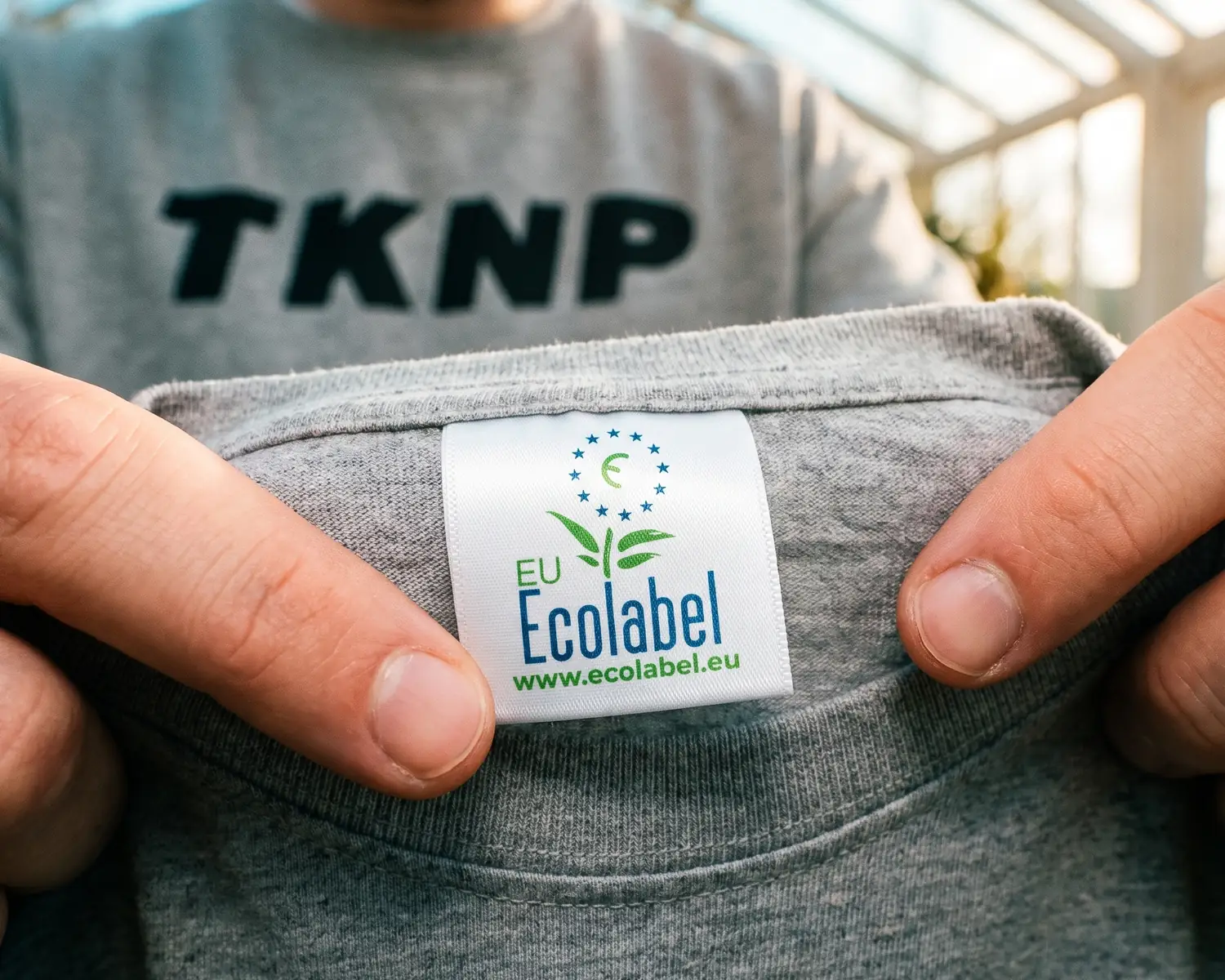
The EU Ecolabel is the official ecolabel of the European Union. On a garment, it guarantees more sustainable fibre production, restricted hazardous substances, regulated printing, tested wash performance and fundamental labour rights checked in garment making, all verified by an independent body.
Key points:
- The EU Ecolabel is the official ecolabel of the EU (Regulation No 66/2010); for garments, its criteria are those of Decision 2014/350/EU, valid until 31 December 2028.
- An EU Ecolabel garment is not necessarily organic: when a labelled t-shirt contains cotton, that cotton must be at least 95% organic or at least 60% grown under integrated pest management, and some labelled models contain none (recycled polyester).
- The EU Ecolabel is checked through its registration number (country/016/number for textiles), to be looked up in the European Commission's official catalogue.
- On tknp.io, 18 product pages mention the EU Ecolabel, all from the Neutral brand; the logo you have added to them is not part of the licence.
A club that wants more responsible merch, a brand selling to its community, a company careful about what it buys: all of them come across the small flower of the EU Ecolabel sooner or later. This ecolabel is set up by public authorities, with textile criteria published in the Official Journal of the European Union. Here is what it really requires of a garment, what it does not promise, how to check a licence number, and what you can write once your logo is on it.
What is the EU Ecolabel?
The EU Ecolabel is the official ecolabel of the European Union, recognisable by its flower. Its framework is Regulation (EC) No 66/2010 of 25 November 2009, which makes it a voluntary scheme. No brand has to apply for it; a brand that displays it has had its product checked against published criteria, based on scientific data and on the product's whole life cycle.
According to AFNOR Certification, it is the only official European ecolabel that can be used in every EU country. Its criteria aim, as an indication, at the 10 to 20% best-performing products in environmental terms at the time they are adopted (Regulation, Annex I).
Who awards the EU Ecolabel in France?
In France, the EU Ecolabel is awarded by certification bodies accredited by COFRAC, the French accreditation body, under Decree No 2022-410 of 23 March 2022, while ADEME, the French government agency for ecological transition, supports the French policy for the label, according to ecolabels.fr, the AFNOR Certification website. ADEME, for its part, states that it takes part in the technical development of the criteria and promotes them in France.
At European level, Regulation (EC) No 66/2010 requires verification by a body independent of the company being checked. It also provides for a contract between the competent body and the applicant, a registration number given to the product and regular checks, which can take the form of unannounced spot checks (Articles 9 and 10).
Is the EU Ecolabel an official label?
Yes, the EU Ecolabel is a public label: Directive (EU) 2024/825 cites logos awarded under Regulation No 66/2010 as an example of sustainability labels established by public authorities, and the European Commission presents it as a way to prevent greenwashing. Applied by Member States since 27 September 2026, the directive lists among banned commercial practices showing a sustainability label backed neither by certification nor by a public authority; our article on the PETA-Approved Vegan label shows what this rule changes for a private label.
What does the EU Ecolabel guarantee on a garment?
On a garment, the EU Ecolabel guarantees compliance with the textile criteria of Commission Decision 2014/350/EU that apply to it: 28 in total, grouped into six families. Extended by Decision (EU) 2026/66, these criteria are valid until 31 December 2028.
| Criteria family | What is checked on a garment |
|---|---|
| Fibres | organic cotton or cotton grown under integrated pest management; for polyester and nylon, a recycled share or another requirement, depending on the case |
| Components and accessories | padding; coatings, laminates and membranes; accessories |
| Chemicals and processes | a restricted substance list, hazardous substances in dyeing, printing and finishing, energy efficiency, treatment of emissions to air and water |
| Fitness for use | shrinkage in the wash, colour fastness, pilling |
| Social responsibility | fundamental labour rights in garment making, denim sandblasting banned |
| Information | statements shown next to the flower |
Is an EU Ecolabel t-shirt made of organic cotton?
Not necessarily: the EU Ecolabel regulates cotton when the garment contains some, without requiring organic cotton. That cotton must then be at least 10% organic, or at least 20% grown under integrated pest management (IPM), a farming method with restrictions on pesticides. For the cotton in t-shirts, blouses, shirts, jeans, pyjamas and nightwear, underwear and socks, the thresholds rise to 95% organic or 60% IPM cotton; clothing for babies under 3 must contain at least 95% organic cotton. A garment without cotton falls outside this criterion: in our catalogue, two t-shirts whose page mentions the EU Ecolabel are made of recycled polyester (R61001 and R81001).
To know whether the cotton really is organic, look next to the flower for "Made with organic cotton", reserved for products containing more than 95%. Our article on organic cotton covers this fibre in detail.
What does the EU Ecolabel guarantee for polyester and nylon?
For a polyester garment sold to consumers, the EU Ecolabel requires at least 50% recycled PET in staple (short) fibres and 20% in continuous filaments, with an antimony cap of 260 ppm. For a garment sold mainly to businesses and the public sector, that share of recycled polyester can be replaced by a cap on VOC emissions when the polyester is made. For polyamide (nylon), the manufacturer must either use at least 20% recycled nylon, or keep nitrous oxide emissions to 9 g per kilo of base material (caprolactam or adipic acid). Our article on recycled polyester explains where this fibre comes from.
What does the EU Ecolabel check on chemicals and printing?
The EU Ecolabel restricts hazardous substances without promising they are absent: according to the 2014 decision, their use has been limited as far as technically possible without harming the use of the garment, and the product is tested against a list of restricted substances. That list follows every stage: spinning, dyeing, printing and finishing.
When the manufacturer prints the garment, the printing is part of the file: printing pastes with no more than 5% volatile organic compounds, plastisol-type additives (PVC, phthalates) banned, and a declaration from the printer as evidence. Another label, Oeko-Tex Standard 100, tests the textile against harmful substances: our page on the Oeko-Tex label presents it.
Does an EU Ecolabel garment hold up in the wash?
Yes, the EU Ecolabel tests wash performance: a knitted garment, such as a t-shirt or a sweatshirt, must not shrink or stretch by more than 4% after three washes at the stated temperature, each followed by tumble drying. Colour fastness to washing must reach at least 3-4, for both colour change and staining; white garments, or garments neither dyed nor printed, are exempt.
Pilling is rated (at least 3) for wool, wool and polyester blends, fleece included, and woven cotton; the decision sets no pilling grade for the cotton jersey of a t-shirt. Among the statements allowed next to the flower is "Tested for durability".
What does the EU Ecolabel guarantee on working conditions?
The EU Ecolabel requires fundamental labour rights to be respected in the sites where the garment is cut, sewn and finished. The decision refers to nine ILO (International Labour Organization) conventions, which cover forced labour (two conventions), freedom of association, collective bargaining, equal pay, discrimination, health and safety, minimum age and the worst forms of child labour. A third party must verify compliance.
The criterion stops at garment making: cotton fields and spinning mills are not covered. Another criterion bans sandblasting to distress jeans.
What does the text next to the EU Ecolabel flower mean?
Next to the EU Ecolabel flower, an optional text box can show "More sustainable fibre production", "Less polluting production processes", "Restrictions on hazardous substances" and "Tested for durability". The first one can give way to a composition statement, awarded above set thresholds:
| Statement next to the flower | What it guarantees |
|---|---|
| Made with organic cotton | over 95% organic cotton |
| Made with xx % organic cotton | over 50% organic cotton |
| Cotton grown with reduced pesticides | over 70% IPM cotton |
| Made with xx % recycled polyester | over 50% recycled polyester |
| Made with recycled polyester | over 95% recycled polyester |
| Made with xx % recycled nylon | over 20% recycled nylon |
What the EU Ecolabel does not guarantee
The EU Ecolabel guarantees neither a 100% organic garment, nor manufacturing in Europe, nor the absence of every chemical. Six limits to know before you put it forward:
- Not necessarily organic: for the cotton in a t-shirt, 60% from integrated pest management is enough.
- Not an origin: for a product made outside the Union, the Regulation provides for the application to be filed in a country where it is sold; the label says nothing about where it was made.
- Not chemical-free: hazardous substances are limited as far as possible, and the Commission can grant derogations.
- Not the whole social chain: the social check stops at garment-making sites.
- Not a lifetime guarantee: the licence is a contract that provides for withdrawal of the label, notably after a revision of the criteria.
- Not your decoration: the licence only covers the garment the brand had assessed.
To place the EU Ecolabel among GOTS, Oeko-Tex and the rest, our guide to textile labels sorts out what each one proves.
Your logo on an EU Ecolabel garment: what can you write?
Once your logo is on it, talk about the model, not the finished garment: your custom merch is made on a model that carries the EU Ecolabel; it is not ecolabelled itself. Regulation (EC) No 66/2010 reserves the label for products that have been awarded it, and the licence covers the garment as the brand had it assessed; decoration added afterwards, by us or by another workshop, is not part of that file.
Directive (EU) 2024/825 also lists among banned practices making an environmental claim about an entire product when it only concerns one aspect of it, and the Regulation bans any logo likely to be confused with the flower. To stay accurate:
- Write: "Neutral Mens Classic t-shirt, a model that carries the EU Ecolabel (licence DK/016/049)".
- Avoid: "ecolabelled t-shirt" or "EU Ecolabel merch" for the decorated version, and the flower reproduced in your artwork or on your sales page.
At tknp.io, the mention on a product page refers to the blank model as its brand presents it.
How do you check that a garment really carries the EU Ecolabel?
To check an EU Ecolabel garment, look for the flower and the registration number the brand must put on the product, then find that licence number in the European Commission's official catalogue.
- Read the number. It follows the format country/product group/number, and the textile products group has the code 016. Example: DK/016/049, Neutral's licence, registered in Denmark.
- Look it up in the official catalogue of labelled products, under Clothing and textiles then Textile products: each product appears with its licence number and the licence holder's name. On 26 October 2026, that list had 11,548 textile product entries.
- Do not jump to conclusions if nothing shows up: the Commission points out that registering products in the catalogue is up to licence holders and that the database may be incomplete. Ask the brand for its licence number.
- Report misuse: the European Commission invites you to notify it of any improper use of the label.
Where can you find EU Ecolabel garments on tknp.io, and at what price?
On 26 October 2026, 18 tknp.io product pages mention the EU Ecolabel, out of the 4,287 items listed in our catalogue: every one is a Neutral model, and all appear in the official catalogue under licence DK/016/049.
| Family | Neutral models whose page mentions the EU Ecolabel | Composition (catalogue thumbnail) |
|---|---|---|
| Men's t-shirts | Mens Classic T-Shirt (O60001), Mens V-Neck T-Shirt (O61005) | 100% organic cotton |
| Women's t-shirts | Ladies Classic, Ladies Loose Fit, Ladies Half Sleeve, Ladies V-Neck, Ladies Three Quarter Sleeve and Ladies Long Length T-Shirt (O80001, O81003, O81004, O81005, O81006, O81020) | 100% organic cotton |
| Sports t-shirts | Recycled Performance T-Shirt (R61001), Ladies Recycled Performance T-Shirt (R81001) | 100% recycled polyester |
| Jacket and bottoms | Unisex Jacket With Zip (O73501), Sweatpants With Cuff And Zip Pocket (O74002) | 100% organic cotton |
| Bags (tote bag, gym bag) | Shopping Bag, Long Handles (O90014), Twill Gym Bag (O90020) | 100% organic cotton |
| Apron, scarf, beanies | Chef Apron (O92003), Scarf (O93010), Classic Beanie (O93055), Mixed Knit Beanie (O93056) | 100% organic cotton |
On a labelled model, your custom t-shirt is priced right on the product page, decoration included, with no need to wait for a quote. Unless stated otherwise, the prices below assume a single order of one model, an identical logo placed in the same spot, and the public rate on the page, without the discount given to verified accounts. On 26 October 2026, the tknp.io page of the Neutral Mens Classic T-Shirt (180 g/m², 100% organic cotton) showed these indicative prices per item, excluding VAT, with one print position, the standard two-week lead time and the most accessible colourway, transport extra:
| Items | Blank | A6 DTF transfer | One-colour screen print |
|---|---|---|---|
| 10 | €12.05 | €16.97 | €25.45 |
| 25 | €11.68 | €14.68 | €17.04 |
| 50 | €11.30 | €13.62 | €13.62 |
| 100 | €10.92 | €12.80 | €12.21 |
The Ladies Classic T-Shirt (O80001) page shows the same grid. The Mens Classic comes in 10 colours, including two greys: Sport Grey and Dark Heather. A decorated run of Mens Classic tees starts at 10 items, sizes and colours mixed, and the price tier then counts that model's total. The quote prevails.
Domande frequenti
How much does the EU Ecolabel cost a clothing brand?
To obtain the EU Ecolabel, a brand pays an application fee of between €200 and €2,000, capped at €600 for an SME and €350 for a micro-enterprise. On top of that comes an annual fee, either flat or based on sales (0.15% at most), up to €25,000 per product group; testing and inspections remain at its own expense.
How many textile products carry the EU Ecolabel?
As of September 2026, the European Commission counted 11,708 awarded products in its "Clothing and textiles" category, out of 121,083 products and 3,665 licences in total.
Will the EU Ecolabel textile criteria change?
Yes, the EU Ecolabel textile criteria are under revision. Decision (EU) 2026/66 extended them until 31 December 2028 and plans to complete the revision after the textile delegated act of the European ecodesign regulation, the same regulation that creates the digital product passport.
Can a fabric carry the EU Ecolabel without the garment?
Yes: since 2017, the EU Ecolabel textile criteria also cover intermediate products (fibres, yarns, fabrics and knits), and they also apply to non-textile components such as zips and buttons. A labelled fabric is therefore not enough: the label can only be used with the product that was awarded it, with its own number.
Since when has the EU Ecolabel existed?
According to AFNOR Certification, the EU Ecolabel was created in 1992. Its current framework, Regulation (EC) No 66/2010, repealed Regulation (EC) No 1980/2000, which had already revised the scheme.
Il suo progetto, preventivato in 24 ore.
Descriva i capi, la personalizzazione e le quantità: riceverà un preventivo dettagliato, personalizzazione inclusa, entro 24 ore lavorative.