DTF or screen printing: which to choose for your quantity?
On two tknp.io t-shirts, at the prices shown on 30 October 2026, a one-colour logo in screen printing costs less than an A6 DTF transfer from 100 units, the same at 50, and more below that. DTF keeps the edge for photos, gradients and logos with many colours.
The essentials before you choose:
- Price: on these two product pages, screen printing a one-colour logo costs more than an A6 DTF transfer at 10 and 25 units, the same at 50, and less from 100.
- Colours: in screen printing, every colour of the logo needs its own screen; DTF transfer lays down all the shades at once, in four-colour process.
- Look: dense, opaque flat colours for screen printing; fine detail, gradients and photos for DTF.
- Feel and durability: our technique pages describe screen-printing ink that bonds with the fabric, with "Excellent" wash resistance, and DTF that can feel a little like a film over a big solid area, with "Very good" wash resistance.
You are ordering the merch for a tournament, custom t-shirts for an association or for the crew of an event, and the product page shows two price lines that do not fall at the same pace: the DTF transfer line starts low and drops gently, the screen-printing line starts high and drops fast. DTF or screen printing? The right choice depends first on how many t-shirts you need, then on your logo and on the use the t-shirt is meant for. Here are today's figures, then what should tip the balance when the prices are level.
DTF or screen printing: what is the difference?
Screen printing pushes ink through a screen, colour by colour, straight onto the t-shirt; DTF transfer first prints the whole design on a film, which is then applied to the t-shirt under a heat press.
On our screen printing page, which presents it as "The large-run reference", one screen is engraved for each colour of the design, and that is the fixed setup cost; the ink is then heat-cured. On our DTF transfer page, the design goes onto a film in full colour, gets a coat of adhesive powder, goes under the press, then the film is peeled off. How the screen works and how it is lined up is covered in our guide how a t-shirt is screen printed.
One related technique should not be confused with DTF: DTG prints straight onto the fabric, the ink right in the fibre, with no film. Our DTF or DTG comparison tells the two apart.
From how many t-shirts does screen printing cost less than DTF?
On two tknp.io t-shirts, at the prices shown on 30 October 2026, screen printing a one-colour logo costs less than an A6 DTF transfer from 100 units, and the same at 50. At 10 and 25 units, DTF transfer is the cheaper of the two. Our flex or screen printing comparison made the same comparison on 21 October 2026 on another t-shirt, the #E150 by B&C.
The two models are the Man Regular T-Shirt by JHK (155 g/m², 100% cotton) and the Crafter by Stanley/Stella (155 g/m², organic cotton). Their product pages list three techniques orderable online (DTF transfer, screen printing, embroidery) and two on quote (DTG printing, patches). The prices below are for the decorated t-shirt, garment included, as tknp.io publishes them: excluding VAT, for a single placement, with the standard 2-week lead time, at "Prices for the base colours in standard sizes" (per the product page, a few colours and the biggest sizes are slightly dearer, an extra that appears as soon as you select them), shipping extra, for guidance only. They are valid for a single run of one model carrying one logo in one position, at the listed public price without any discount; the DTF transfer line prices an A6 design (10.5 × 14.8 cm), the screen-printing line a one-colour logo.
| Quantity | Man Regular, A6 DTF transfer | Man Regular, 1-colour screen print | Crafter, A6 DTF transfer | Crafter, 1-colour screen print | Gap, screen print minus DTF |
|---|---|---|---|---|---|
| 10 | €7.89 | €16.37 | €11.59 | €20.07 | +€8.48 |
| 25 | €5.88 | €8.24 | €9.38 | €11.74 | +€2.36 |
| 50 | €5.10 | €5.10 | €8.49 | €8.49 | €0.00 |
| 100 | €4.57 | €3.98 | €7.82 | €7.23 | −€0.59 |
| 250 | €4.32 | €3.57 | €7.29 | €6.54 | −€0.75 |
| 500 | €4.05 | €3.37 | €6.82 | €6.14 | −€0.68 |
| 1,000 | €3.68 | €3.08 | €6.32 | €5.72 | −€0.60 |
Over a whole run, the gap adds up quickly: 10 Man Regular come to €163.70 excluding VAT in screen printing against €78.90 in DTF transfer, and 100 Crafter to €723.00 in screen printing against €782.00 in DTF transfer.
On these two product pages, the gap between the two lines does not move by a cent from one model to the other, even though the Crafter costs more than the Man Regular: our article on volume pricing makes the same finding of an identical gap on three other t-shirts, and explains why screen printing, which pays for its screens before the first t-shirt, falls faster.
What do the "1 colour" and "A6" lines on the product pages price?
On the Man Regular and Crafter product pages, the screen-printing line prices a logo in a single colour, and the DTF transfer line an A6 design, with no number of colours. For a one-colour logo, the two lines can therefore be compared directly; for a logo with two colours or more, the screen-printing price is calculated in the tknp.io designer.
The reason lies in the process: our screen printing page counts one engraved screen per colour of the design, while our DTF transfer page promises "Unlimited full colour from small runs". Both techniques are described there as "Priced online at any quantity": place the logo in the designer, then compare its screen-printing price with the A6 DTF line of the same product page. On a dark t-shirt, screen printing also starts with a white underbase, explained in our guide to printing on a black t-shirt.
The American trade magazine Screen Printing noted in September 2025, from the workshop side, that small jobs with a lot of colours and detail have moved to DTF, and that it is in orders of 40 or fewer that DTF is eating into screen printing.
Flat colours, gradients, photos: what look should you expect from each technique?
Screen printing gives dense, opaque flat colours; DTF transfer reproduces fine detail, gradients and photos. The FAQ on the tknp.io home page sums it up: screen printing "suits flat colours and larger runs", DTF "reproduces fine detail and gradients, even in small quantities".
Our technique pages spell out the limits: for screen printing, "Photo gradients are hard (halftone)"; for DTF, fine detail and crisp edges. On a logo in flat colours, the French Wikipedia article on screen printing gives a way to recognise it: under a magnifier, no halftone dots are visible, the colour is laid down in flat areas; halftone only comes in to imitate a photo or a gradient. Before you choose, the "The result" section of the Man Regular and Crafter product pages shows a photo of a DTF-transfer t-shirt and of a screen-printed t-shirt.
How do a screen print and a DTF transfer feel under the hand?
Under the hand, screen-printing ink bonds with the fabric, according to our screen printing page, whereas our DTF transfer page mentions a "Slight film hand-feel on large solids" and describes it as "Less tactile than embroidery or screen print". The difference therefore shows mostly on large designs, which is where our DTF page places this film feel.
The English Wikipedia article on DTF explains this feel: the design, printed on a film then fixed with a hot-melt powder and pressed, sits on top of the garment instead of blending into the fabric the way sublimation does.
For wash resistance, the tknp.io technique pages rate screen printing "Excellent" and DTF "Very good"; the habits that make them last, such as washing and ironing inside out as the Crafter product page asks, are in our guide to washing a printed t-shirt.
Cotton, polyester, dark t-shirts: which fabrics do they work on?
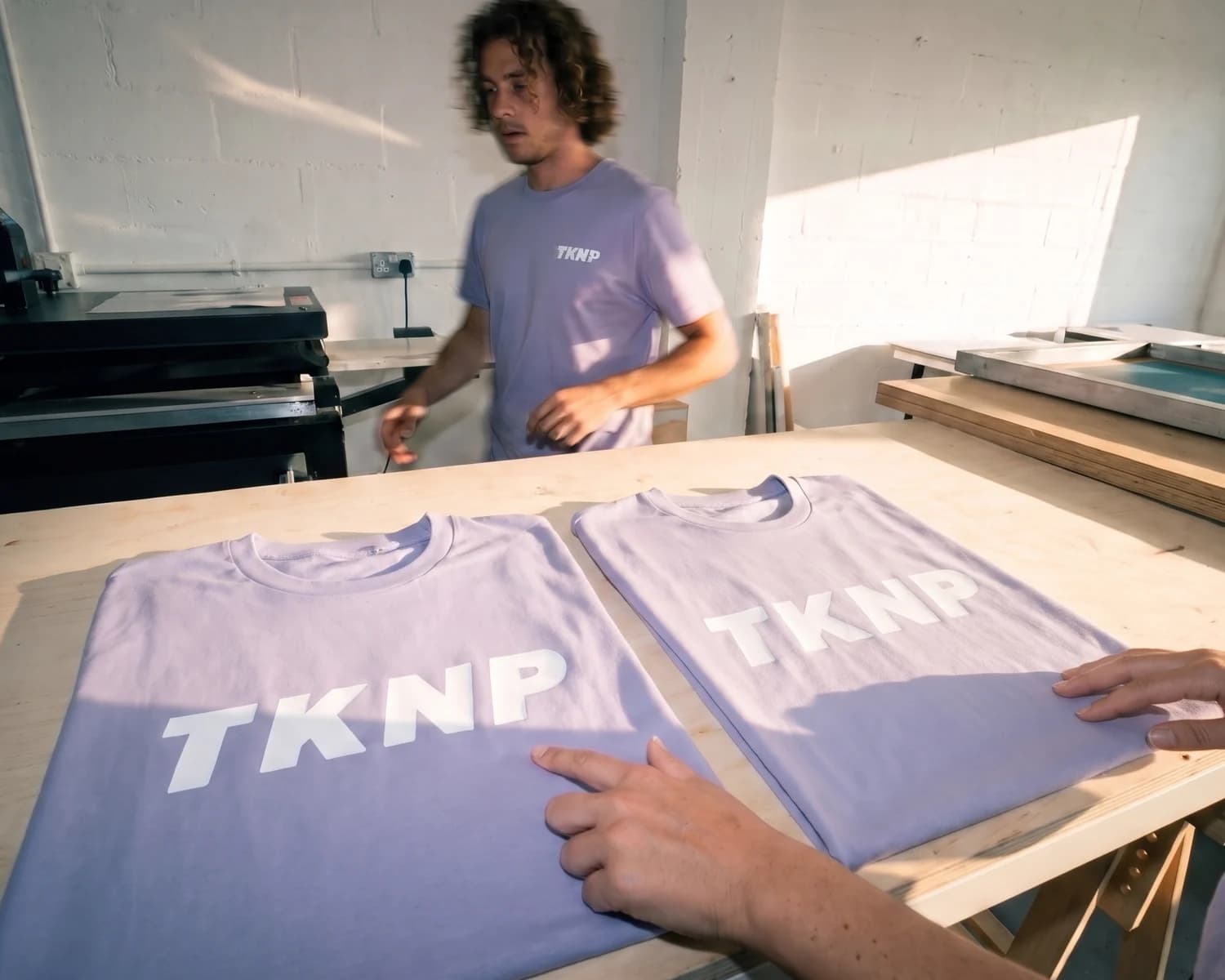
Screen printing and DTF transfer both decorate cotton, polyester and dark fabrics, according to the tknp.io technique pages: "Any flat textile" for screen printing, with "Dense, opaque colours, even on dark fabric", and, for DTF, cotton, polyester or a blend of the two, on almost any fibre and almost any fabric colour. On these pages, the fabric of a t-shirt does not separate the two techniques. As for shade, the Man Regular comes in 84 colours and the Crafter in 41, lavender included on both product pages.
On polyester, screen printing needs an ink suited to that fibre: our article on printing on polyester fabric explains why.
Do lead time and minimum change with the technique?
On the Man Regular and Crafter product pages, the minimum is the same for DTF transfer and screen printing, from 10 units per product, and the whole grid, both techniques included, is quoted at the 2-week standard lead time. The FAQ on these product pages applies this minimum to every technique, with sizes and colours mixed, since each run has its own setup: the screen for screen printing, the film for DTF.
For lead time, the tknp.io FAQ says "You choose at checkout": customisation takes "10 working days" as standard; with the "express" option it drops to 5 working days at a 10% surcharge, and the economy option extends it to 20 days at 5% off. On the product pages, the lead time selected adjusts the price displayed at the top of the product page and in the basket. According to the FAQ, shipping then takes "1 to 2 working days" more to France and up to 7 to the rest of Europe, and the basket shows an estimated delivery date before you pay.
Beyond price, what tips the choice towards DTF or screen printing?
Beyond price, your design and the use you have in mind for the t-shirt tip the choice one way or the other, and they decide on their own at 50 units, where both techniques show the same price on the product pages. This table sums up what our technique pages say:
| Your case | What tips it, according to our pages |
|---|---|
| A photo, a gradient, fine detail | DTF transfer, printed in four-colour process, as screen printing finds "Photo gradients are hard" |
| A logo in flat, bold colours | screen printing, with "Dense, opaque colours" |
| A large solid area with no film feel | screen printing, since our DTF page warns of a slightly filmy touch over big solid areas |
| A number of t-shirts still unknown | a pre-order on the Store, which settles it at closing |
A pre-order when you do not yet know how many t-shirts will go
In a pre-order, the final quantity is only known when the campaign closes, and with it the cheaper technique. The tknp.io Store settles this garment by garment (a tool reserved for verified organisations): every t-shirt put into the campaign has its own threshold, set so that the price your members pay covers production, and if it misses it, our Sell page says it will be produced with another technique when possible at the same price, "DTF print instead of screen printing"; otherwise its reservations are refunded in full.
A t-shirt planned in screen printing is therefore not lost if reservations stay below its threshold: when possible, it goes into DTF transfer at the announced price, with the look of that technique. Setting up a Store costs nothing, and neither does publishing a campaign; the full process, from reservations to refunds, is explained step by step to help you run a t-shirt pre-order.
Häufig gestellte Fragen
How much does a large design on the back cost in DTF or screen printing?
A large design on the back is priced in the tknp.io designer, once placed at its real size: our technique pages describe DTF transfer and screen printing as priced online at any quantity, whereas the lines on the product pages stick to an A6 design (10.5 × 14.8 cm) for the first and a one-colour logo for the second. Our DTF transfer page offers the technique up to A3 format (29.7 × 42 cm).
Does screen printing also take the lead at 100 units on a sports t-shirt?
Yes on the Cooldry Tee 7020 by Tee Jays, a polyester and elastane sports t-shirt checked on 30 October 2026: a one-colour screen-printed logo costs €17.50 excluding VAT per t-shirt at 100 units, against €18.09 in A6 DTF transfer; both show €19.09 at 50, and at 10 screen printing costs €31.28 against €22.80. These public prices, given for guidance only by tknp.io, include the decorated t-shirt, on the same terms as the other prices in this article (2-week production, base shade, delivery on top). Its decoration line: DTF transfer, screen printing and embroidery orderable online, DTG printing and patches on quote.
Does an organic cotton t-shirt take DTF as well as screen printing?
For the Crafter, one of Stanley/Stella's organic cotton t-shirts, yes according to the brand: its printing guide rates screen printing and transfers, DTF included, "Excellent" on this model, with a maximum temperature of 180°C for transfers. At tknp.io, the Crafter product page puts DTF transfer, screen printing and embroidery online, and keeps DTG printing and patches on quote.
Ihr Projekt, in 24 Stunden kalkuliert.
Beschreiben Sie uns Ihre Teile, Ihre Veredelung und Ihre Mengen: Sie erhalten innerhalb von 24 Werkstunden ein detailliertes Angebot inklusive Veredelung.