Printing on polyester fabric
On a polyester garment, DTF transfer and screen printing with a suitable ink decorate technical t-shirts, sublimation dyes light polyester with no thickness at all, and softshell printing, with its anti-migration layer, covers jackets and windbreakers. Direct-to-garment printing (DTG), designed for cotton, is ruled out.
The essentials before you order:
- Fabric colour: on dyed polyester, the ink maker Avient advises inks that cure at low temperature and an underbase that acts as a barrier to the dye.
- Heat: according to Wikipedia, PET, the main form of polyester, has its glass transition at 70 °C and melts at around 245 °C; sublimation inks activate from 175 °C.
- The knit: we do not advise embroidery on a t-shirt lighter than 180 g/m², whereas a 340 g/m² softshell can be embroidered online.
- At tknp.io: on the product pages we checked on 29 October 2026, Just Cool's Cool T and Pen Duick's Firstee Men are decorated online with DTF transfer or screen printing, the Atlantic Men softshell with softshell printing or embroidery, from 10 items per reference; sublimation is priced on quote.
The running club's t-shirt, the staff softshell, the windbreaker handed to an event's volunteers: this technical merch is almost always made of polyester. You have already chosen the fabric; what remains is knowing which textile print will hold on it. The answer depends on three things: the colour of the fabric, the heat it can take and the thickness of its knit.
Which textile printing techniques hold on polyester?
On polyester, five decoration techniques work, each with its own condition, and a sixth is best avoided. Here is what our technique pages and product pages say, re-read on 29 October 2026.
| Technique | On a polyester garment | At tknp.io |
|---|---|---|
| DTF transfer | light or dark technical t-shirt | online on the sports t-shirt pages read |
| Screen printing | with an ink made for polyester | online on the same pages |
| Sublimation | light polyester only | on quote, 6 compatible references |
| Softshell printing | jacket, softshell, windbreaker | online on the jacket pages read |
| Embroidery | thick fabric; on a thin knit, small size and backing | online, advised against on a t-shirt under 180 g/m² |
| Direct-to-garment (DTG) | designed for cotton | on quote, not our advice here |
Each technique is covered below: what makes it hold on polyester, what makes it fail, and what our product pages offer. The qualities of the fabric itself, washing, drying, colour fastness, are the subject of our polyester guide.
Can polyester take the heat of a press?
Polyester can take the heat of a press, provided each technique stays within its intended range. For polyethylene terephthalate (PET), the main form of polyester according to Wikipedia, the encyclopaedia gives a glass transition temperature of 70 °C and a melting temperature of 245 °C.
Decoration techniques do not all heat to the same degree:
- Sublimation: according to Wikipedia's English article on dye-sublimation printing, the most common inks activate at 175 °C, and a range of 195 to 215 °C is usually recommended for optimal colour.
- Screen printing: the technical data sheet of Wilflex's Epic Polywhite LC white ink recommends curing at 280 °F, or 138 °C, and allows up to 320 °F (160 °C); the range's brochure presents low-cure inks as a way to resist dye migration better and to limit fabric distortion.
- DTF transfer and softshell printing: our pages describe a film pressed onto the garment with heat.
The same Wilflex brochure sums it up from the printer's side: replacing a performance tee damaged by heat costs too much. For you, the practical consequence is simple: on polyester, ask for a technique made for this fibre; the right temperature is the job of whoever does the decoration.
Which ink for screen printing on polyester?
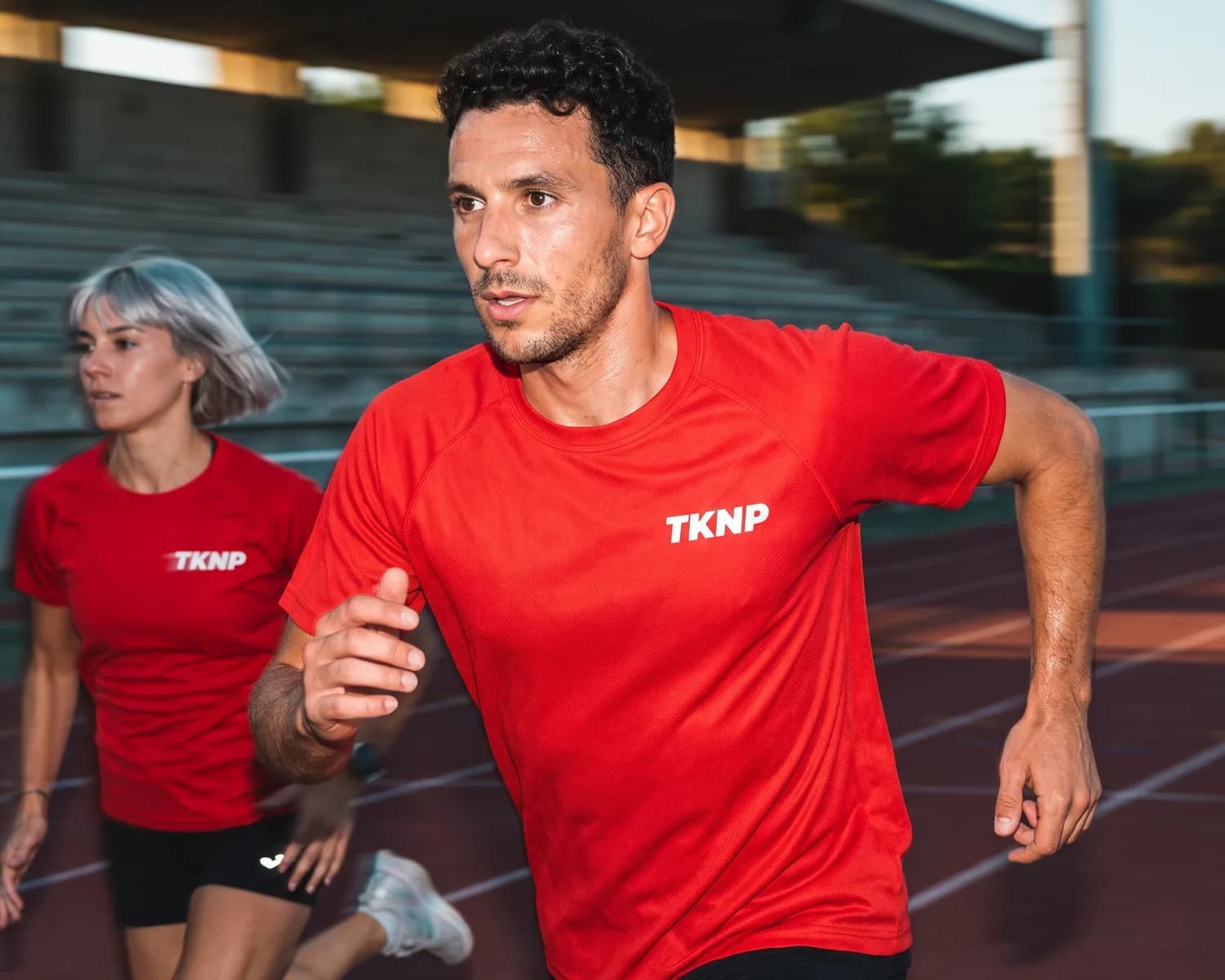
Screen printing on polyester holds with an ink made for this fibre: an ink that cures at low temperature and, on the most heavily dyed fabrics, an underbase that blocks the dye. The reason, the fabric's dye rising into the logo under heat, is explained with the red t-shirt example in our custom running t-shirt guide.
What that example does not say is where this dye comes from. Wikipedia's English article presents disperse dyes as a family of dyes intended for polyester, and Wikipedia's French article on disperse dyes describes a dyeing process, thermosol, in which high temperature softens the polyester fibre so that the dyes laid on the surface penetrate to its core.
On the ink side, the maker Avient, which produces the Wilflex range, has a page on polyester and performance apparel: it advises lowering the cure temperature to resist migration better, laying an underbase that acts as a barrier, and avoiding excess heat and temperature spikes. It presents its grey underbase as a barrier against the most migratory dyes, printed first, before the colours.
At tknp.io, one-colour screen printing can be ordered online on the product pages of the Cool T by Just Cool and the Firstee Men by Pen Duick, two 140 g/m² polyester sports t-shirts. Our screen-printing page describes ink laid colour by colour through a screen, then cured with heat; the cost of the screen, counted per colour, makes it most worthwhile from medium runs upwards.
Sublimation, on light polyester only
Sublimation only works on light polyester: under the press, the ink turns to gas and enters the fibre, so the colour becomes the fabric instead of sitting on it. Our sublimation page excludes it on cotton as on dark fabric; for a dark t-shirt, our guide to choosing a print for a black t-shirt reviews the other techniques.
Its strength is the complete absence of thickness: nothing can be felt under the hand, and the design can cover the whole garment. Our inspiration for a handball club with a sublimated crest shows it on a white sports t-shirt, JHK's Man Sport T-Shirt, the crest on the chest and again, large, on the back.
At tknp.io, sublimation goes through a quote, sent within 24 working hours, for a run of at least 10 items, and our page counts 6 compatible references: 5 t-shirts and 1 polo shirt. The process is explained in our article on textile sublimation.
DTF transfer on light or dark polyester
DTF transfer goes on a light or a dark technical t-shirt, as our DTF transfer guide explains, along with its wash resistance. On dark fabric, the guide that comes with our sports t-shirts recommends a transfer made for polyester, with an anti-migration barrier. DTF can be ordered online on the Cool T and Firstee Men pages, whose price grid lists it in A6 format.
Leave direct-to-garment printing (DTG) to cotton
Direct-to-garment printing (DTG) is designed for cotton, as our DTF or DTG comparison shows. On a technical knit, our selection of sports t-shirts adds that it does not bond to synthetic fibre.
Keep embroidery for the technical jacket
On a light sports t-shirt, embroidery is not our advice, as our running t-shirt guide and our technical or cotton t-shirt article say, the latter advising against it under 180 g/m²: the Cool T and the Firstee Men, at 140 g/m², therefore stay with transfer or screen printing. Our "chest and back, sports spirit" inspiration adds the reason: on a thin technical fabric, embroidery pulls the knit.
On a thick jacket, embroidery is back in its element: the product page of the Atlantic Men, a 340 g/m² softshell by Pen Duick, offers it online, in an 8 × 10 cm format.
Which technique for a polyester softshell or windbreaker?
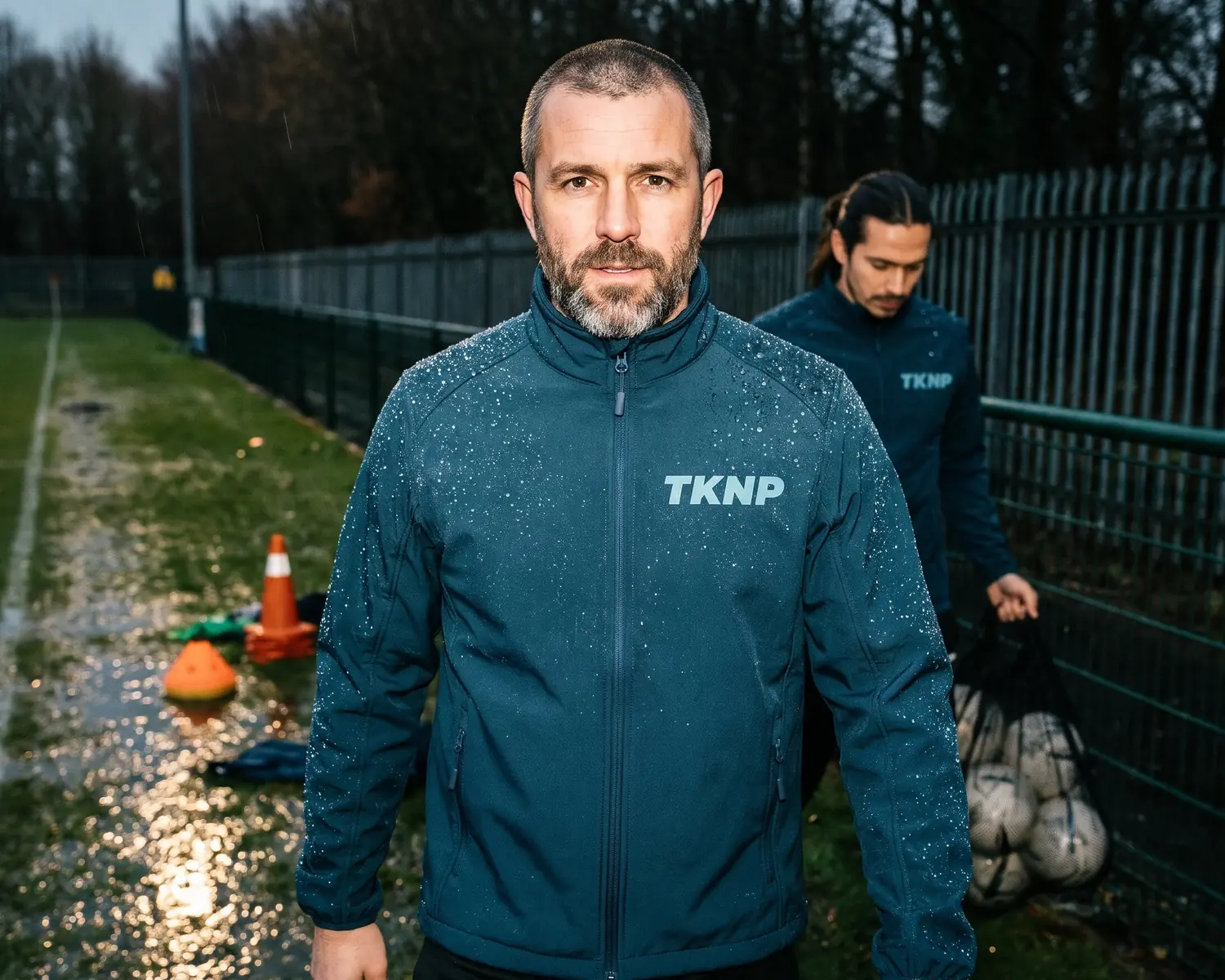
On a polyester softshell or windbreaker, the printing technique our pages offer is softshell printing: a film printed in four-colour process, backed with a white base that keeps colours bright on dark fabric, and with an anti-migration layer that keeps the dye of the cloth from creeping up. It is heat-pressed away from the seams.
Our page also gives its limits: no printing on a seam or within a 2 to 4 cm margin either side of it, and a slight film feel on large formats. Softshell printing does, however, hold on water-repellent fabrics, where a direct ink does not take.
Our polyamide or polyester comparison notes these techniques on B&C windbreakers: online, softshell printing and embroidery; on quote, patch. The Atlantic Men, Pen Duick's polyester and elastane softshell, shows the same on its product page.
How much does a decorated polyester technical garment cost?
On the tknp.io product pages we checked on 29 October 2026, two polyester technical t-shirts, the Cool T and the Firstee Men, decorated with one-colour screen printing or an A6 DTF transfer, cost €5.17 to €18.43 excl. VAT each, and the Atlantic Men softshell, printed or embroidered, €33.17 to €45.87 excl. VAT, at the 10, 25, 50 and 100-item price breaks.
Unless stated otherwise, every price below is based on one run of a single reference, the same logo in the same place, and the public price shown on the product page. These amounts, read on our product pages on 29 October 2026, are given as an indication: in euros excluding VAT, garment and decoration included, for a single print position, at standard lead time (two weeks), in the base colour and standard sizes, shipping extra. All three pages warn that the larger sizes and a few colours are charged slightly more.
140 g/m² polyester technical t-shirts, price excl. VAT per decorated t-shirt
| Model and technique | 10 | 25 | 50 | 100 |
|---|---|---|---|---|
| Cool T (Just Cool), A6 DTF transfer | €9.95 | €7.87 | €7.04 | €6.44 |
| Cool T (Just Cool), one-colour screen print | €18.43 | €10.23 | €7.04 | €5.85 |
| Firstee Men (Pen Duick), A6 DTF transfer | €9.20 | €7.15 | €6.34 | €5.76 |
| Firstee Men (Pen Duick), one-colour screen print | €17.68 | €9.51 | €6.34 | €5.17 |
Pen Duick's Atlantic Men, a 340 g/m² softshell, price excl. VAT per decorated jacket
| Technique | 10 | 25 | 50 | 100 |
|---|---|---|---|---|
| A5 softshell printing | €45.87 | €42.72 | €36.27 | €33.71 |
| 8 × 10 cm embroidery | €37.94 | €36.41 | €35.27 | €33.17 |
To dress 25 people, allow €178.75 excl. VAT in Firstee Men carrying an A6 DTF transfer, or €910.25 excl. VAT in embroidered Atlantic Men. Sublimation, on quote, has no public price. For choice, the Cool T comes in 50 colours, from XS to 5XL, the Firstee Men in 17 colours, from S to 4XL, and the Atlantic Men in 22 colours, from S to 6XL.
As for quantity, a decorated run starts at 10 items of the same reference, with sizes and colours freely mixed.
See on the product page which techniques suit your polyester garment
On the 6 product pages read on 29 October 2026, the "Available markings" line states which techniques can be ordered online on that exact garment and which go through a quote. The Cool T's shows five: online, DTF transfer, screen printing, embroidery; on quote, DTG printing and patch. The Atlantic Men's shows three: online, softshell printing and embroidery; on quote, patch. A sports t-shirt and a jacket, both in polyester, are not decorated the same way, and the page shows it before any calculation.
The "Customise online" button then opens the designer on that model; once the logo is dropped in, the preview shows where it sits, at what real size and with which technique. The account is free and production only starts when you order: trying your logo on a technical t-shirt, then on a softshell, costs nothing.
Häufig gestellte Fragen
Can you apply flex vinyl to a polyester garment?
Flex, the cut vinyl film pressed onto fabric, is not among our techniques under that name. For a technical t-shirt, our product pages offer DTF transfer or screen printing; for a jacket, softshell printing. Digital transfer, a design printed on vinyl or film and then cut out, is priced on quote.
Is polyester blended with elastane decorated like pure polyester?
On tknp.io, the product pages of the Cooldry Tee (Tee Jays) and the Cool T (Just Cool), read on 29 October 2026, show that the share of elastane does not change the techniques offered: the Cooldry Tee, at 95% polyester and 5% elastane, shows the same ones as the 100% polyester Cool T, DTF transfer, screen printing and embroidery online. On the product page of the Atlantic Men, Pen Duick's polyester and elastane softshell, the list changes with the type of garment: online, softshell printing and embroidery; on quote, patch.
Is sublimation possible on a polyester polo shirt?
Yes, on a light polyester polo shirt: among the 6 references our sublimation page lists as compatible, one is a polo shirt and the other five are t-shirts. As on a t-shirt, sublimation is then priced on quote, from 10 items.
Ihr Projekt, in 24 Stunden kalkuliert.
Beschreiben Sie uns Ihre Teile, Ihre Veredelung und Ihre Mengen: Sie erhalten innerhalb von 24 Werkstunden ein detailliertes Angebot inklusive Veredelung.