French textile environmental labelling: what changes for your brand
France's textile environmental labelling gives each garment an environmental cost, expressed in impact points and calculated over its whole life, from materials to end of life. It has been voluntary since 1 October 2025. For a brand, it is a selling point to build with its suppliers' data.
You are launching a brand or selling your merch, and a new number is starting to appear on clothing in France. Here is what it measures, what the official text really says, and how to prepare for it when you are not the one making the garments.
French textile environmental labelling: what is it?
France's textile environmental labelling is an official score that sums up a garment's environmental impact as an "environmental cost", counted in impact points. It comes as two figures: the garment's total cost, and its cost per 100 grams, so that garments of different weights can be compared.
The reading direction can be surprising: the higher the number, the stronger the impact. A good score is therefore a low score.
Eco-score or environmental cost: is it the same thing?
Yes. "Eco-score textile" is the everyday name, used even on the French Ministry of the Economy's website, for the same scheme. The official name is "coût environnemental" (environmental cost), and that is the term used in the decree.
Is environmental labelling mandatory?
No, environmental labelling for clothing is voluntary. It is governed by decree no. 2025-957 of 6 September 2025, in force since 1 October 2025, and the French Ministry for the Ecological Transition has not announced any date for it to become mandatory.
Voluntary does not mean unregulated. A brand that chooses to communicate its environmental cost must follow the official method, use the official visual, and declare its data on a state-designated portal before communicating anything.
What changes on 1 October 2026?
Decree no. 2025-957 sets a turning point: until 1 October 2026, a third party may only calculate or communicate a garment's environmental cost with the brand's consent, or if the brand has published it on the official portal itself. From that date, the text no longer makes calculation by a third party subject to the brand's consent.
For a brand, the question therefore changes: it is no longer only whether you want to display your score, but whether you would rather calculate it yourself, with your real data, than leave others to do it.
How is the environmental cost calculated?
The environmental cost is calculated with Ecobalyse, the French state's free public tool, through a life cycle assessment. Every stage of the garment is counted:
- materials (cotton, polyester, wool...);
- processing, from dyeing to sewing;
- transport between stages;
- use and care;
- end of life, recycling or disposal.
The French method adds two criteria: microfibre release, and durability linked to the brand's practices, such as the breadth of its range or how it encourages repair. This durability coefficient moves the result between 0.67 and 1.45.
What data do you need?
To calculate a garment's environmental cost, you need its weight, its category, the materials it is made of, and the country where each manufacturing stage takes place, such as weaving, dyeing and sewing.
This is where it gets decisive for a small brand. Weight and composition can be read on the garment's product page and its composition label. The country of each stage, however, is only known to the garment's manufacturer.
How do you get the data when you don't manufacture yourself?
When you have blank garments customised, the manufacturing data comes from the garment's brand: that is who you ask, item by item. Some already publish it.
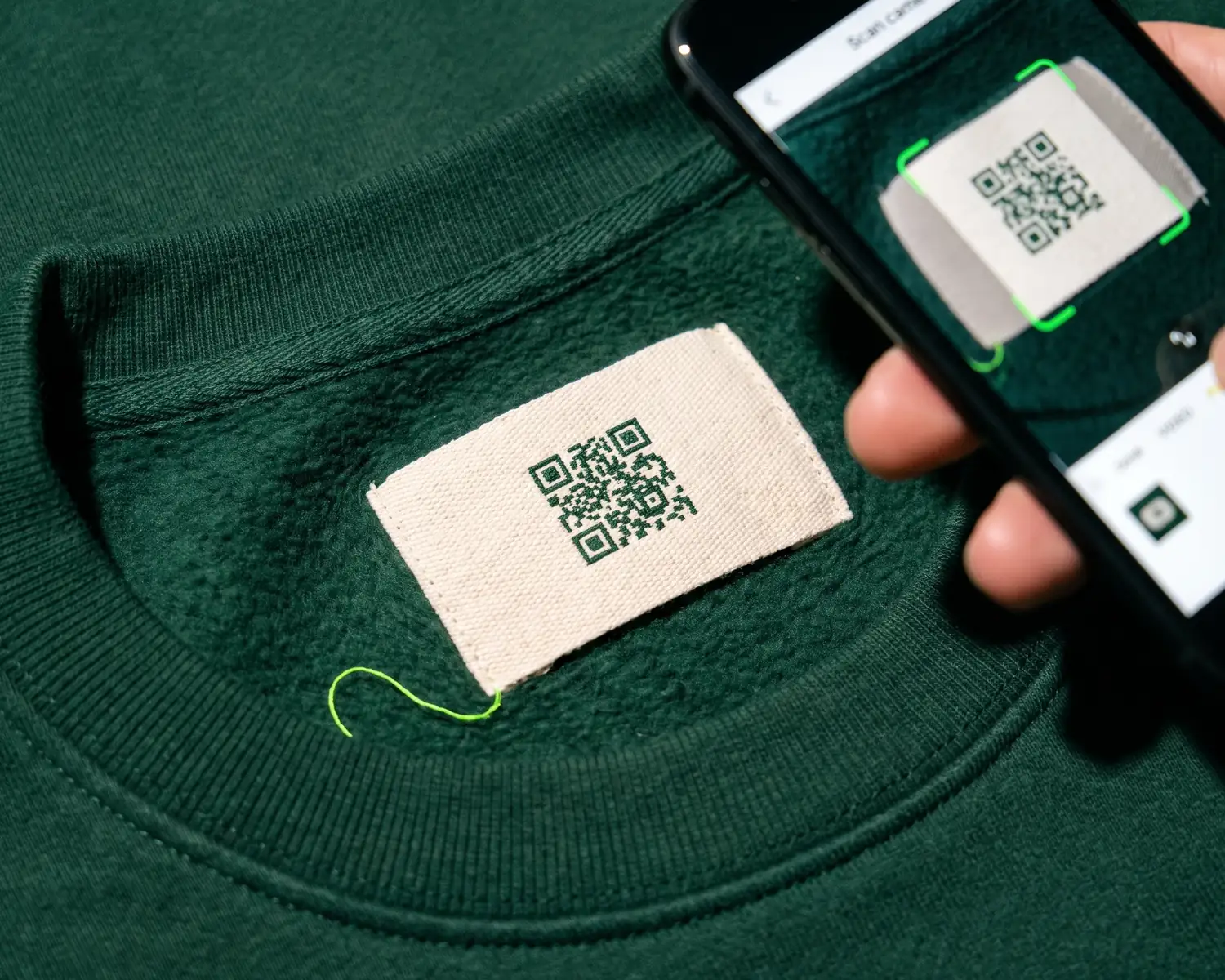
B&C, for example, says on its website that a QR code, on the product page or on the care label, gives access to its garments' traceability data, a service run with Fairly Made. Several B&C garments are available in our catalogue, such as the #E150 t-shirt: check its label or ask the brand whether the model you choose carries that QR code. Before choosing a garment for a collection you plan to sell, ask its manufacturer one simple question: where are its manufacturing stages published?
Where is the environmental cost displayed?
The environmental cost is displayed on the garment itself, on the shelf label or on the online product page, always with the official visual. In shops, it must remain visible and legible.
Which garments are covered?
Most garments sold to consumers in France can carry an environmental cost. According to the ministry, two categories are not covered yet: bras and down jackets.
Does a small brand need to deal with it?
A small brand has no obligation to display its garments' environmental cost. Three reasons still make it worth preparing: it is a concrete argument for a community that cares about the environment; from 1 October 2026, a third party no longer needs your consent to calculate that cost; and the data is far easier to gather when you choose the garments than after the order.
If you are just starting out, our step-by-step guide to launching your own clothing label puts these choices in order.
Environmental labelling and labels: what's the difference?
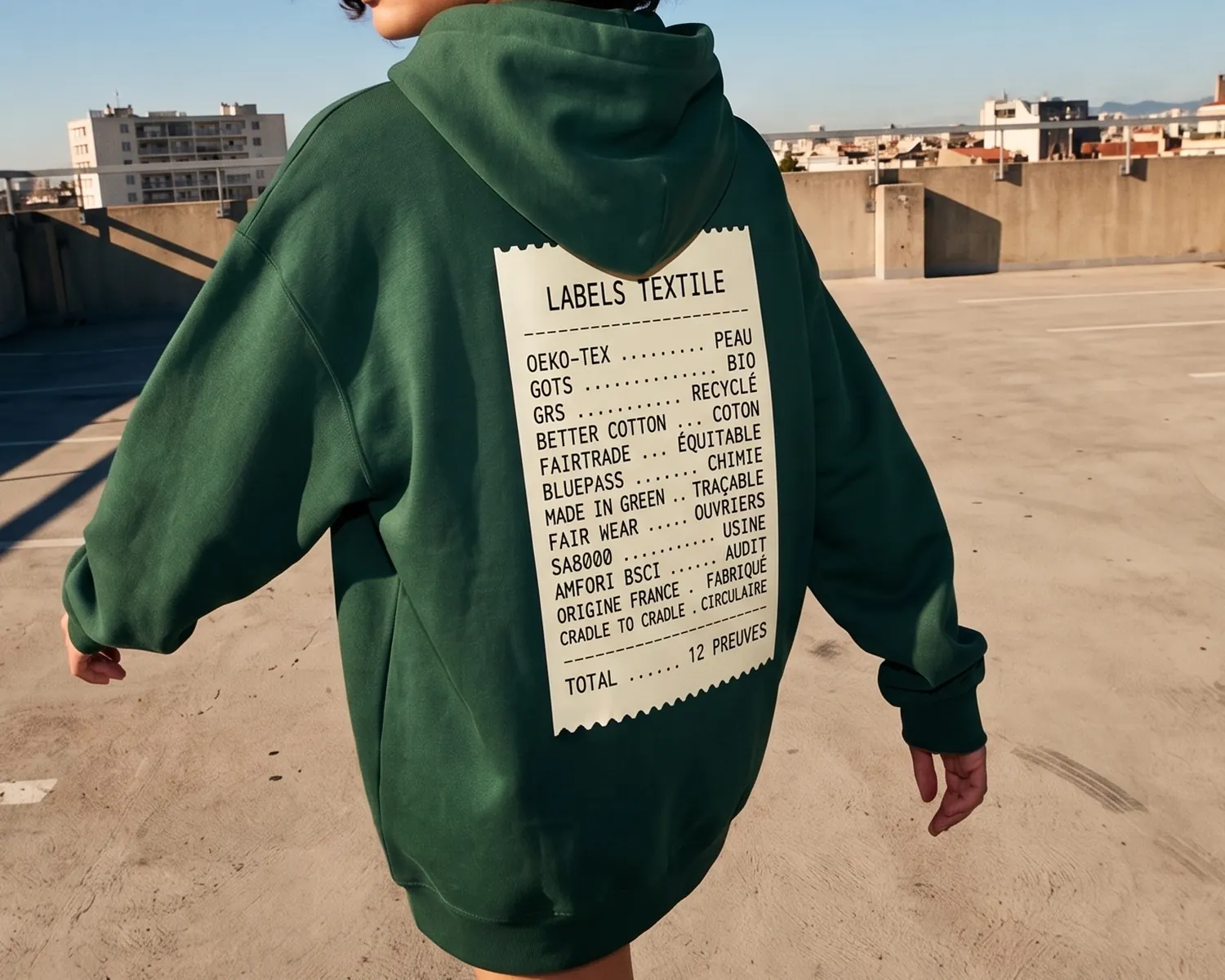
Environmental labelling is not a label: a label proves one specific point, such as an organic fibre or the absence of harmful substances, whereas the environmental cost sums up the whole life cycle in a single number. The two complement each other. Our guide to textile labels details what each one guarantees, and the Made in Green label already provides traceability of the manufacturing stages.
Garments ordered to the exact size
The most sober garment is the one that finds a wearer. On tknp.io product pages, an order starts from 10 garments, whatever the technique, sizes and colours mixed: you order the sizes your community actually needs, with no box of orphan sizes gathering dust in a storeroom.
Key takeaways
- French textile environmental labelling, or eco-score, gives a cost in impact points: the lower, the better.
- It has been voluntary since 1 October 2025, but a brand that displays it follows the official method, visual and declaration.
- Manufacturing data comes from the garment's supplier: ask for it before choosing your items.
Frequently asked questions
Who calculates a garment's environmental cost?
In principle, whoever places the garment on the market: the brand, the manufacturer or the importer, using the public Ecobalyse tool. The decree also governs calculation by a third party, which requires the brand's consent until 1 October 2026.
Is calculating the environmental cost expensive?
No, Ecobalyse is a free public tool. For a brand, the work mainly consists of gathering reliable data on each manufacturing stage.
Do you have to display the environmental cost on an online shop?
No, nothing requires it. A brand that chooses to display it online does so on the product page, with the official visual, after declaring its data on the state portal.
Your project, quoted within 24 hours.
Describe your garments, your decoration and your quantities: you receive a detailed quote, decoration included, within one business day.