How to start a clothing brand in 6 steps (step 3 decides the budget)
Starting a clothing brand comes down to 6 steps: the concept, the visual identity, the choice of business model, the products, the first drop, then selling and iterating. And contrary to what classic guides suggest, budget is no longer the first barrier: the model you choose decides the budget, not the other way around.
Search "how to start a clothing brand" and you'll find two incompatible stories: on one side, legal-minded guides pricing the launch at tens of thousands of euros; on the other, articles promising a brand "with no money". Both are true, and neither explains why: everything hinges on a single decision, which this guide puts at the center (step 3).
The essentials in 4 points:
- A clothing brand starts with a community to serve, not a forty-page business plan.
- The identity (name, logo, colors) must be designed for a worn garment, not just for a screen.
- The choice of model (bulk production or on-demand) determines the entire budget: it's THE decision of the project.
- A successful first drop is small, coherent, and dated: scarcity is a strength, not an admission of weakness.
Step 1: the concept, or who you're creating for
The starting question isn't "which market to attack" but "who will wear this, and why me". A clothing brand that works almost always starts from a real community: an audience you already have, a scene you belong to, a world you know from the inside. The garment comes next, as that group's sign of recognition.
The classic mistake is trying to please everyone: the wider a brand casts its net, the less reason anyone has to wear it. The most reliable test fits in one question: can you name the first ten people who will buy? If yes, your concept exists. If the answer is "anyone could like it", you don't have a brand yet, you have a moodboard.
Step 2: the identity, designed to be worn
Three jobs, in order: a name (check it's available before you get attached), a logo, and a small brand style guide that locks in your colors and typefaces.
The rule generalist guides forget: this identity will live on fabric, not on a screen. A 7-color gradient logo looks great on Instagram and terrible in embroidery; a name that's illegible at small sizes will be a problem everywhere. Aim for 2 to 3 solid colors, shapes that stay sharp when small, and a logo file in the right format from day one: it's what you'll be asked for at every production run.
Step 3: the model, the decision that sets the budget
Here's what nobody tells you. The five-figure budgets in classic guides correspond to one specific model: bulk production. You have dozens or hundreds of pieces made, you finance the stock, you carry the risk of unsold items. In exchange, your cost per garment is as low as it gets.
The other model is print on demand: each garment is only made after it sells. No stock to finance, no unsold items, a lower margin per piece than a production run. It's not a "budget" model, it's a different order of operations: you prove demand first, you invest second.
The smartest path for a first brand often combines both: launch on-demand to test without risk, then move to bulk production for the references whose demand is proven. Bulk rewards certainty; until you have it, it makes you pay for doubt.
Step 4: the products, few and good
A first catalog doesn't need ten references, it needs two or three good ones. Choose a fit that tells your brand's story: an ample fit says streetwear and community, a straight fit stays neutral, and that choice speaks before your logo is even visible. Then a fabric that lasts: a garment that pills or warps after three washes hurts a young brand more than any communication mistake, because your name is on it.
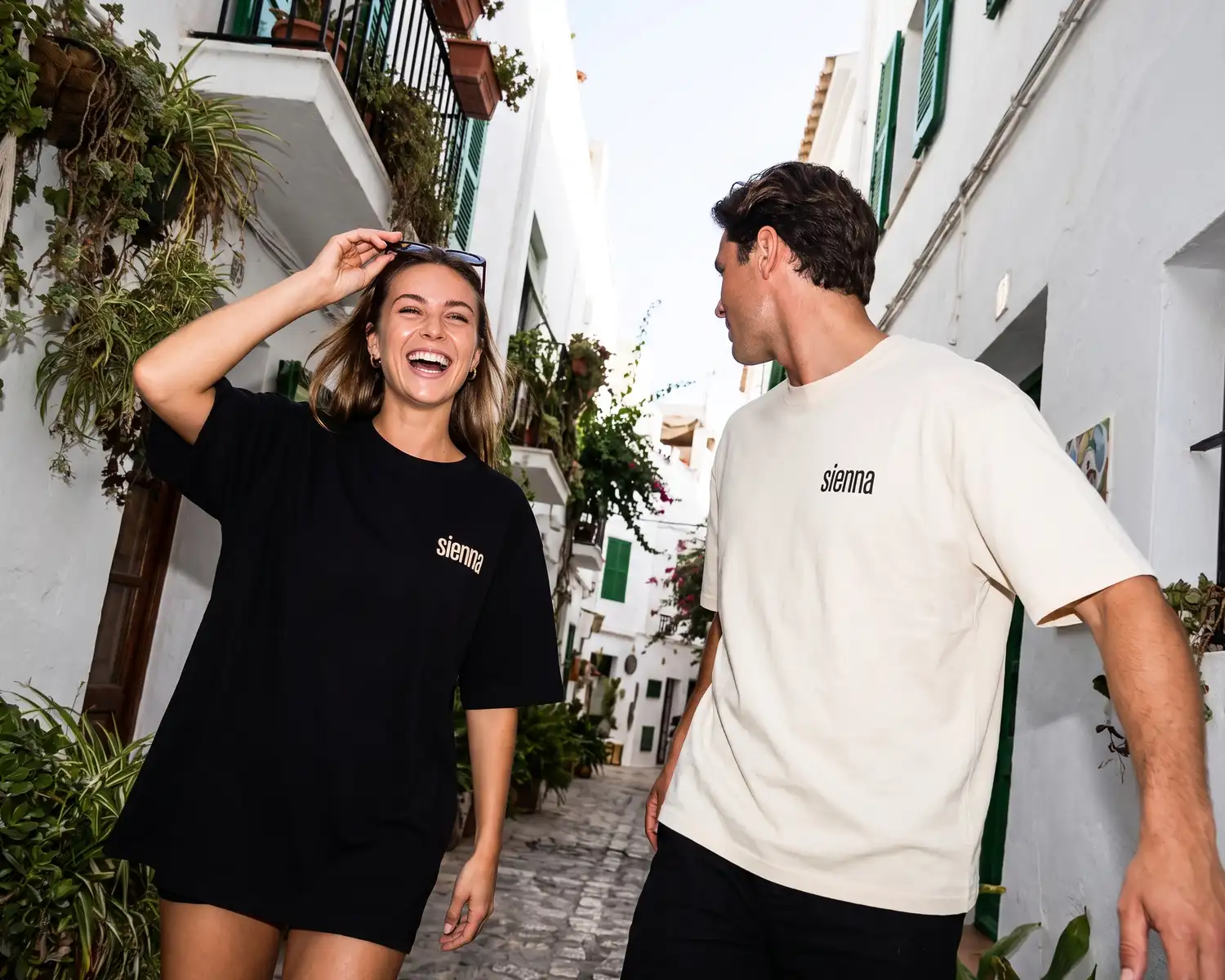
A trick many brands use without saying so: start with a two-color alternation. Black logo on white fabric, white logo on black fabric, or any duo that carries your identity: with just two references, the range looks deliberate, each product answers the other, and you only manage two marking colors.
As for the garments themselves, brand creators' reflex often goes to Stanley/Stella in organic cotton, for very concrete reasons: organic cotton is an argument your community understands immediately, the feel justifies premium positioning, and the maker's label on these garments tears off (the tear-away label) to make room for yours. The brand comparison helps you decide based on your budget.
Which brings up the question almost every creator discovers too late: the label. Your own brand label can be a simple print inside the collar, often cleaner and simpler than a sewn-in label. And in any case, the composition label remains a legal requirement (fiber content in percentages): plan for it at this stage, not when you're about to ship.
This is also where your step 2 work pays off: a simple logo in solid colors carries over cleanly to a t-shirt, a hoodie, and a cap with no extra cost and no bad surprises.
Step 5: the first drop
Resist the permanent-catalog reflex. A small coherent collection, announced in advance, available for a defined window: the drop turns your brand's small size into a strength. Scarcity creates the moment, the moment creates anticipation, and a sold-out collection is a far better signal than one gathering dust.
Pre-orders are your best ally at this stage, and they work on two levels: they validate demand before you produce, and they finance the drop, since the money comes in before production starts. It's the exact opposite of the stock model, and your community understands this perfectly when it's announced clearly.
Step 6: sell, measure, repeat
Your first sales channel is the community from step 1: that's where the drop gets announced and the pre-order gets shared. Then look at what the numbers tell you: which reference sells first, which color lingers, who buys without knowing you. A clothing brand is built through iterations, drop after drop, not in one perfect launch.
The mistake at this stage is going silent after launch: a brand lives on what it says between two collections, not only at the moment it sells.
What TKNP does for you
On tknp.io, your brand can take shape today: the online designer places your identity on the catalog's products, your wardrobe gathers your personalized products, and you order size by size, from a single piece for prototyping to volume for your first drop's production run, printing included in the price. The online Store, the turnkey shop to sell directly to your community, is coming soon: until then, your products can already exist.
Frequently asked questions
How much does it cost to start a clothing brand?
It all depends on the model. With bulk production, specialized guides mention five-figure budgets, driven by stock and minimum order quantities. With print on demand, launching your brand requires almost no upfront money: each garment is made after it sells.
Can you start a clothing brand with no money?
Yes, with the on-demand model: no stock to finance, no minimums. The honest trade-off is a lower margin per piece than a large production run. It's the ideal model to prove demand before investing.
Should you register your trademark before selling?
Registration isn't required to start selling, but it protects your name and logo. The right reflex: check name availability at the identity stage, and register before investing seriously in communication.
How many products for a first drop?
Two or three coherent references are plenty. A tight first drop is simpler to produce, clearer for your community, and easier to sell out entirely, which is the best possible starting signal.
How do you start a clothing brand without a fashion background?
You need neither sewing skills nor a design degree: the 6 steps in this guide require no technical expertise. What can't be delegated is knowing your community; the rest (production, logo rendering, logistics) is handled online today.
What's the difference between a clothing brand and merch?
Merch is the clothing of an existing community (an artist, an association, a company); a clothing brand builds its own identity and its own audience. In practice, many brands start out as merch that outgrew its original community.
Your project, quoted within 24 hours.
Describe your garments, your decoration and your quantities: you receive a detailed quote, decoration included, within one business day.