Better Cotton: definition, criteria and limits of the label
Better Cotton is a sustainable cotton programme covering about 12% of the world's cotton: founded in 2005 and active in 24 countries, it trains farmers to manage water, soil and pesticides better, and to respect the rights of the people who work the fields.
On the product page of a t-shirt or a polo shirt to customise, the words Better Cotton are reassuring: they speak of cotton grown differently. They cover real agricultural progress at a very large scale, and a narrower promise than many labels suggest. Here is what the programme checks in the fields, what it doesn't check in your garment, and how to talk about it on your custom merch without getting it wrong.
What is Better Cotton?
Better Cotton is an international programme that helps cotton farmers grow with less impact on water, soil and the people who work the fields. It is run by the Better Cotton Initiative (BCI), a non-profit founded in 2005, based in Geneva and active in 24 countries, which accounts for about 12% of the world's cotton production, according to Wikipedia.
Better Cotton and BCI refer to the same approach. Better Cotton is the programme's historical name; since October 2025 the organisation has gone back to its full name, Better Cotton Initiative, and calls its cotton "BCI Cotton". On product pages, both names still coexist.
What are the Better Cotton criteria for farmers?
The Better Cotton standard sets rules for farms in three areas: water and soil, biodiversity, working conditions. On the crop side, the most harmful pesticides are banned and those still allowed must be used correctly. Each farm keeps a water and soil management plan (irrigation, erosion, crop rotation, fertiliser use) and protects its most valuable biodiversity areas.
On the human side, the Better Cotton standard follows the core standards of the International Labour Organization (ILO): no forced labour, no child labour, freedom of association, minimum wage, non-discrimination, safety at work.
Is Better Cotton organic cotton?
No, Better Cotton is not organic cotton. Organic farming bans synthetic pesticides and GMO seeds; Better Cotton only bans the most hazardous pesticides, and part of its cotton is grown with pesticides and GMO seeds.
The two approaches don't aim at the same thing. Better Cotton improves conventional cotton where it already grows; organic cotton changes the way it is grown. If organic is what you are after, we explain what it changes and why it costs more in our article on organic cotton.
What does the Better Cotton logo guarantee on a t-shirt?
It depends on the marking: the historical Better Cotton claim guarantees that the brand buys responsible cotton, the new BCI Cotton label guarantees that this cotton is actually in the garment. For years the programme worked only on a principle called mass balance: Better Cotton was mixed with conventional cotton along the supply chain, and a product could carry the claim as soon as an equivalent volume had been bought, without that cotton necessarily being in the t-shirt.
It works like a green electricity contract: your energy supplier buys the equivalent of your consumption in renewable energy, but the power coming out of your socket is still the grid's. For the textile industry, the system simplifies sourcing and cuts costs.
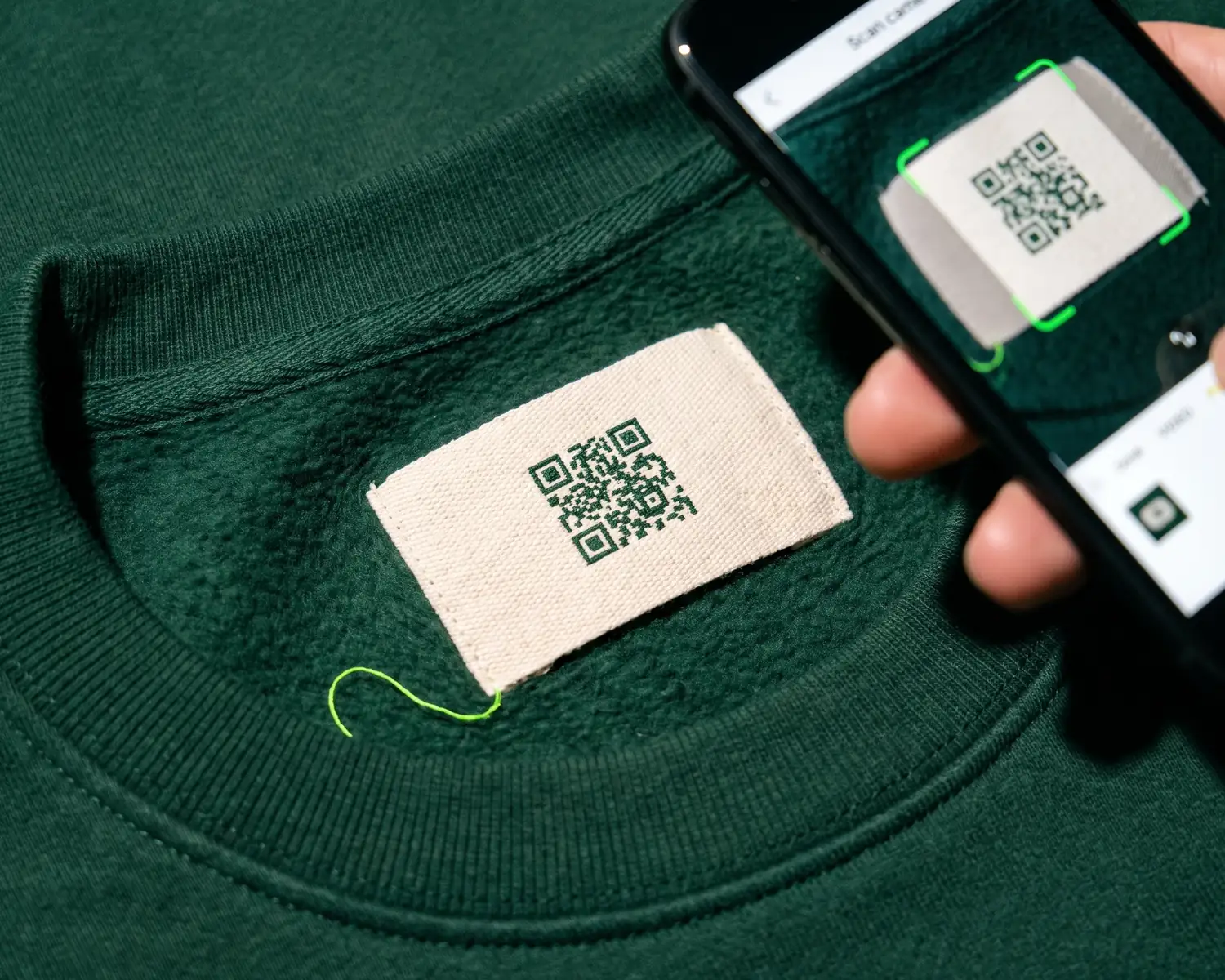
Since November 2023, part of BCI cotton has been physically traced to its country of origin. In October 2025, the organisation launched a new label: it can only go on a product containing at least 30% traced BCI cotton, and it shows the origin, the percentage and a certification number. To know what a given garment guarantees, check its product page: a percentage and a certification number point to the new label.
Why is Better Cotton accused of greenwashing?
Better Cotton is accused of greenwashing because its claim can appear on a garment that contains no Better Cotton. In November 2017, the French investigative programme Cash Investigation (France 2) showed that a garment labelled BCI could contain no BCI cotton at all, and portrayed the organisation as an empty shell.
BCI replied, in its answer published by FashionNetwork, that it is first and foremost a support and training programme for farmers, 99% of whom are smallholders with limited resources. Both readings hold together: the Better Cotton programme improves farms at a very large scale, and its historical claim says nothing about the fibre in any given garment. That is the criticism that physical traceability in 2023, then the 2025 label, set out to address.
Better Cotton, GOTS or Fairtrade: which one for your merch?
Choose the label according to what you want to be able to claim on your merch. Better Cotton supports better practices in the fields; GOTS certifies organic cotton and its entire manufacturing chain; Fairtrade protects the farmer's income.
| Better Cotton | GOTS | Fairtrade | |
|---|---|---|---|
| What it checks | the farming practices of the programme's farms | the organic cotton and every manufacturing step | the price paid to the cotton farmer |
| Organic cotton | no | yes | not necessarily |
| What you can write | cotton sourced through Better Cotton | certified organic cotton | fair trade cotton |
The three labels add up more than they compete. To go further: GOTS and Fairtrade cotton.
What can you write on Better Cotton merch?
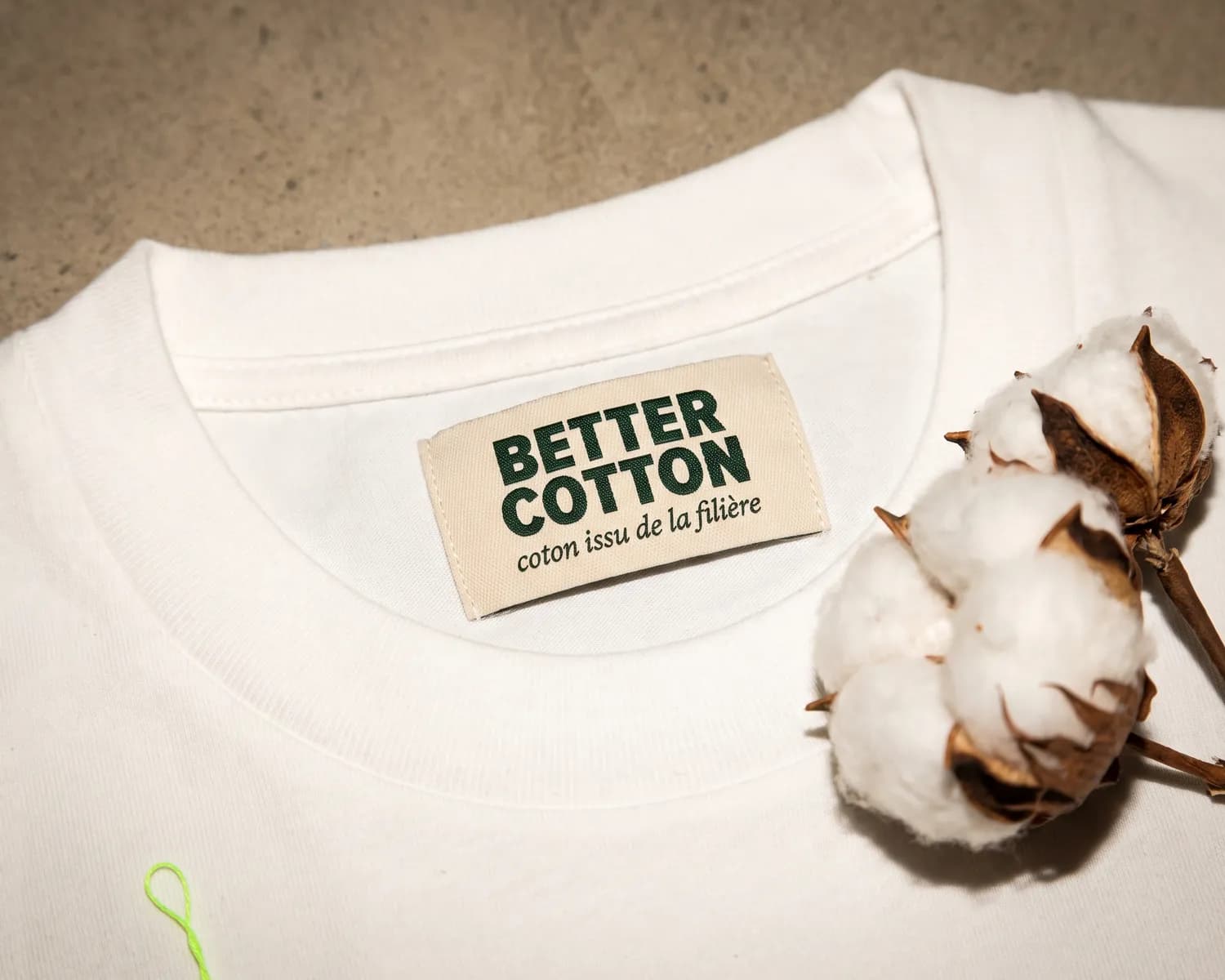
On Better Cotton merch, write "cotton sourced through Better Cotton", the wording B&C uses on the product page of its #E150 t-shirt. If the garment carries the new BCI Cotton label, you can reuse the percentage and origin it shows. Either way, don't write "organic cotton" or "100% sustainable": neither marking supports it.
That precision protects your credibility, whether on the label, in a post or, soon, on your Store page. A member of your community who knows the subject will spot the difference, and a false claim costs more in trust than the argument earns. For the fibre wording itself, our guide to reading a textile composition gives the right formulas.
Better Cotton in the TKNP catalogue
The TKNP catalogue lists at least sixteen garments to customise whose product page mentions Better Cotton, from B&C and Gildan. They include t-shirts, among them B&C's #E150, made of pre-shrunk cotton sourced through Better Cotton, a women's cut and an oversized cut, polo shirts, a crewneck sweatshirt and a zipped hoodie.
Put your logo on one of them in the online designer: you see the result before spending anything. If your project needs a verifiable organic claim, the GOTS-certified garments in the catalogue take over, starting with this organic cotton t-shirt.
Key takeaways
- Better Cotton improves the way conventional cotton is grown in 24 countries; it is not organic cotton.
- The historical claim relies on mass balance; since October 2025, a new label guarantees at least 30% traced BCI cotton in the product.
- On your merch, write "cotton sourced through Better Cotton", or the label's percentage if there is one; for an organic claim, choose a GOTS-certified garment.
Frequently asked questions
Who checks compliance with the Better Cotton standard?
Independent, accredited control bodies audit the programme's farms. In case of breaches, the Better Cotton Initiative says it withdraws the licence of the farmers concerned.
Are Better Cotton farmers paid more?
No, the Better Cotton programme guarantees farmers neither a minimum price nor a premium. Protecting income is the job of fair trade labels such as Fairtrade.
How many members does Better Cotton have?
The Better Cotton Initiative has more than 1,000 members according to Wikipedia; FashionNetwork counted 1,163 in November 2017, at the time of the Cash Investigation report.
Can you order a single Better Cotton t-shirt?
Yes: at TKNP, a t-shirt from the catalogue can be ordered from a single unit in digital print. You judge how your logo looks on a real Better Cotton t-shirt before ordering for your whole group.
Your project, quoted within 24 hours.
Describe your garments, your decoration and your quantities: you receive a detailed quote, decoration included, within one business day.