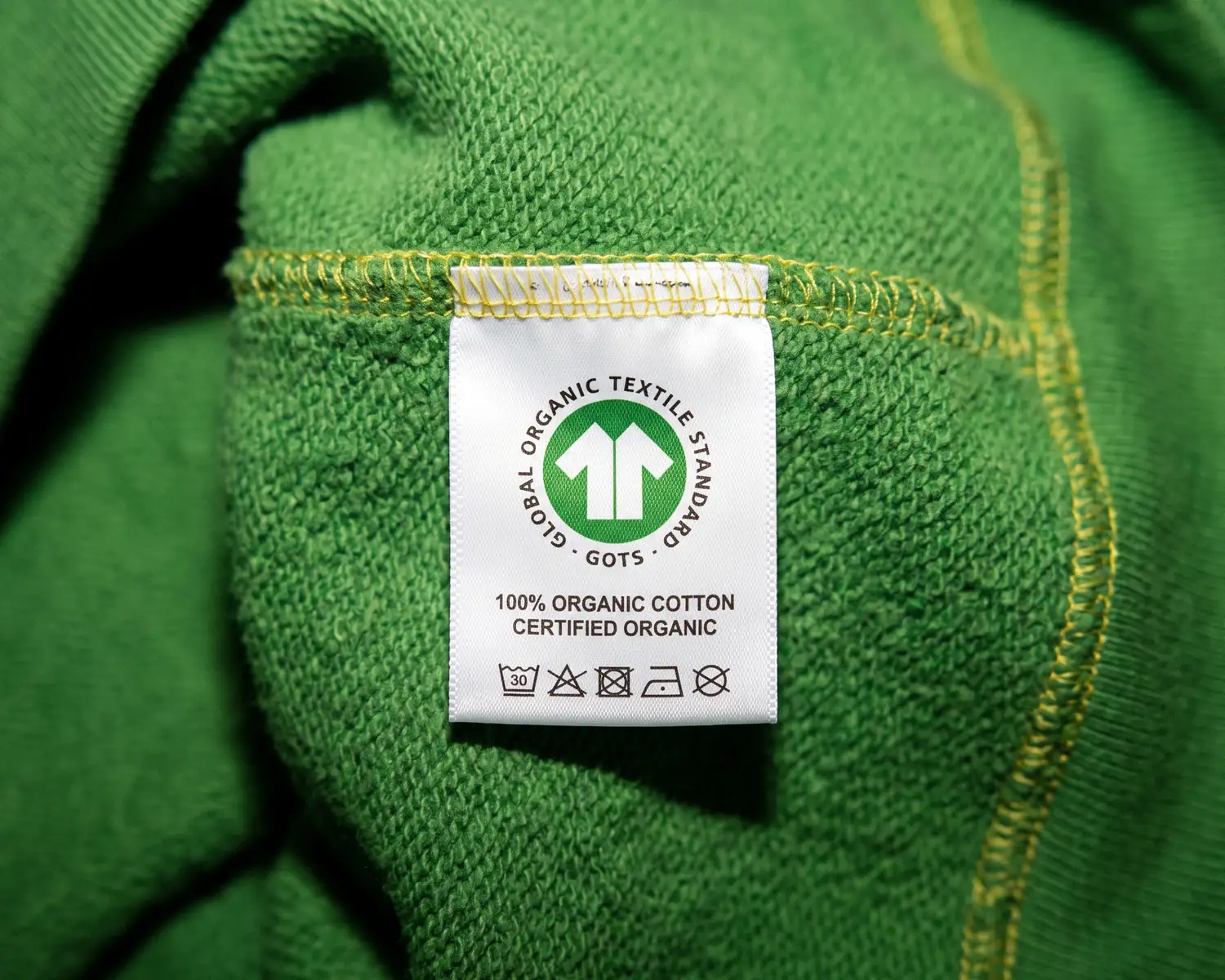
GOTS (Global Organic Textile Standard) is the world standard for organic textiles. It certifies that a garment contains at least 70% organic fibres, 95% for the organic grade, and that its entire production meets environmental and social criteria, audited every year by an independent body.
The essentials in 4 points:
- GOTS certifies the fibre AND the whole production: dyes, wastewater, working conditions, with an audit renewed every year.
- Two grades to know: the organic grade from 95% organic fibres, made with organic materials from 70%.
- The certification belongs to the manufacturer, not to the garment: you check it through their licence number in the standard's public database.
- Natural cotton, eco-responsible, respectful fibre are not labels, only adjectives.
You have a custom clothing project, you want organic cotton, and four letters keep coming up on every product page: GOTS. Between a genuinely certified garment and one simply sold as natural, the gap is huge, and it does not show on the photo. I spent eighteen years choosing fabrics and references: GOTS remains the simplest way to tell a promise from a guarantee.
What GOTS stands for
GOTS is short for Global Organic Textile Standard, the world standard for organic textiles. It is not a logo a brand awards itself: it is a public set of requirements, applied by independent accredited certification bodies, Ecocert for example, which audit production sites.
Its scope is natural fibres from organic farming: cotton, wool, linen, silk. Synthetic fibres can only make up a limited share of the composition.
Its defining feature fits in one sentence: GOTS does not certify a material, it certifies a chain. The cotton may well come from organic farming, but if the mill that dyes it discharges its water untreated, the garment will not be certified.
From field to workshop: what the label controls
- The fibre. Certified organic farming, with no GMOs and no synthetic pesticides.
- The processing. A list of banned substances for dyes and finishes, plus requirements on how mills treat their wastewater.
- Working conditions. Social criteria based on the conventions of the International Labour Organization: safety, pay, no forced labour, no child labour.
- Traceability. Every link in the chain must be certified, from spinning and weaving through to the garment workshop, and the check is renewed every year.
It is the four together that give the label its value, and that set it apart from a label which only looks at the finished product.
95% or 70%: two grades that are not equal
The label comes in two grades, and the difference is read on the tag. The organic grade requires at least 95% fibres from organic farming. The made with organic materials grade goes down to 70%. Both are GOTS, both are audited, but they do not tell the same story.
An example you can verify on our own catalogue: the Creator 2.0 t-shirt by Stanley/Stella is GOTS certified. In its solid colours, its composition is 100% combed organic cotton. In its Heather Haze marl colourway, it shifts to 70% organic cotton and 30% recycled cotton. Same reference, same certification, two compositions. The habit to build: read the composition of the colourway you are ordering, not just the logo displayed on the page.
For merch that claims to be organic, aim for 100% organic cotton. A blended fabric is still a good product, but it weakens the very message it is meant to carry.
Checking that a garment really is certified
The certification does not belong to the garment, it belongs to the company that makes it. The manufacturer holds a licence with a number, and that number can be checked in the standard's public database: it shows the holder, the validity and the product categories covered.
Two habits prevent most unpleasant surprises. Check that the certificate is still valid, because it is renewed through a yearly audit and an expired certificate no longer guarantees anything. And be wary of decorative vocabulary: natural cotton, eco-responsible, respectful fibre are not labels, they are adjectives. A composition label that does not explicitly mention organic cotton promises nothing, whatever the sales page claims.
GOTS, Oeko-Tex, organic cotton: which guarantees what
The confusion between the three is the most common question on the subject. The short version:
| What it is | What it guarantees | |
|---|---|---|
| Organic cotton | a material | a fibre grown without GMOs or synthetic pesticides |
| GOTS | a supply chain standard | the organic fibre and the entire production chain, environment and working conditions included |
| Oeko-Tex Standard 100 | a health label | the absence of harmful substances in the finished product, whatever the material |
They do not replace each other. A garment can carry both labels, and that is the strongest combination you will find on a product page today.
What GOTS changes for your merch
Certification has a cost, and it shows on the catalogue. On a crewneck sweatshirt, expect a ballpark of around twenty euros at entry level and around thirty in organic cotton, printing included. That gap pays for the fibre, the yearly audits and the traceability.
What you buy with it is the right to write organic on your Store's product page with proof behind it. On a custom t-shirt or hoodie meant to be worn in the street, that argument holds over time, unlike an in-house label nobody can verify.
The smart move is not to certify everything. It is to pick one or two certified references, to own that choice clearly in your collection, and never to use the word organic for the rest.
Frequently asked questions
GOTS or Oeko-Tex: what is the difference?
GOTS certifies the organic origin of the fibres and the whole supply chain, working conditions included. Oeko-Tex Standard 100 tests for the absence of harmful substances in the finished product, on any material. One is about how it is produced, the other about what the garment contains.
Are organic cotton and GOTS the same thing?
No. Organic cotton is a fibre grown without GMOs or synthetic pesticides. GOTS is the standard that certifies that fibre and everything that happens to it afterwards, from spinning to garment making. A garment can contain organic cotton without being GOTS certified.
Does a GOTS certified garment cost more?
Generally yes. Organic fibre costs more than conventional fibre, and auditing the whole chain every year has a price. On a sweatshirt, the gap between an entry level option and an organic cotton one comes to about ten euros on the catalogue, printing included.
Does the GOTS label guarantee production in Europe?
No. GOTS certifies practices, not geography: a certified garment can be made in India, Turkey or Portugal, with the same criteria applied everywhere. The origin is read on the country of manufacture, which is separate information from the label.
Your project, quoted within 24 hours.
Describe your garments, your decoration and your quantities: you receive a detailed quote, decoration included, within one business day.