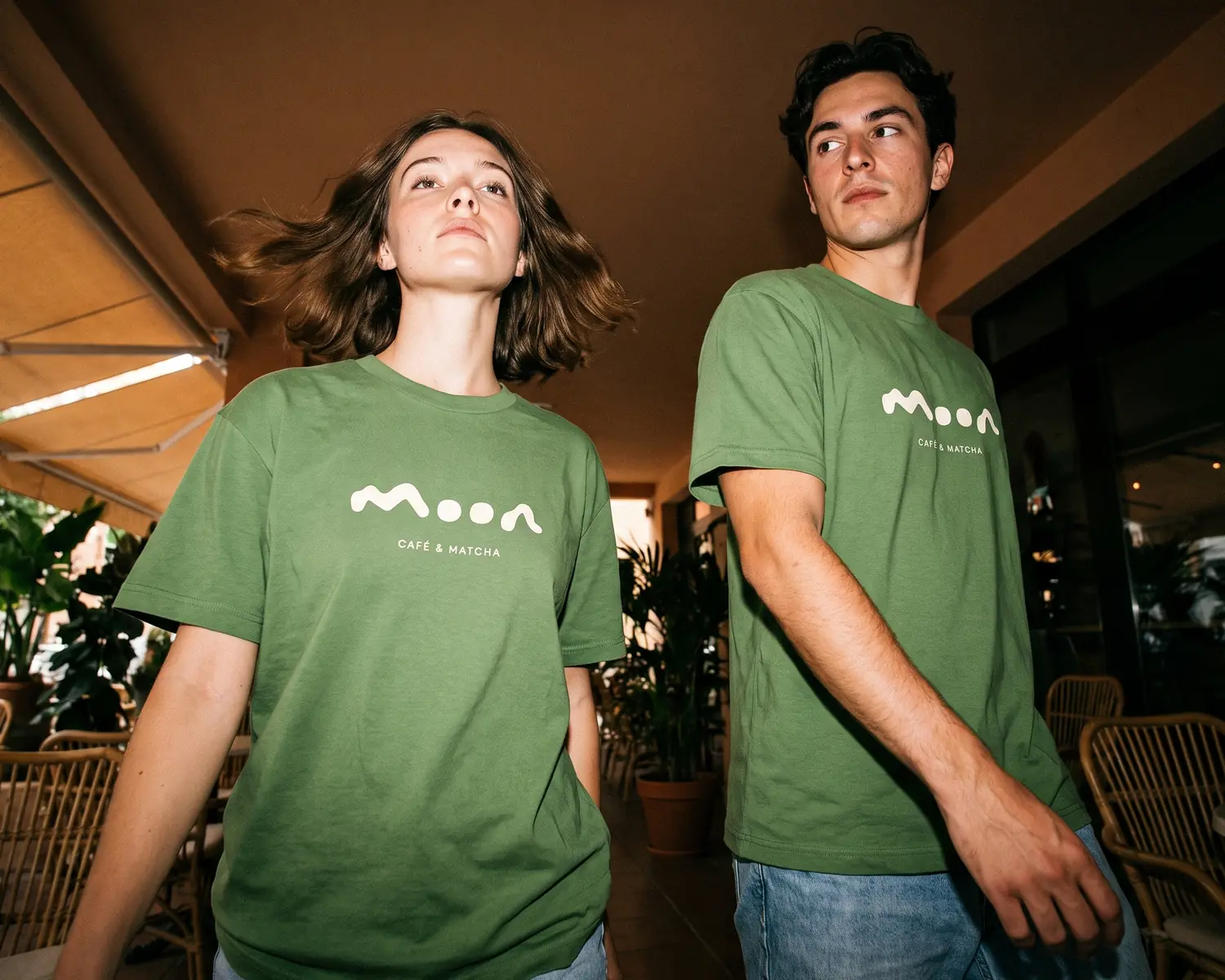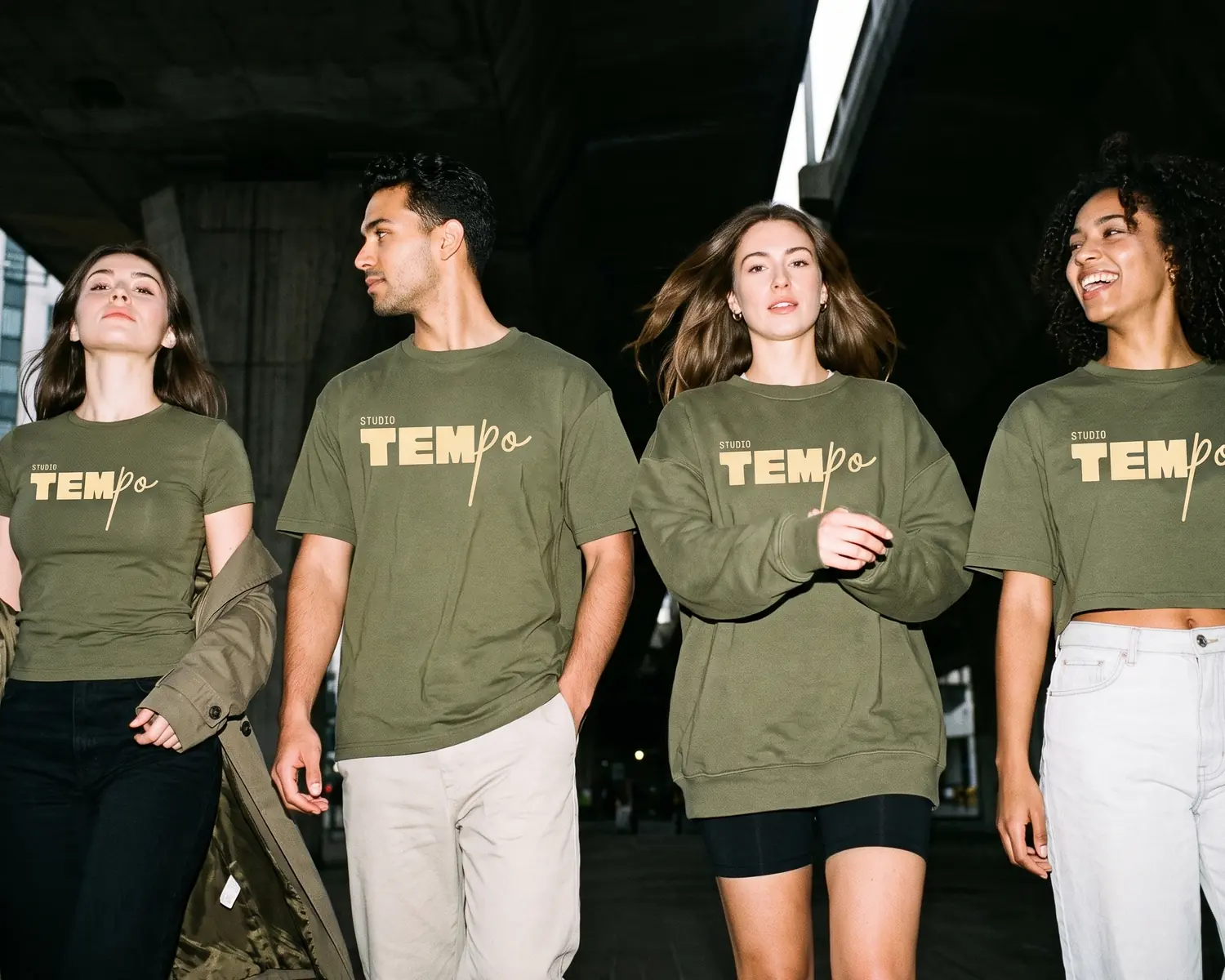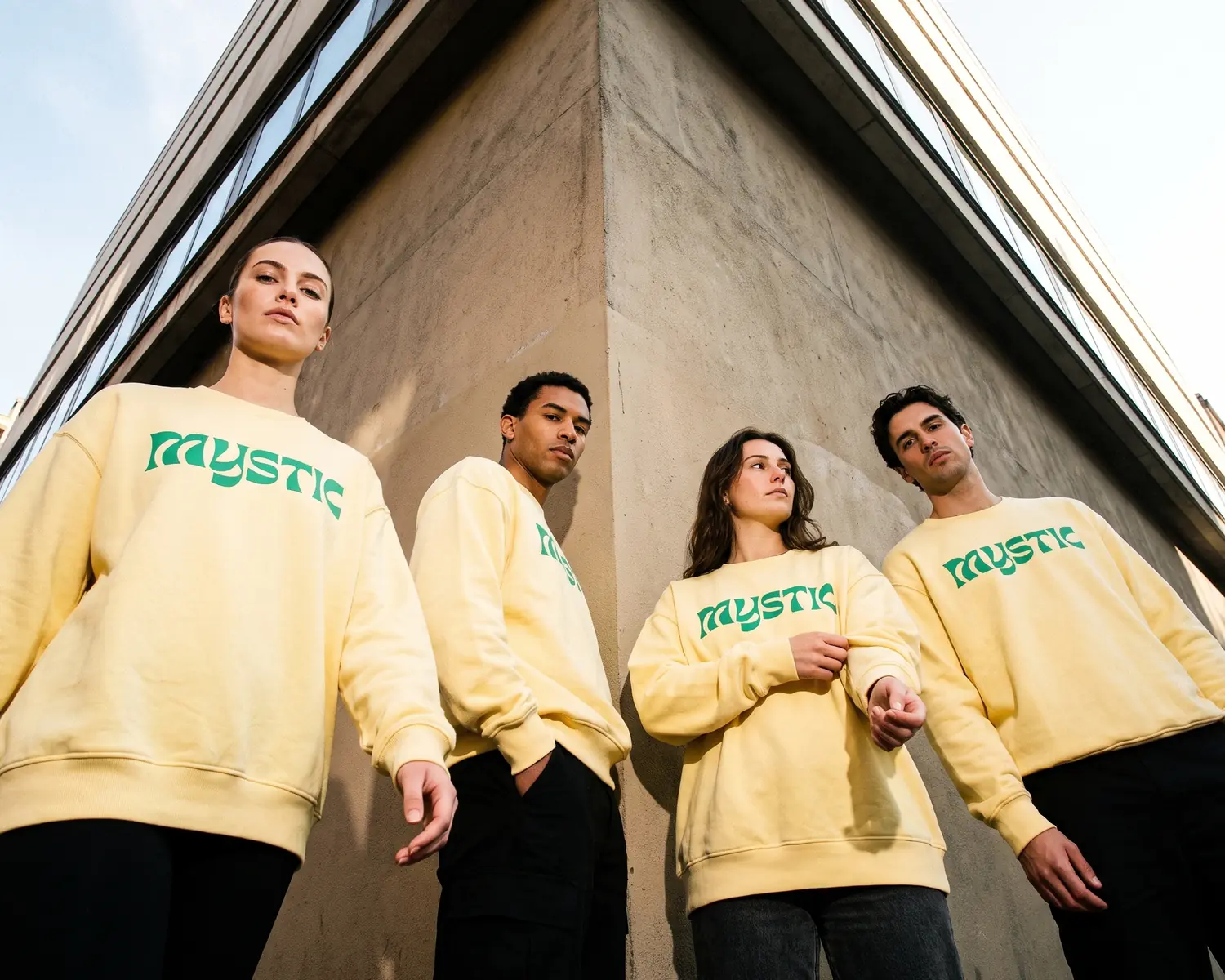
A crewneck is a round-neck sweatshirt, with no hood and no kangaroo pocket. It costs around four euros less per unit than a hoodie, and its front is completely clear for a large print. The hoodie is warmer and remains the most worn, but its pocket limits printing.
The essentials in 4 points:
- Crewneck comes from crew neck: a round-neck sweatshirt, no hood, no drawcords, no pocket.
- The front of a crewneck is one clean surface: a large print sits straight on it. On a hoodie, the pocket and the drawcords shrink the usable area to a narrow band at the top.
- The price gap is real: 22.99 euros for a mid-range crewneck against 26.99 for the equivalent hoodie, printing included.
- The hoodie is still the most requested garment in a collection. The crewneck captures everyone who never wears a hood.
Round neck or hood. Put like that, the question looks like a matter of taste, and everyone has their own. It stops being one the second you put a logo on it: the sweatshirt you pick decides how big your artwork can be, and how much each person will pay.
What exactly is a crewneck
A crewneck is a round-neck sweatshirt. The name comes from the crew neck worn by sailors. No hood, no drawcords, no zip, and above all no kangaroo pocket on the front. The collar, the cuffs and the bottom band are ribbed, the stretchy knit that keeps its shape wash after wash.
The fabric is the same as a hoodie's: fleece brushed on the inside, or unbrushed french terry, lighter and drier to wear. Weight is measured in grams per square metre: our sweatshirts range from 220 to 450 gsm, and 300 gsm is the comfortable all-year standard.
One vocabulary trap: crewneck first describes a type of collar, which also exists on a t-shirt or a knit. In merch, when someone says "a crewneck", everyone understands "a round-neck sweatshirt".
Crewneck, sweatshirt, hoodie: which is which
Sweatshirt is the family name. The crewneck and the hoodie are two members of it: the first has a round collar, the second a hood. So a hoodie is a sweatshirt, and so is a crewneck. Saying "a sweat" settles nothing at all.
What really separates them once you print on them
This is the point nobody makes in store, and it is the one that decides.
The front of a crewneck is one clean surface. Nothing crosses it, nothing cuts it: a large centred artwork sits straight, a line of text reads in full, a crest stays in the middle.
The front of a hoodie is already taken. The kangaroo pocket eats the bottom third. The drawcords cross the top and move with every gesture. The hood falls over the shoulders and shortens the usable area. What is left is a narrow band, high up, between the collar and the pocket.
The consequence is simple. On a hoodie, the large artwork goes on the back and the front takes a small logo at the heart. On a crewneck, a large front print is possible, and it is usually what makes the garment recognisable from a distance.
Two house rules worth remembering. Never more than two print positions on the same sweatshirt: with a third, the result gets heavy, the bill climbs, and so do the production risks. And one technique per garment: an embroidery at the heart with a print on the back is not coherent, neither to the eye nor over time. Embroidery lasts a good ten years where screen printing wears out well before: on the same sweatshirt, one of the two markings would look tired while the other stayed intact.
Crewneck or hoodie: the table
| Crewneck | Hoodie | |
|---|---|---|
| The collar | round, ribbed | hood and drawcords |
| The front | completely clear | kangaroo pocket, reduced area |
| Large artwork | front or back | back |
| Indicative price, mid-range | 22.99 euros | 26.99 euros |
| Indicative price, organic cotton | 33.99 euros | 40.99 euros |
| Warmth | layers easily, fits under a jacket | warmer, covers the neck |
| Its ground | class, office, indoors | outdoors, stands, winter |
Catalogue unit prices including tax and printing, given as an order of magnitude.
Warmth, season, use: what people actually wear
The hoodie is warmer, protects the neck and works outdoors: the stands, a night out, a walk in the rain. It is the most requested garment in a collection, and that will not change this season.
The crewneck has another ground. It layers without bulk, fits under a jacket, and is worn in class or at the office without looking like sportswear. It also dresses everyone who never puts a hood up, and there are more of them in a group than you would think.
In a collection, the two do not replace each other: they complete each other.
Price: the real gap between the two
At equal quality, a crewneck costs less than a hoodie. Less fabric, less assembly, no hood to attach and no eyelets to set.
In unit price including printing, a mid-range crewneck is 22.99 euros where the equivalent hoodie is 26.99. Four euros per garment. On an order of thirty, that is 120 euros, and it is exactly the margin an association tends to be missing. In organic cotton the gap widens: 33.99 euros for a Stanley/Stella crewneck against 40.99 for the same brand's hoodie.
These prices drop with quantity, in published tiers. The same crewneck goes to 21.15 euros from 25, 19.31 from 50 and 17.70 from 100. Do not confuse those tiers with the minimum order quantity, which depends on the printing technique: screen printing starts at 25 garments, embroidery and DTF transfer at 10, direct-to-garment printing at a single one.
Which one to choose, depending on your project
Take the crewneck if your artwork is large and has to be seen from the front, if budget matters, if you want the margin to fund something, or if the sweatshirt will be worn indoors more often than outdoors.
Take the hoodie if the collection has to please the widest crowd straight away, if the garment will live outdoors in winter, or if your artwork belongs on the back.
And if you are still torn: release both. Same artwork, two cuts, two prices. Everyone picks the one they will actually wear, and nobody ends up with a hood they will never use.
Frequently asked questions
What is the difference between a crewneck and a sweatshirt?
There is no opposition: a crewneck is a sweatshirt. Sweatshirt names the family, crewneck specifies the round collar. The hoodie is the other main member of the family, with its hood.
Can you print a large artwork on a hoodie?
On the front, hardly: the kangaroo pocket and the drawcords cut the area down to a narrow band under the collar. A large artwork on a hoodie goes on the back. If the front matters, the crewneck is the right call.
What weight should I choose for a crewneck?
Around 280 gsm for a light sweatshirt worn indoors, 300 gsm for the comfortable all-year standard, 350 gsm and above for a genuinely thick one that replaces a jacket in mid-season.
Are there women's cuts, or only unisex?
Both. The unisex cut suits most group orders, and dedicated women's cuts exist in the catalogue, closer at the waist and the shoulders. Nothing stops you from offering both in the same collection.
Can I order a single custom crewneck?
Yes, with print on demand: digital printing runs from one garment, with no minimum and no stock to pay for up front. The other techniques keep their thresholds, which only make sense in volume.
Your project, quoted within 24 hours.
Describe your garments, your decoration and your quantities: you receive a detailed quote, decoration included, within one business day.