DTG printing: how it works, and who it's for
DTG (Direct to Garment) projects your design in a single digital pass, straight onto the fabric, with no screen or film in between: no minimum, every gradient and photo comes through effortlessly, but the per-unit price stays higher than in a production run. It's the technique that lets you order a single t-shirt.
The essentials in 4 points:
- DTG lays ink straight onto the textile, with no screen and no film: zero minimum order, from a single piece.
- Its real strength: rich visuals (photos, gradients, fine shading) that would cost extra in screen printing come at the same price as a flat single-color design.
- Its real limit: on a dark fabric, a white pretreatment step is needed before printing, and results are best on cotton, weaker on synthetic or technical fabrics.
- Beyond about ten identical pieces, DTF or screen printing become more cost-effective: DTG is the single-unit technique, not the volume one.
How it actually works
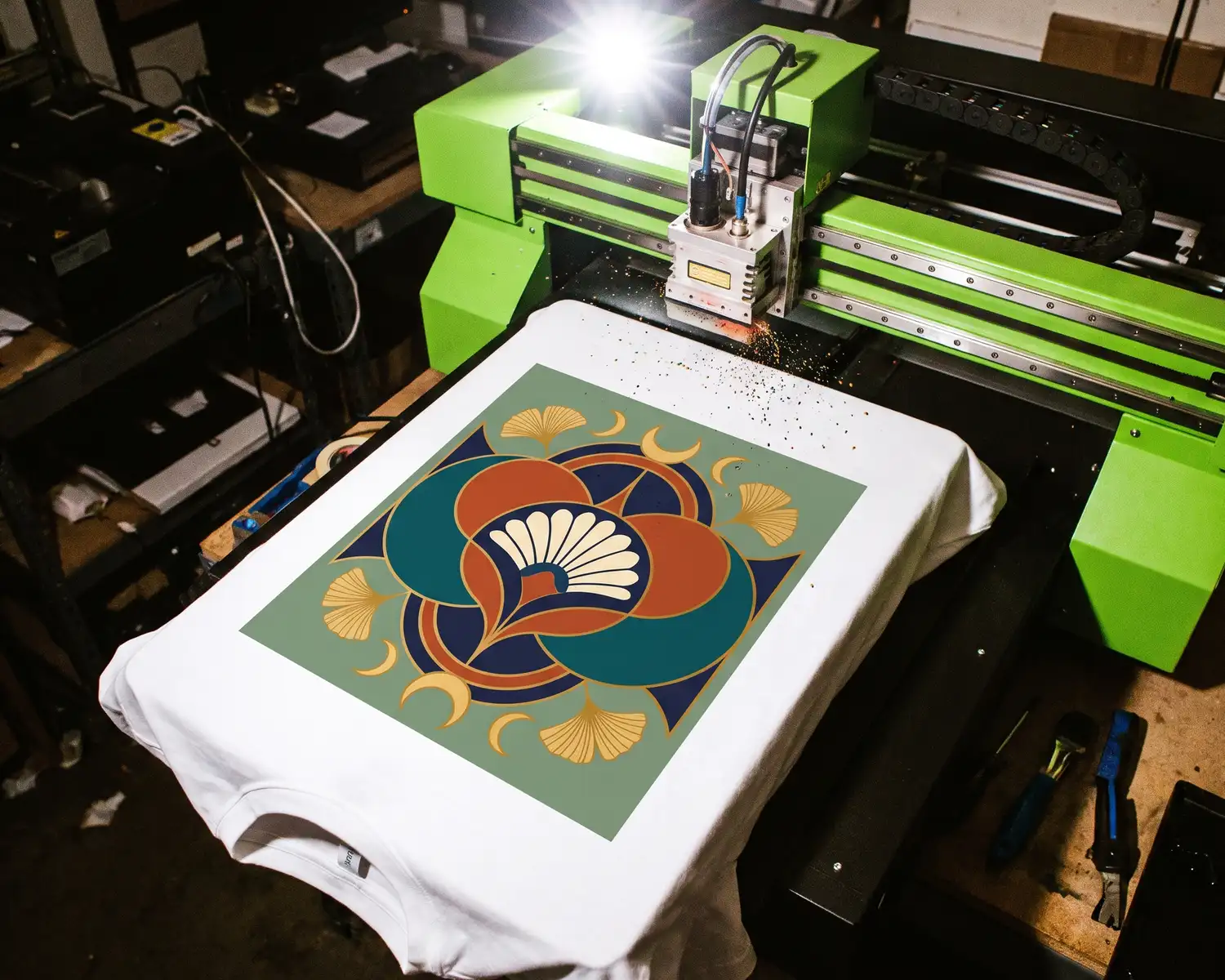
A DTG machine works like a household inkjet printer, at industrial scale: print heads lay special textile inks directly onto the fabric, pixel by pixel, exactly like a file printing onto paper. The garment then goes through an oven that heat-sets the ink into the fibers.
It's this printing logic, not a placement logic, that explains everything else. No screen to engrave like in screen printing, no film to cut like in DTF: the file goes straight onto the fabric. The first piece costs the same as the hundredth, unlike techniques that spread tooling costs over quantity.
Why it's the single-unit technique
Three concrete reasons, all tied to this absence of upfront tooling.
No minimum. Screen printing requires engraving a screen per color before the first print; DTG has nothing to prepare beforehand. An order of a single t-shirt goes straight into production, with no setup cost to cover.
The visual doesn't cost more. A photo, a color gradient, a logo with fifteen shades: in screen printing, every extra shade complicates and raises the setup cost. In DTG, the printer renders the file as it is, whatever its color complexity.
It's the technology that made single-piece personalization accessible. Before DTG, printing a single personalized garment at a reasonable price was practically impossible: this technique is what opened the door to print on demand as it exists today, from creator merch to a team sample tested before the full run.
Its limits, stated honestly
No technique is perfect everywhere, and DTG has its own.
Pretreatment on dark fabric. On a black or navy t-shirt, white ink has to be laid down as an undercoat first so the colors come out right: an extra step, invisible to you, but part of the workshop's know-how.
The fabric choice matters. DTG gives its best results on cotton or mostly-cotton blends. On mostly polyester or technical fabrics, the ink grips less well and the result loses sharpness: not the right choice for a softshell jacket or a technical sports jersey.
The per-unit price stays high at volume. With no tooling to spread out, each print costs the same individually: an advantage at the single-unit level, a disadvantage past about ten identical pieces, where DTF or screen printing become more economical (our full comparison of marking techniques details the thresholds).
From test to production run, without starting over
DTG is often a first step, not an end point: a design tested on a single t-shirt in DTG can then move to DTF or screen printing once the quantity justifies it, on the same file, with no new setup. The technique follows the project's pace, from prototype to production run, it doesn't lock you into a single order format.
Frequently asked questions
What is DTG printing?
DTG (Direct to Garment) is a digital printing technique that projects ink straight onto the fabric, like an inkjet printer, then heat-sets it. It needs no screen or film in between, which makes it possible to order from a single piece.
What's the difference between DTG and DTF?
Both print digitally, but not the same way: DTG lays ink directly onto the fabric, DTF prints onto a film that's then heat-pressed. The full detail, including the quantity threshold where one technique overtakes the other, lives in our DTF guide.
Does DTG work on a black garment?
Yes, but with an extra step: a white pretreatment is applied before the colors are printed, otherwise they would look dull on a dark background. It's a standard operation at an equipped workshop, not an obstacle.
Your project, quoted within 24 hours.
Describe your garments, your decoration and your quantities: you receive a detailed quote, decoration included, within one business day.