DTG printing: price per garment, results on cotton and on dark fabrics, and when to choose DTF instead
DTG printing lays your design in ink right into the fibre of a cotton garment, like a photo. At tknp.io, a #E150 Men by B&C printed in DTG at A6 costs €10.50 excluding VAT at 10 units and €5.91 at 100, with the t-shirt, at the standard lead time; figures for guidance only, from its product page of 7 November 2026.
The essentials in 4 points:
- DTG works in three steps, according to our technique page: the garment is pretreated, the printer jets the ink straight onto the textile, then the ink is heat-fixed. No screen to engrave, no film to press.
- On three of our product pages, what DTG printing at A6 adds to the blank garment is the same for a t-shirt or a hoodie: €8.01 excluding VAT at 10 units, €5.22 at 50, then €3.65 from 100 to 1,000 (standard lead time, product pages read on 7 November 2026, for guidance only).
- On light cotton, the print is almost impossible to feel; on a dark fabric, a white underbase goes under the colours, and our price grid lists dark textiles separately.
- For polyester, a cap, a bag or a tight budget, DTF takes over; on light cotton, DTG stays the softest.
What DTG means, and how the printing works
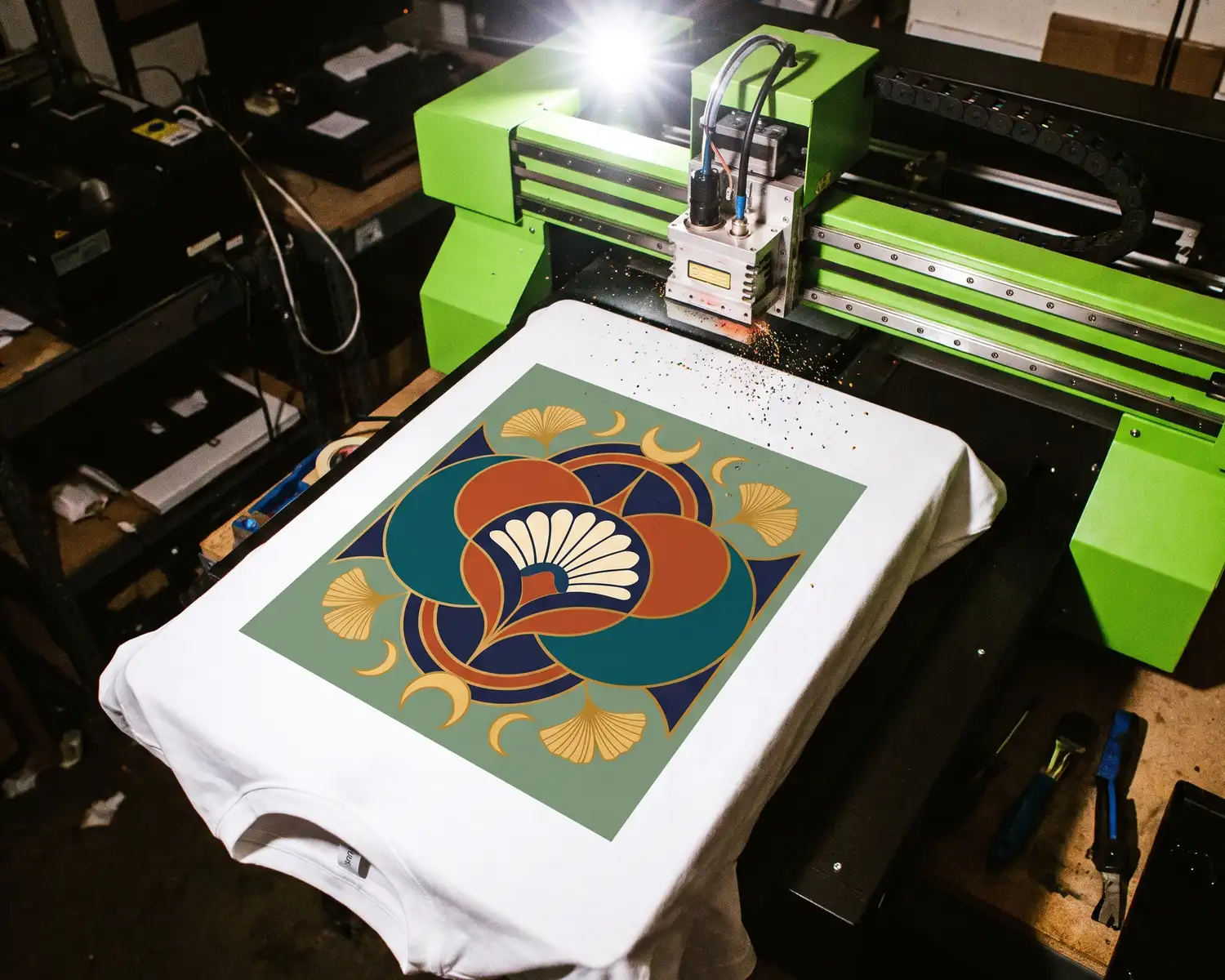
DTG stands for direct to garment: the ink travels from the printer to the fabric, with nothing in between. Our DTG technique page describes the process in three steps. The garment is first pretreated, so the fibre can take the ink. The printer then jets the ink straight onto the textile, like a photo. Finally the ink is heat-fixed, for a print with "no added hand-feel".
Two features of DTG follow from this process. No tool has to be made before the first print: the page speaks of "no setup cost". And the file prints as it is: a photo, a gradient or an illustration in ten shades changes nothing in the price, since the DTG line on our product pages does not count the colours in the design. To see where DTG stands against screen printing, DTF transfer and sublimation, our guide to textile printing techniques sorts them by what you print, on which fabric and in how many units.
The price of DTG printing per garment, from 10 to 250 units
At tknp.io, a t-shirt printed in DTG at A6 costs €10.50 excluding VAT each for 10 #E150 Men by B&C, and €15.73 for 10 Creator 2.0 by Stanley/Stella; at the same brand, the Cruiser 2.0 hoodie goes up to €41.68, garment included. The price falls with quantity: for 250 units, the #E150 Men comes down to €5.80 and the Creator 2.0 to €10.06. These amounts were read on the product pages on 7 November 2026: excluding VAT, for an A6 design measuring 10.5 by 14.8 cm placed in one spot, in the base colourway, white for these three models, in regular sizes, at the two-week standard lead time, for guidance only, with shipping on top. A rarer colourway or a large size pushes the bill up slightly.
| Model printed in DTG at A6 (price per garment excl. VAT) | for 10 | for 25 | for 50 | for 100 | for 250 |
|---|---|---|---|---|---|
| #E150 Men (B&C), cotton t-shirt, 145 g/m² | €10.50 | €9.69 | €7.55 | €5.91 | €5.80 |
| Creator 2.0 (Stanley/Stella), organic cotton t-shirt, 180 g/m² | €15.73 | €14.67 | €12.36 | €10.54 | €10.06 |
| Cruiser 2.0 (Stanley/Stella), organic cotton hoodie, 350 g/m² | €41.68 | €39.54 | €36.40 | €33.76 | €31.74 |
A budget example: 50 Creator 2.0 t-shirts printed in DTG at A6 come to €618.00 excluding VAT, shipping extra.
Each product page also shows the price of the blank garment. The gap between the two lines, in other words what DTG printing at A6 adds to the garment, is the same on all three models: €8.01 excluding VAT at 10 units, €7.28 at 25, €5.22 at 50, then €3.65 at 100 as at 1,000. Beyond 100 units, the printing share stops falling; only the price of the garment keeps going down. Our technique page says as much: "flat unit cost", "little scale economy".
Two limits worth knowing. The product pages only price DTG at A6: a 25 × 30 cm illustration on the front needs a quote. And DTG is always ordered on quotation, even when the product page shows its line: the quote is what counts.
The result on light cotton: a photo you can barely feel
On light cotton, DTG is at its best. Our technique page credits it with "near-zero hand-feel on light cotton" and a photo-real result, gradients included. The site's DTG inspiration, a six-colour illustration on a white Creator 2.0, puts it in its own words: a light fabric lets the ink into the fibre, with no underbase. It is the technique for an illustrator's merch, a group photo or a design full of shades, worn every day without the print being felt.
As for fabric, the page lists its supports: "cotton and cotton-rich blends". The three models in the table, all in cotton, are among them. For a photo, preparing the file matters as much as the technique: our guide to the custom t-shirt with a photo gives the resolution and size to aim for.
The result on a dark garment: the white underbase
On a black, navy or burgundy t-shirt, DTG lays a white underbase under the colours, which light cotton does not need. It has two effects. It can show: our DTG inspiration advises against a solid flat colour on a black tee, where "the white underbase shows through", and points to screen printing instead. It also costs more: the price grid on our technique page gives dark textiles a line of their own, more expensive than the light-textile line, at every size and every quantity. The exact price for your colourway comes with the quote.
For a dark garment, compare before choosing: our article on black t-shirt printing sets screen printing, DTF transfer, DTG and embroidery side by side on a dark fabric.
When to choose DTF over DTG printing
DTF takes over from DTG in three situations: a fabric that is not mostly cotton, such as polyester, a cap or a bag, and a budget where every cent counts. DTG keeps the edge on light cotton, when the feel matters more than the price. To decide between the two, criterion by criterion and with the prices from our product pages, read our DTF vs DTG comparison; our guide to DTF printing explains the transfer itself.
Ordering DTG printing at tknp.io
At tknp.io, DTG printing is priced on quotation, from 10 units of the same garment, with sizes and colours spread across them as you wish. The "Request a quote" button, found on the garment's product page as on the technique page, opens the request; you describe the model, the design and the quantity, and a proposal comes back within one working day. For planning, the site's FAQ allows ten working days of customisation as standard.
Key takeaways
- DTG jets the ink onto a pretreated garment, then heat-fixes it: a photo-like result, almost impossible to feel on light cotton.
- On the three models of our table, DTG printing at A6 adds €8.01 excluding VAT to the garment at 10 units and €3.65 from 100 (standard lead time, product pages of 7 November 2026, for guidance only); beyond that, only the garment gets cheaper.
- On a dark fabric, a white underbase goes under the colours, and the grid lists dark textiles separately.
- Polyester, caps, bags or a tight budget: look at DTF.
- Ordered on quotation, answer within one working day, from 10 units per model.
Frequently asked questions
What is DTG printing?
It is direct digital printing: the pretreated garment receives the ink from a textile printer, then the ink is heat-fixed. No screen or film has to be made before the first print, and photos and gradients come through as they are. At tknp.io, DTG is priced on quotation, from 10 units per model.
Does DTG work on a black garment?
Yes, with a white underbase under the colours, which light cotton does not need. It can show through under a solid flat colour, and our grid prices dark textiles separately. For a flat-colour logo on black, look at screen printing first.
Which fabric should you choose for DTG printing?
Cotton, or a blend where cotton dominates: that is what our technique page asks for. The three models in our table are cotton: the 145 g/m² #E150 Men, then two Stanley/Stella models in 100% organic cotton, up to the 350 g/m² Cruiser 2.0 hoodie. On polyester, go for DTF transfer.
Your project, quoted within 24 hours.
Describe your garments, your decoration and your quantities: you receive a detailed quote, decoration included, within one business day.