Textile printing techniques: which one to choose for your design, fabric and quantity?
The right choice starts with your design: a photo or a gradient goes to DTF transfer, to DTG on cotton or to sublimation on light polyester; a flat-colour logo goes to screen printing. On tknp.io, DTF and screen printing can be ordered online from 10 units, the others on quote.
In short:
- The design: screen printing needs one screen for every colour of the logo and struggles with gradients; DTF transfer, DTG and sublimation work in four-colour process, so an extra shade adds nothing to the price.
- The fabric: DTF transfer accepts nearly every material, screen printing any flat textile; DTG needs a mostly cotton fabric, sublimation a light polyester.
- The quantity: at tknp.io, DTF transfer, screen printing, DTG and sublimation start at 10 units, screen-printed transfer at 25; the screen used in screen printing pays for itself over the run.
- Ordering: DTF transfer and screen printing are ordered online at the price listed on each garment's page; DTG, sublimation and screen-printed transfer go through a quote, answered within 24 working hours.
A neighbourhood association is getting the merch ready for its street party. For the volunteers, cotton t-shirts with the logo in two colours; for the morning run, polyester sports t-shirts with this year's poster as a photo. The two orders are not decided the same way: a two-colour flat logo on cotton leaves a choice between several prints, while a photo on polyester rules most of them out.
This guide reviews five printing techniques for custom clothing, plus the four-colour process that drives three of them. Three criteria decide between them, in this order: your design, the fabric that takes it, and the number of units. Here are the answers, technique by technique, with what tknp.io offers online and on quote.
What are the textile printing techniques?
For custom clothing, textile printing techniques fall into two families: those that push ink through an engraved screen, screen printing and screen-printed transfer, and the digital methods, DTF transfer, direct-to-garment printing (DTG) and sublimation. Four-colour process, often listed alongside them, is in fact the way these digital methods rebuild colours.
Our decoration page lists twelve techniques in all. Four of them do not print, the three embroideries and the patch, and on that page relief comes from thread, all the way to the raised volume of 3D embroidery. Outside textiles, objects have processes of their own: on a pen or a mug, the logo is often pad printed, with a silicone pad that follows the curves.
Start from the design: flat colours, number of colours or photo
The design is the first criterion, because it rules out some techniques straight away: a photo or a gradient needs four-colour printing, so DTF transfer, DTG or sublimation, while a logo in solid flat colours remains screen printing's home ground. Screen printing actually struggles with photo gradients, because of the halftone they require.
The number of colours then weighs on the price, but only in screen printing, where every colour calls for a separate screen, which explains the price gaps set out in our article on screen printing t-shirts. The grid on our screen-printing page has one row per number of colours, from one to six, with a separate rate for a white textile and a coloured one. Digital methods print every shade in one go: according to our decoration page, a photo gradient costs the same there as a flat colour.
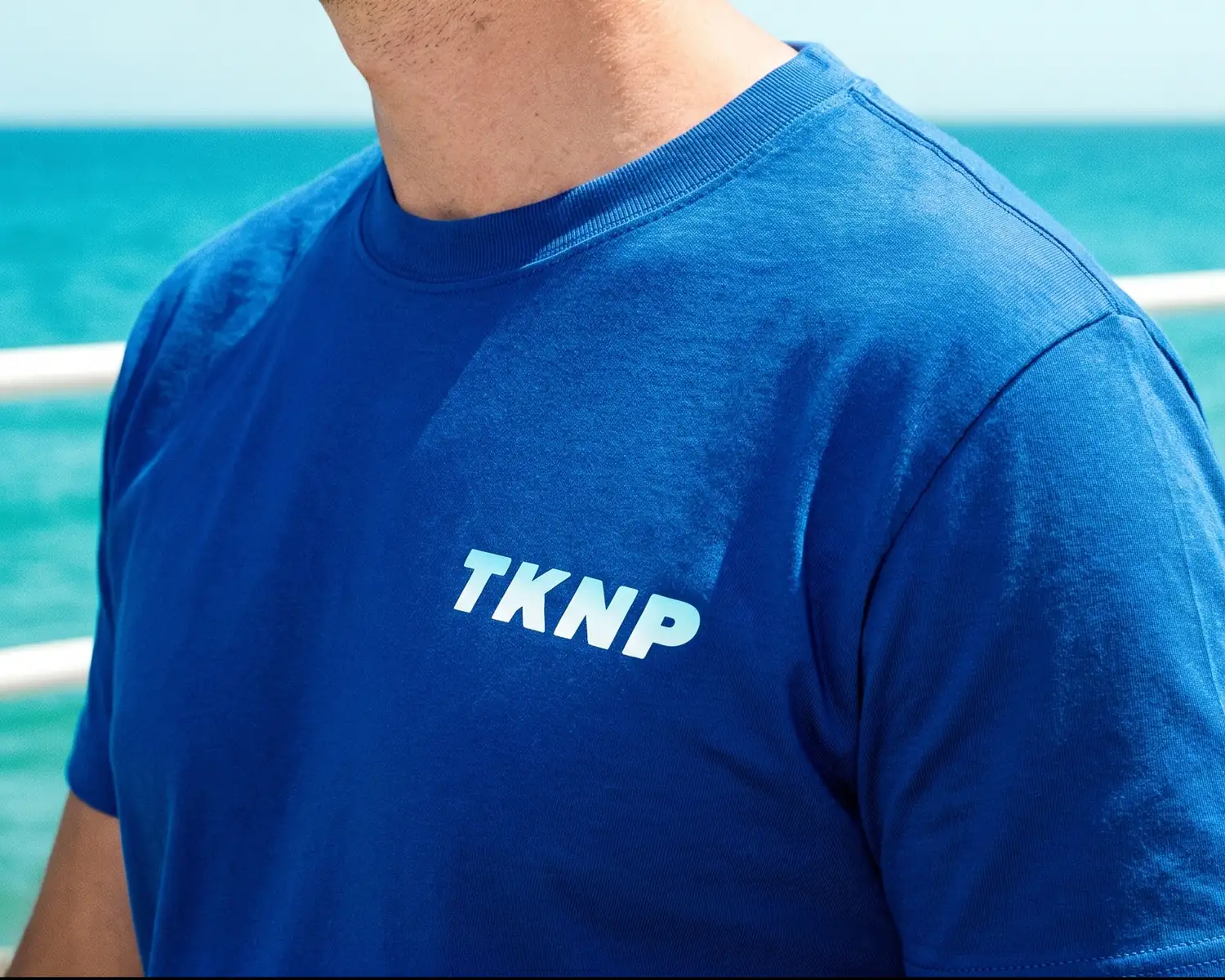
A logo in a gradient, white to cyan on a royal blue t-shirt for instance, therefore calls for a digital print: on a coloured cotton, DTF transfer can be ordered online. A one- or two-colour logo, on the other hand, can go either way, and then the fabric and the quantity decide.
The fabric: cotton, polyester, light or dark
A garment's fabric narrows the choice of printing techniques in turn. DTF transfer holds on cotton, polyester and mixes of both, almost every material in fact, while any flat textile takes screen printing; DTG is kept for mostly cotton textiles, and sublimation for light polyester, the only fabric where its ink enters the fibre.
Fabric colour also counts: sublimation is impossible on a dark textile, while screen printing keeps opaque colours on it. For a black garment, technique by technique, our black t-shirt printing guide goes through it.
For a t-shirt, our article on the fabric of a custom t-shirt matches each fibre with each technique. A polyester garment has its own guide, on printing on polyester textiles.
Technical jackets finally have a print of their own: tknp.io's softshell printing prints in four-colour process on a film, over a white base that keeps colours bright and behind an anti-migration barrier, and can be ordered online from 10 units.
The quantity: what each technique needs to get started
At tknp.io, DTF transfer, screen printing, DTG and sublimation start at 10 units, and screen-printed transfer at 25, according to our decoration page. Below 10, a garment can only be ordered blank, from a single unit.
With quantity, what changes is the share of fixed cost. Before the first t-shirt, screen printing has already paid for its screens, a cost that spreads over the run; DTG has no fixed cost, but its price per unit drops little with volume. Between DTF transfer and screen printing, the point where one overtakes the other can be read on each product page: our comparison DTF or screen printing works it out on two t-shirts.
Screen-printed transfer, for its part, keeps the screen cost of direct screen printing.
Textile printing techniques, one by one
Screen printing, for flat colours and runs
Screen printing lays down flat areas of ink cured with heat: they are the densest colours, even on a dark textile, and the lowest price per unit on a large run. On tknp.io, 1,203 products accept it, and it can be ordered online from 10 units.
DTF transfer, four-colour process on almost any fabric
DTF transfer starts from a film printed in four-colour process, which the heat press bonds to the garment before it is peeled off. It handles every colour, photos included, on most materials and on fabrics of almost any colour, with a slightly filmy feel on large flat areas; it can be ordered online, from 10 units, on every product page that offers it. A so-called "flocked" t-shirt actually comes out of tknp.io as a DTF transfer, for the reasons given in the article on t-shirt flocking. The process, step by step, is in the guide to DTF printing.
DTG printing, the photo on cotton
Direct-to-garment printing (DTG) puts the ink directly into the fibre once the garment has been pre-treated: it renders photos and gradients with an almost imperceptible feel on light cotton. It needs a mostly cotton textile, and tknp.io prices it on quote from 10 units. Our guide to DTG printing explains who it suits best. Against the transfer, the comparison DTF or DTG puts their look and durability side by side.
Sublimation, for light polyester only
Sublimation only marks a light polyester, whose fibre takes in its ink: no cotton, no dark textile. Six products in the catalogue take it, five t-shirts and one polo shirt, on quote from 10 units. The article on textile sublimation explains this requirement, and what it allows in return.
Screen-printed transfer, for awkward areas
Screen-printed transfer is screen printing done in reverse on paper, then carried over to the garment with heat. It brings the sharpness and Pantone colours of screen printing to places a direct screen cannot reach: a sleeve, a pocket, the edge of a seam. It is requested on quote, from 25 units. What separates it from direct screen printing is explained in the article on screen-printed transfer.
Four-colour process, a printing mode rather than a technique
Four-colour process is not a printing technique of its own: it is the way DTF transfer, DTG and sublimation rebuild the shades of a design. The French Wikipedia article on four-colour process describes it as a printing process that obtains a wide range of shades from cyan, magenta and yellow, to which black is added. The article on four-colour textile printing shows what it changes on a custom garment.
The table to decide between printing techniques
This table sums up the five printing techniques in this guide that tknp.io offers: the design each one renders best, the fabrics it accepts, its wash resistance, its minimum and how to order it, based on our technique pages read on 6 November 2026.
| Technique | The design it renders best | Fabrics | Wash resistance | Minimum at tknp.io | Ordering |
|---|---|---|---|---|---|
| Screen printing | solid flat colours, from one to six colours | any flat textile, dark included | excellent | 10 units | online |
| DTF transfer | every colour, photos, fine details | almost any material: cotton, polyester, blends | very good | 10 units | online |
| DTG printing | photos and gradients | mostly cotton textiles | very good | 10 units | on quote |
| Sublimation | photos, design over the whole garment | light polyester only | excellent | 10 units | on quote |
| Screen-printed transfer | sharp logos, Pantone colours | textile, awkward areas: sleeves, pockets, seams | very good | 25 units | on quote |
Wash resistance also depends on care: the habits that protect each print are gathered in our guide to washing a printed or flocked t-shirt.
For the street party at the start, the volunteers' cotton t-shirts, with a two-colour logo, can go to screen printing or DTF transfer, and the quantity will make the difference; the photo for the run, on polyester, goes to DTF transfer, or to sublimation on quote if the polyester is light.
Read on a t-shirt's product page what each print costs
On tknp.io, the product page of the Round Neck T-Shirt by Build Your Brand prices 25 t-shirts at €8.25 excl. VAT each when the A6 design goes to DTF transfer, and at €10.61 excl. VAT when a single-colour logo is screen printed, prices taken on 6 November 2026 for guidance only. This 180 g/m² cotton jersey shows in its "available decorations" line three techniques you can order online, embroidery, screen printing and DTF transfer, and two on quote, DTG printing and patches.
Its grid of indicative prices has one row per technique, from 10 to 1,000 units: you read the column for your own quantity, from top to bottom, and the same column also prices an 8 × 10 cm embroidery. Your design then tells you which row to look at: for a photo, only the DTF transfer row applies among the online techniques; a one-colour logo can be read on both printing rows.
These prices are for the printed t-shirt, garment included, excluding VAT, at the public price listed for this model: one run of this model only, an identical logo placed in one spot, the grid at the standard lead time (2 weeks), in base colours and common sizes, delivery charged on top; according to the page, a few colours and the largest sizes cost slightly more.
Frequently asked questions
Can you use two printing techniques on the same t-shirt?
Our advice is to keep a single technique per garment, even when it carries two prints, on the chest and on the back: two prints that do not age at the same pace are quickly noticed. We also advise two decorations at most, and at tknp.io each position counts as a separate decoration, invoiced on its own.
How do you order a print that is offered on quote?
The "request a quote" button on the technique's page, or on the garment's product page when it lists the technique, opens the request: say what the project is and how many you need, and you get a proposal within 24 working hours. This is the route for DTG printing, sublimation and screen-printed transfer, which tknp.io does not sell online.
What is the difference between printing and textile decoration?
Textile decoration covers every way of putting a logo on a garment, printing it, embroidering it or attaching a patch; printing is only one family, the one where an ink or a film colours the fabric. The choice between these broad families is covered in our article on textile decoration.
Which print for a logo with very fine lines?
For fine lines or small text, DTF transfer keeps fine details and sharp outlines, on almost any fabric. Screen-printed transfer, on quote from 25 units, also promises sharp logos, even on a sleeve or a pocket.
Your project, quoted within 24 hours.
Describe your garments, your decoration and your quantities: you receive a detailed quote, decoration included, within one business day.