Finding a sponsor for your association or club: the pitch pack and the argument that get a yes
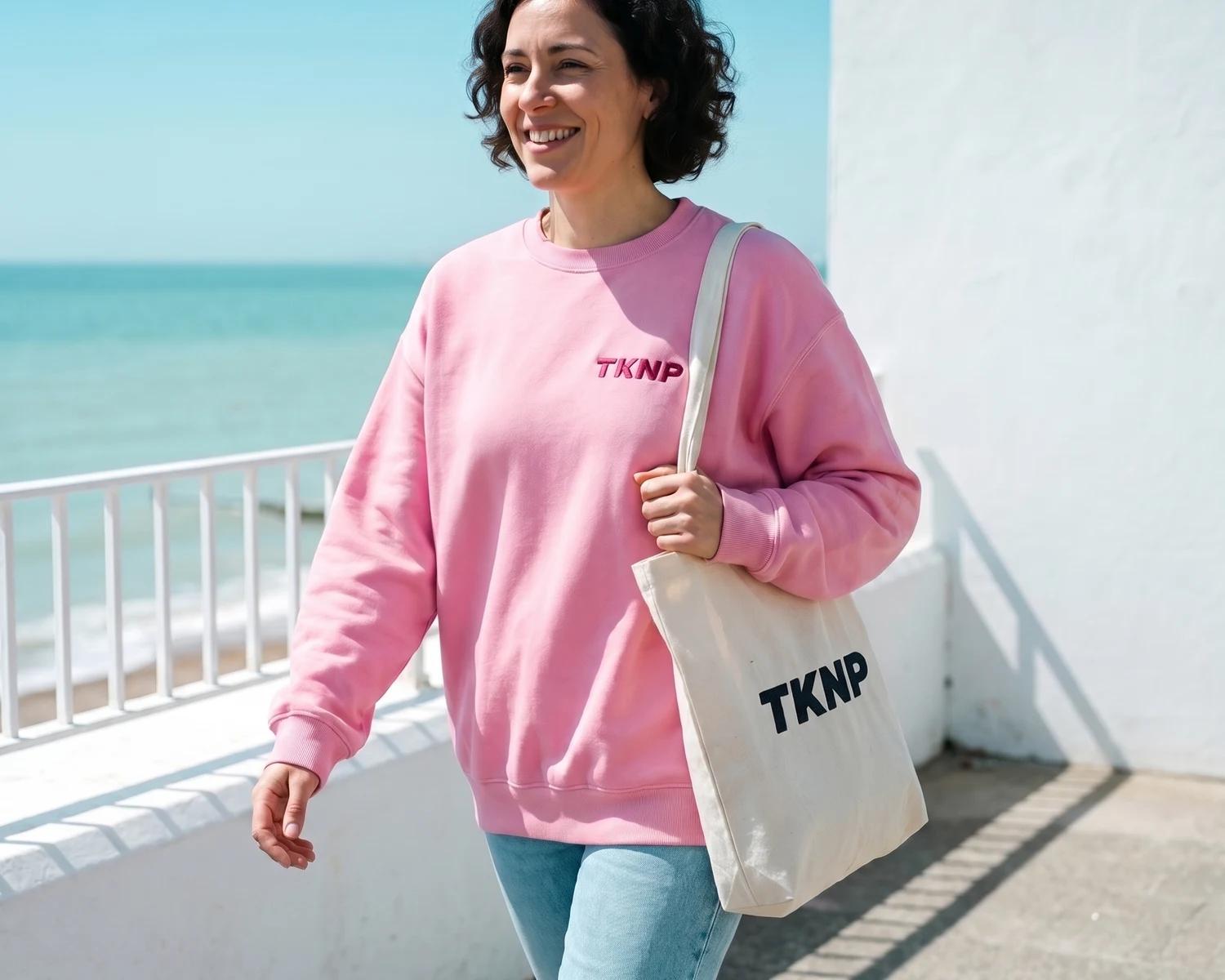
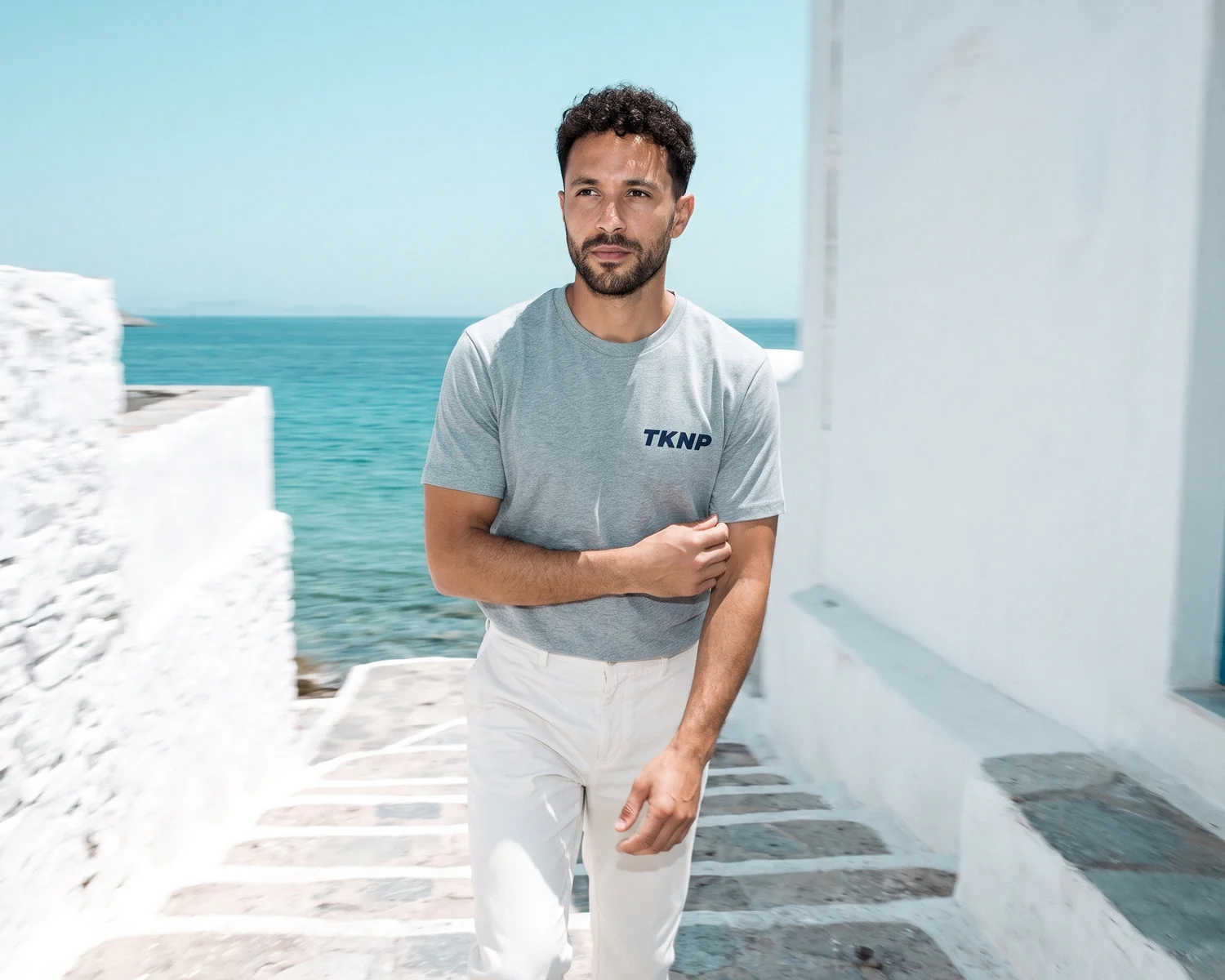
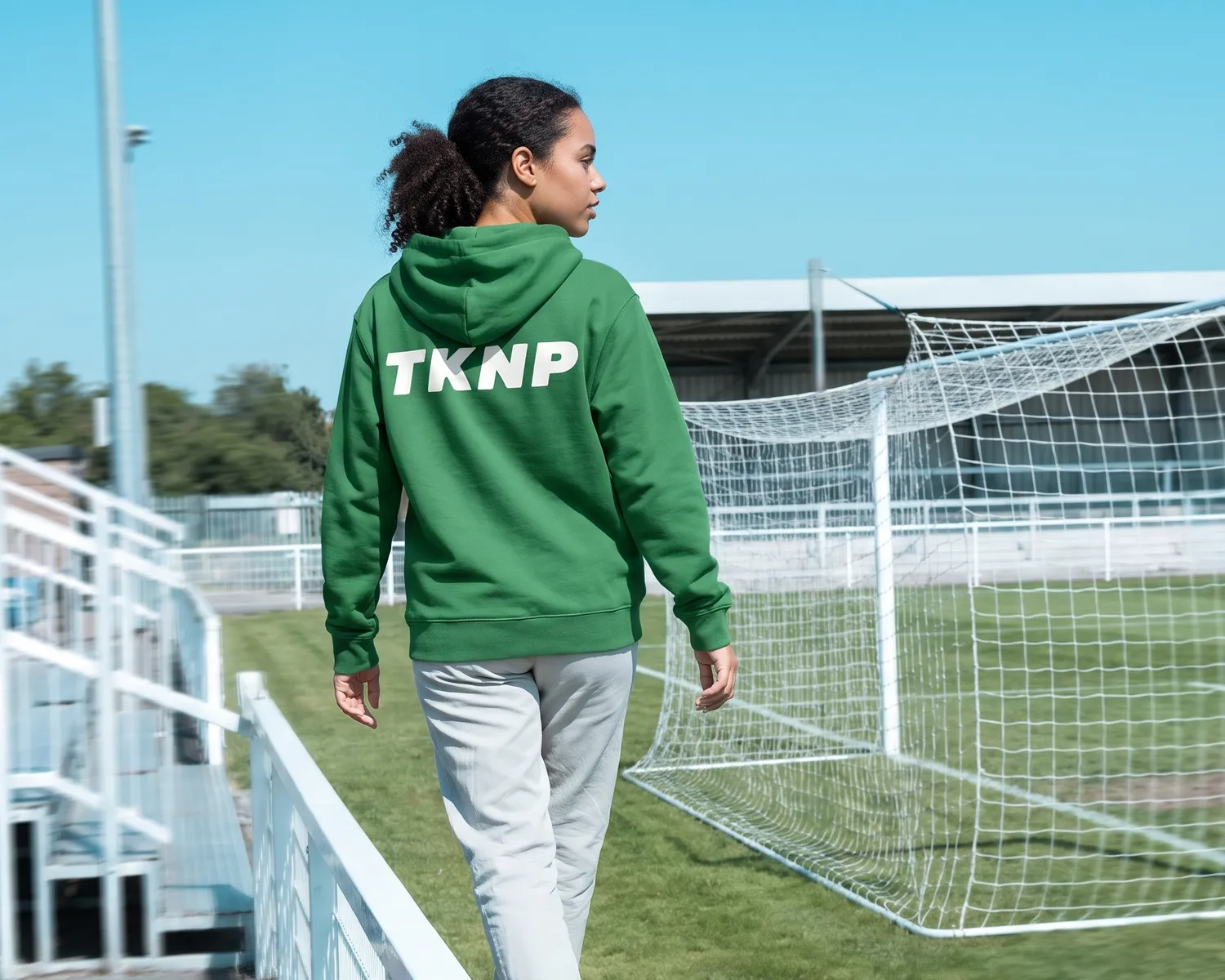
To find a sponsor, offer a local business its place on the club collection: the hoodie, t-shirt and tote bag your members wear away from the ground, where its logo travels all year. At tknp.io, the College Hoodie, screen-printed in one colour, comes to €17.89 excluding VAT each for 50, with the crest on the chest and the partner's logo on the back, by our calculation from the product page of 12 November 2026, as a guide.
Key points:
- A sponsor buys visibility, not a good cause: France's Ministry of Culture points out that the return on a sponsorship must be "quantifiable and proportionate" to what the business invests.
- The argument that gets a yes is a club collection made well enough that your members want to wear it around town: the logos leave the ground, and the partner is seen on days with no game.
- Your pack fits on three or four pages: the club's figures, two or three fixed, priced offers, a preview of the collection with the partner's logo, and a visibility estimate filled in with your own numbers.
- The collection is priced to the cent before the meeting: 50 hoodies, 50 t-shirts, 25 caps and 50 tote bags come to €2,104.00 excluding VAT, of which €348.00 is the partner's logo on the hoodies, t-shirts and tote bags (the cap carries the crest only), by our calculation from our product pages of 12 November 2026, as a guide.
- The tknp.io Store and its pre-order take care of the logistics: every member chooses their size and settles their own order, and the club keeps no size list, pays nothing upfront and holds no stock.
- Sponsorship is a commercial service: it is signed through an agreement and paid against an invoice.
The president has the list of local shops, the treasurer has a hole in the season's budget, and nobody knows how to open the meeting with the baker. This guide gives the method, from choosing which businesses to approach to the signed agreement, with the real price of the perk that an amateur club's partners see most: their name on a collection members wear out and about.
All prices quoted come from the tknp.io product pages read on 12 November 2026: price per garment or accessory excluding VAT, at the standard two-week lead time, base colours, standard sizes, shipping not included. They are given as a guide; on every product page, the quote is binding.
How do you find a sponsor for your association or club?
Finding a sponsor starts with a list of twenty nearby businesses whose customers are your members, their families and your audience. The shop your members walk into every week has a simple reason to back you: the club speaks to customers it already knows, on the street where it works.
To build that list, start from what the club already has at hand:
- Your members' employers and businesses. A parent who runs a building firm, a member who owns an estate agency: first contact is already made, and the request comes through someone they know.
- The shops along the way. The bakery next to the sports hall, the garage on the road to the ground, the café where the team meets after the game.
- The businesses hiring in your town. An employer brand is also built on the pitch on a Saturday morning.
- The partners of other clubs nearby. A business that already sponsors has a budget for it; it will not need the idea explained.
Then approach them in order of proximity, in person rather than by e-mail, with the printed pack in hand. The best contact is the manager or whoever decides on local marketing, rarely a switchboard.
A sponsor is not a patron. A patron gives without expecting anything back, a sponsor pays to be seen: our guide to funding an association explains the difference between the two under French rules. This guide is about the second kind, the one who expects something in return.
What does a local sponsor really buy?
A local sponsor buys the right to be seen and recognised by your audience, under its name or brand. The official French definition of sponsorship, from a ministerial order of 6 January 1989 quoted by associations.gouv.fr, the government's site for associations, describes support given to an organisation "in order to obtain a direct benefit", with "an indication of its name or brand".
For the business, that benefit has to show up in its accounts. The French Ministry of Culture explains that sponsorship spending can be deducted from a company's taxable profit when it serves the direct interest of its business, which requires two conditions: the company must be identified "whatever the medium used", and the spending must stay in line with the benefit expected. The same page sums up the spirit of it: the return must be "quantifiable and proportionate to the initial investment".
That is the sentence to keep in mind for the whole pack. The manager is not asking whether the club deserves help; they are wondering how many people will see their name, where, and for how long. A pack that answers those three questions with figures is already halfway there.
What goes into a sponsorship pack?
A good sponsorship pack fits on three or four pages: who the club is in figures, what it offers the partner, what that costs, and how to sign. Every figure must be yours, counted over the last season, never a flattering estimate the manager could check by dropping by the ground.
Here is an outline to copy and fill in with the club's data:
PARTNERSHIP PACK, [year] SEASON
[Name of the club or association], [town]

1. THE CLUB IN FIGURES
- Members or registered players: [number], including [number] young people
- Teams or sections: [number]
- Home games or events per season: [number]
- Average attendance per game or event: [number]
- Social media followers: [number per network]
- Families reached by the club's newsletter or group chat: [number]

2. WHAT WE OFFER YOU
- [Name] package: [perks], [duration], [price excl. VAT]
- [Name] package: [perks], [duration], [price excl. VAT]

3. WHERE YOUR LOGO WILL BE SEEN
- On the club collection: [number] hoodies, [number] t-shirts, [number] tote bags
- Worn by [who], [where], [when], away from match days
- Our estimate for the season: [number] outings of your logo (calculation attached)
- Preview of the collection with your logo: [images]

4. HOW TO SIGN
- One-season partnership agreement, invoice on signature
- Contact: [name, role, phone, e-mail]
Part 3 is the one that makes the difference. A manager who sees their logo on the club's hoodie, t-shirt and tote bag, at the right size, grasps the offer in a second; a line saying "visibility on kit" tells them nothing.
Which perks should you offer a sponsor?
Offer two or three fixed packages, each with its perks, duration and price, rather than a list the sponsor picks from. A named, priced package gets signed; an open list gets haggled over and lost in follow-ups.
An amateur club usually has four kinds of perks to offer:
- The logo on the club collection, the hoodie, t-shirt and tote bag members wear at training, in the stands and in the street.
- The logo on the venue: a banner at the edge of the pitch, a board in the sports hall, a tournament poster.
- Online presence: logo on the club website, a thank-you post, a mention in match announcements.
- Moments together: an invitation to the annual tournament or the end-of-season dinner, a framed shirt.
Build the packages by stacking these kinds. The entry package gives online presence and one venue spot; the mid-range package adds the logo on one garment of the collection; the lead partner package keeps the season's hoodie, t-shirt and tote bag for a single name. Exclusivity by trade (one garage, one bank) reassures the partner and costs the club nothing.
Why offer a club collection rather than a logo on a single sweatshirt?
Offer the sponsor a club collection rather than a single sweatshirt, because its logo is only seen if the garment leaves the wardrobe: a collection gives every member something they want to wear away from the ground. A banner is seen on match days, by the people already there; the club's hoodie, t-shirt and tote bag are worn at the school gate, at work, at the Saturday market, and the partner's name travels with them.
A single sweatshirt has two limits: it stays folded for part of the year, and it does not suit everyone. A short collection lifts both. The hoodie covers winter, the t-shirt takes over when the weather turns, and the tote bag is out all year: the partner's logo is out on more days, on more people. The cap, embroidered with the club crest alone, rounds off the collection for the member who will never wear a sweatshirt.
The condition is that the collection is well made: a garment your members would not wear in town shows the partner to nobody. Tell the manager so, it works in their favour: on a small line of merch in the club's colours, their logo is worn at a modest size, far more willingly than on a sponsor's kit.
It is also the easiest perk to count, which is exactly what the sponsorship rule asks for. You know how many garments carry the logo and who wears them, and the manager can check it for themselves by bumping into your players around town.
The collection has one last edge over venue signage: it stays. A garment people enjoy wearing lives well beyond the contract, and the partner's logo with it. Say so in the pack: it is a selling point a banner does not have.
How do you estimate how often the sponsor's logo will be seen?
To estimate how often the sponsor's logo will be seen, start from your own club's numbers: the number of garments carrying that logo, multiplied by the number of times each is worn in a month, multiplied by the number of months in the season. The result is a number of outings for the logo, which the manager can understand and check.
Here is the calculation to attach to the pack, to fill in with your data:
VISIBILITY ESTIMATE, [year] SEASON

A. Garments and accessories carrying your logo: [number]
B. Times each one is worn per month, away from the ground: [number, from our members' answers]
C. Months in the season: [number]

Outings of your logo over the season = A x B x C = [number]

The club's assumption, to discuss together:
D. People who come across the garment on each outing: [number]
Estimated views over the season = outings x D = [number]
Three rules so the calculation stands up in front of a manager:
- Ask your members for B, in the club's group chat: how many times a month do you wear the club hoodie or t-shirt outside training? Take the middle answer, not the most flattering one.
- Present D as what it is, an assumption. Pick the lowest figure you find credible, write it down in black and white, and let the manager correct it: they know their street better than you do.
- Do not borrow an audience figure from another club or from a study you cannot show. A modest estimate built on your own numbers carries more weight than a big number with no source.
At the end of the season, replace the estimate with the real count: the number of garments made, and what your members say about how they wore them. That review is what gets a partner to renew.
What does the collection cost the club?
When the club places the order, the collection costs it the price of the printed garments: €2,104.00 excluding VAT for 50 hoodies, 50 t-shirts, 25 caps and 50 tote bags, by our calculation, as a guide, on the product pages tknp.io showed on 12 November 2026. When members reserve their garments during a tknp.io Store pre-order, the club pays nothing upfront.
Here is a sample collection for a club of 50 members. Our product pages show the price with one position; for the hoodie, the t-shirt and the tote bag we have added, by our calculation, a second position in the same format, the partner's one. The minimum is 10 units per model:
| In the collection | Model | Decoration | Price each, excl. VAT | Quantity | Total, excl. VAT |
|---|---|---|---|---|---|
| The hoodie | Just Hoods College Hoodie (product page), 280 g/m² | one-colour screen printing: crest on the chest, partner's logo on the back | €17.89 | 50 | €894.50 |
| The t-shirt | B&C #E190, 185 g/m² | one-colour screen printing: crest on the chest, partner's logo on the back | €7.77 | 50 | €388.50 |
| The cap | Beechfield Low Profile 6 Panel Dad Cap, cotton chino | embroidery 5 × 8 cm: the crest only | €12.62 | 25 | €315.50 |
| The tote bag | Stanley/Stella Tote Bag, 300 g/m² | one-colour screen printing: crest on one side, partner's logo on the other | €10.11 | 50 | €505.50 |
| The whole collection | 175 | €2,104.00 |
Each two-position row adds the listed price, which already includes the crest, and the partner's logo, which, by our calculation, is what the printed garment costs over the same blank garment at the same quantity; tknp.io product pages of 12 November 2026, excluding VAT and shipping (€15.00 excl. VAT per order in France), as a guide; the quote is binding. The cap carries the crest only: its product page offers embroidery, in a single spot.
Within that total, the partner's logo accounts for €348.00 excluding VAT: €2.32 on each of the 150 hoodies, t-shirts and tote bags, at the format of each page's price grid. The tier-by-tier detail, where the logos go and which technique to choose are in our guide to sponsor logos on club sweatshirts; a large block on the back costs more, and the quote is binding.
The price you ask the sponsor does not have to stop there. The lead partner package can cover the whole collection and part of the season's budget: the amount is yours to set, as long as it stays in a proportion the partner can justify. For the rest of the budget, public money can help: the grants open to French clubs are gathered in our guide to sports club grants.
How do the tknp.io Store and its pre-order take care of sizes and upfront cash?
On the tknp.io Store, a pre-order is a sales campaign of 7 to 21 days during which each member reserves the garments of the club collection themselves, in their own size, and pays online; only what was reserved is made, after the campaign closes. The club no longer keeps a size list, chases payments or fronts the money for the run.
It runs in three stages, according to our Store page read on 12 November 2026:
- You build the collection in the designer and decide what your members will pay; tier by tier, the screen displays our price and the club's share.
- Your members reserve. You share the campaign's link, WhatsApp message or QR code; everyone picks their sizes and pays online. The club can also collect the money itself: the run is then invoiced to the club.
- We produce, once the campaign has closed, the garments whose threshold is met. The order arrives at the club in a bag with each member's name, about three weeks after the campaign closes; the date is shown before payment.
What the pre-order takes off the volunteer running the project:
| The headache | What the tknp.io Store pre-order does |
|---|---|
| The size list | Each member picks their own when reserving |
| Collecting payments | Everyone pays online; tknp.io sells, collects payment, invoices members and handles refunds |
| Cash upfront | None: a Store costs nothing to open, and a campaign nothing to publish |
| Unsold stock | None: only what is reserved gets made |
| Handing out | A bag with each member's name, delivered to the club |
Three limits to know before you announce it. A threshold is set for every garment on sale: below it, we switch decoration technique without touching the price where that is feasible, and failing that its reservations are refunded in full. And a size, once chosen, is not exchanged, under our terms of sale. Finally, according to the FAQ on our home page, a pre-order Store is reserved for verified organisations.
Before you promise the partner a spot, build the campaign: the screen will show you which garments, accessories and decorations it takes, and you will write the offer from what you have seen.
If the partner's logo is on the campaign's garments, the pre-order changes two things for the sponsorship pack. First the count: when the bags are handed out, you know exactly how many garments carry that logo and who wears them; it is line A of your estimate, now a real figure. Since that number is only known at the end of the campaign, commit in the agreement to the garments involved and the duration, and send the count afterwards. Then the money: members pay for their garments, so the partner's contribution goes to the season's budget, and the gap between your members' price and ours, set by the volume reached, lands in the club's pot, paid by bank transfer after delivery.
The prices in the table above apply to an order placed by the club; on pre-order, the price of each garment is shown on the Store screen. To choose what goes on sale and at what price, read how to set up an online store for a sports club.
Show the sponsor their logo on the collection before they sign
The best visual in your pack is a preview of the club collection with the partner's logo already placed. On tknp.io, the designer opens from each garment's product page through the "Personnaliser en ligne" (customise online) button: you place the logo there, at its real size, in the technique you want, and you see at once where it lands and how much room it takes.
Make those previews for every business you are going to see, with its own logo, before the meeting. Opening an account costs nothing, and production only starts with the order, according to our FAQ: you can prepare ten previews for ten shops without spending anything. A manager who discovers their name on the back of the club's green hoodie, then on the t-shirt and the tote bag, no longer has to imagine the offer, they are looking at it.
On the day they sign, the collection can be ordered straight away, from 10 units per model; the product page states that your exact price shows at the top of the page, and the quote is binding. As for timing: 10 working days of production as standard, plus 1 to 2 working days of shipping within France, according to our FAQ of 12 November 2026.
Which contract should you sign with a sponsor?
Sponsorship is signed through a partnership agreement and paid against an invoice: France's Ministry of Culture specifies that, being commercial in nature, sponsorship spending "must be invoiced with VAT". Your association's own VAT status is something to check with its tax office.
The agreement fits on two pages and answers six questions:
- The parties: the club, represented by its president, and the business.
- The duration: one season, with a start and end date.
- The perks: the package chosen, in detail (garments of the collection involved, position and size of the logo, venue signage, posts).
- The price and the payment schedule.
- The logo: the version to use, supplied by the business, which authorises the club to reproduce it.
- The expiry: the end date, and how to renew for the following season.
Send the agreement with the pack, ready to sign: a partner who said yes in the meeting should not wait three weeks for a document.
When should you approach sponsors for the season?
Approach sponsors two to three months before the date the collection needs to be worn, to leave time for the meeting, the signature, the payment and production. When the club orders itself, allow at least two weeks between order and delivery: 10 working days of production as standard and 1 to 2 working days of shipping within France, according to our FAQ.
On pre-order, allow four to six weeks between opening the campaign and handing out the bags, by our addition: a campaign of 7 to 21 days, plus about three weeks once it has closed, according to our Store page.
For a sports club, the date that matters is often the start of the season: a collection that arrives for the first game is worn all season, one that arrives in November has lost two months of visibility for the partner. For an association, it is the year's flagship event, the tournament, the race or the fête.
Frequently asked questions
Can an association that is not a sports club have a sponsor?
Yes. The official French definition of sponsorship covers support given to an event, a person, a product or an organisation, with no limit on the field: a cultural association, a festival or a village fête committee can offer a business visibility in exchange for its support.
Can the sponsor deduct what it pays the club?
Yes, the sponsor deducts its sponsorship spending from its taxable profit when it serves the direct interest of its business, under article 39-1-7° of the French General Tax Code as quoted by the Ministry of Culture. It must be identified on the media used, and the sum must stay in line with the benefit it expects.
What are the tknp.io Store and its pre-order campaign?
The Store is the pre-order shop a club, an association, a school or a company opens on tknp.io. Its campaign runs for 7 to 21 days: every member books their garments in their own size and pays for them. After the close, tknp.io produces the reserved garments that met their threshold and delivers them to the club, in a bag with each member's name. A pre-order Store is reserved for verified organisations. There is no fee to open a Store or to publish a campaign.
Should you redo the sponsorship pack every season?
Yes, the sponsorship pack is redone every season, its figures at least. The number of members, teams and games changes from one season to the next, and a partner who renews wants to see what their logo brought them: how many garments carried it, and how often your members say they wore them. The one-season agreement is renewed together with the updated pack.
Your project, quoted within 24 hours.
Describe your garments, your decoration and your quantities: you receive a detailed quote, decoration included, within one business day.