Funding an association in France: the 7 sources of money, what they weigh and what they ask of you
A French association funds itself through seven sources, from membership fees to selling hoodies. Taken together, French associations draw 65% of their resources from activity income (sales, services, public contracts), 20% from grants, 7% from membership fees and 5% from donations and patronage (Le Paysage associatif français survey, 2020).
The essentials:
- Sales and services keep associations alive: together with public contracts, this activity income provides 65% of their resources in 2020, against 49% in 2005, according to the Paysage associatif survey.
- For a taxpayer in France, a €100 donation to a public-interest association costs €34 after the 66% income tax reduction described by Service-Public.
- A raffle needs the mayor's authorisation; a traditional bingo night for a cause does not, if it stays among members, relatives and friends, with stakes under €20 and no cash prizes. Neither can be played online.
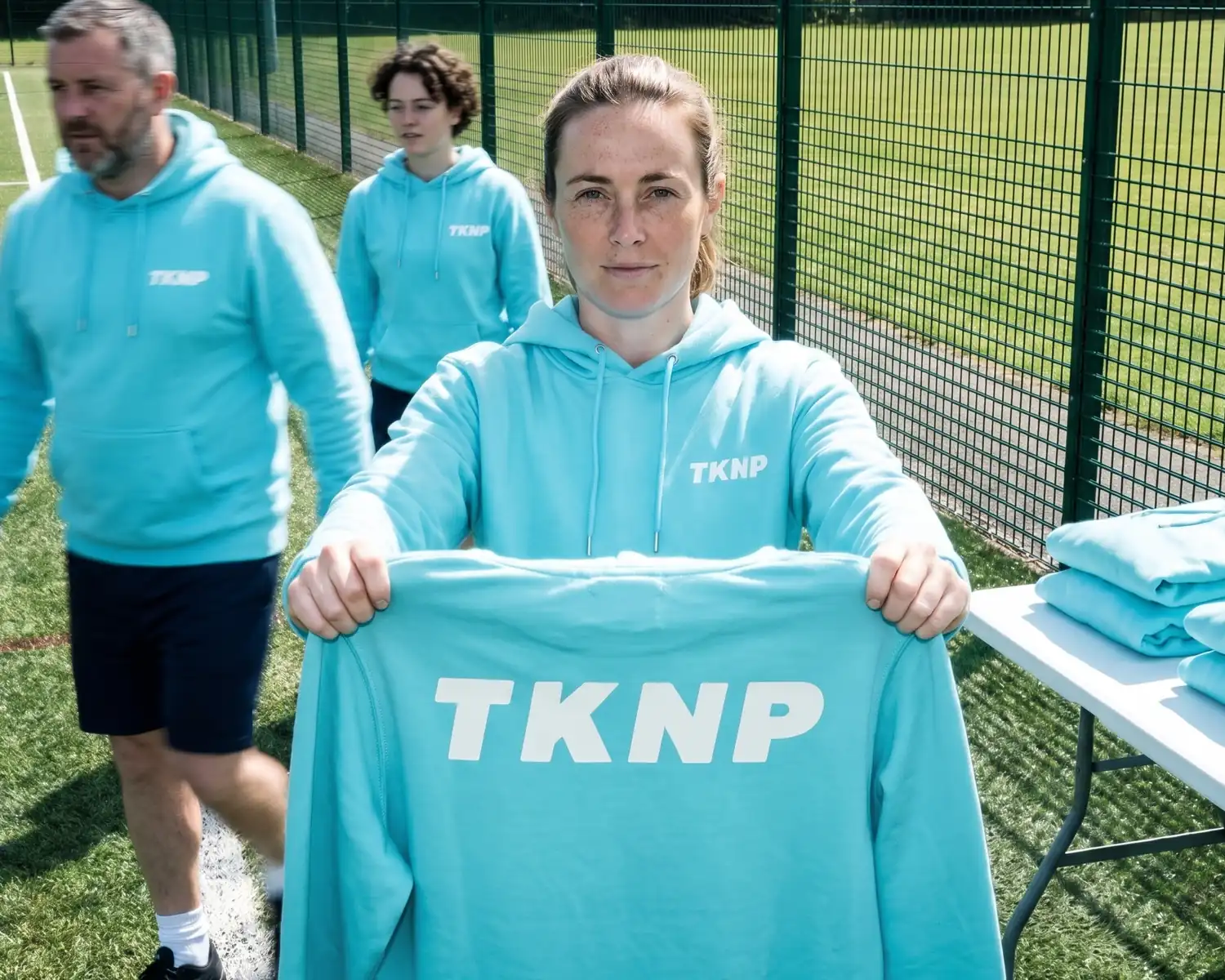
- A hoodie or t-shirt pre-order on the tknp.io Store needs no upfront money: the pot goes to the association by transfer once the order has been delivered.
At every general meeting, the same question comes back when the treasurer presents the accounts: where do we find the money for the next project, the minibus, the tournament, the youth trip? There is never a shortage of ideas. What is missing is knowing what each one can bring in, how long the money takes to arrive, and what it will ask of the board.
This guide maps everything out for an association registered in France (the "loi 1901" non-profit), source by source, with the figures of the national survey on associations' resources and the official rules read on 5 November 2026.
What are the sources of funding for an association?
An association can fund its projects through seven sources of money: its members' fees, donations from individuals, corporate patronage and sponsorship, public grants, sales and events, raffles or bingo, and online fundraising. Each has its own pace and conditions, summed up below from the official pages of Service-Public, the French government's information site, read on 5 November 2026.
| Source | When the money arrives | What it asks of you |
|---|---|---|
| Membership fees | with each membership | members; to open the tax reduction, a public-interest association and any goods handed over limited to a quarter of the fee (€65 a year at most) |
| Donations from individuals | on payment | a public-interest association, so the donor gets the tax reduction |
| Patronage and sponsorship | on the payment agreed with the company | no equivalent benefit in return for patronage; advertising in return for sponsorship |
| Grants | on each funder's own timetable | an application, a provisional budget, often a request on Le Compte Asso, the government's online portal for associations |
| Sales and events | on the day of the sale; for a tknp.io Store campaign, by bank transfer after delivery | for a drinks stand serving alcohol, the mayor's authorisation, five times a year at most |
| Raffle or bingo | when tickets or cards are sold; for a raffle, once the mayor has agreed (with no answer within two months, the request is rejected) | the mayor's authorisation for a raffle; a closed circle, stakes under €20 and no cash prizes for bingo |
| Online fundraising | depending on the platform chosen | a cause listed by law (social, educational, sporting, cultural...), and never a prize draw |
School trips follow their own rules, set by the French Ministry of Education: they are explained, along with what the school's merch can add, on our page about funding a school trip.
What does each source weigh in associations' budgets?
Activity income weighs the most: in 2020, it provides 65% of French associations' resources, ahead of public grants (20%), membership fees (7%) and donations and patronage (5%). These figures come from the fourth edition of the Le Paysage associatif français survey, by Lionel Prouteau (Laboratoire d'économie et de management de Loire-Atlantique) and Viviane Tchernonog (Centre d'économie de la Sorbonne), published by Dalloz in 2023 and conducted among 6,052 associations.
| Type of resource | 2005 | 2020 |
|---|---|---|
| Activity income (sales, services, public contracts) | 49% | 65% |
| of which sales to users | 32% | 36% |
| of which public contracts | 17% | 29% |
| Public grants | 34% | 20% |
| Membership fees | 12% | 7% |
| Donations and patronage | 5% | 5% |
| Covid-related support and compensation | - | 2% |
The long-term trend is plain to see: in fifteen years, the share of grants fell from 34% to 20%, while activity income rose from 49% to 65%. Sponsorship, raffles and online fundraising have no line of their own in this table.
Read these averages with one caveat. They add up the €113 billion of 1,370,000 associations, and the 144,000 associations that employ staff account for 92.5% of it. The 1,226,000 associations without employees share €8 billion, around €6,500 a year each on average, by our calculation. The survey also notes that membership fees are the most frequent resource of sports, cultural and leisure associations, which make up 65% of all associations.
How much do membership fees bring in for an association?
Members' fees provide 7% of associations' resources in 2020, against 12% in 2005, according to the Le Paysage associatif français survey. This money comes in with each membership.
In France, a fee paid to a public-interest association can open the same tax reduction as a donation, Service-Public points out: the right to vote at the general meeting or the newsletter do not count as benefits in return. Goods handed to the member, however, must not be worth more than a quarter of the fee, up to €65 a year. A t-shirt given on joining falls within this limit like any other goods: on a €40 fee, its value must not exceed €10 for the fee to remain deductible.
If the association wants to dress its members at its own expense, our guide to an association's clothing budget works out what to plan per member.
How much does a donation to an association cost the donor?
A €100 donation to a public-interest association costs a French taxpayer €34: the income tax reduction is 66% of the amount given, up to 20% of taxable income, according to Service-Public's page on donations (checked on 15 April 2026). In 2026, the rate rises to 75% on up to €2,000 of donations for an organisation helping people in difficulty (meals, care, housing).
For the donor to qualify, the association must be non-profit, run on a disinterested basis and not operate for the benefit of a closed circle of people. The donation must not lead to anything in return, and the part above the 20% limit carries over to the following five years.
Donations and patronage provide only 5% of associations' resources, a share that has held steady since 2005 in the Paysage associatif survey. The real cost of the gesture, €34 for €100 given, is the line to write into every appeal for donations: donors see straight away what their support really costs them.
Patronage or sponsorship: what is the difference for an association?
Patronage ("mécénat") is corporate support with nothing in return, while sponsorship ("parrainage") is support paid in exchange for a direct benefit, such as advertising. Service-Public gives the textbook example: a bakery that pays the local football club to see its logo on the players' shirts is sponsoring the club, not acting as a patron.
In France, patronage gives the company a tax reduction of 60% of the donation, up to €2 million, with an annual cap of €20,000 or 0.5% of its turnover excluding VAT if that amount is higher: by our calculation, €1,000 given costs it €400. The donation can be made in money, in kind (premises, equipment) or in skills, and the company must be taxed under a standard ("régime réel") regime.
A donation in kind can thus take the form of the volunteers' t-shirts, given by the company. We give the price of embroidered t-shirts for an association's volunteers, for 10, 25 or 50 of them. Sponsorship, for its part, is a service: the company pays in exchange for visibility, and how to place your partners' logos on the club's merch has its own guide.
What are the conditions for getting a grant?
An association can apply for a grant as soon as it is declared and listed in the Sirene directory (the French register of businesses and organisations), from the State, a local authority, a public body, a social security body or a foundation, according to Service-Public's page on grants (checked on 1 January 2026). Procedures and timetables vary from one funder to another, and many State grants, as well as those of some local authorities, are applied for online on Le Compte Asso, the government's portal for associations.
Grants provide 20% of associations' resources in 2020, against 34% in 2005, according to the Paysage associatif survey. For a club, the standard application, the deadlines and what has to be accounted for after payment are set out in our answers on the grants open to a sports club.
Can an association run a fete and a drinks stand?
Yes: an association with a social, educational, cultural, sporting or philanthropic purpose can hold six charity or fundraising events each year (fete, concert, charity sale, raffle, sports entertainment) whose takings are exempt from business taxes, whatever the amount, according to Service-Public. Regular sales, outside these six dates, are covered for t-shirts in our figures on association t-shirt sales.
For a drinks stand serving alcohol at an event it organises (drinks under 18% alcohol, such as wine or beer), the association asks the town's mayor for authorisation, five times a year at most. A drinks stand reserved for members (a get-together, the after-match drinks, a buffet) needs no formalities.
Raffle, lottery, bingo: what legal framework applies to an association?
A French association can run a raffle if the mayor of the town where it has its registered office authorises it (the police prefect in Paris), if the prizes are objects and if all the profits go to a scientific, social, family, humanitarian, philanthropic, educational, sporting or cultural cause, to animal protection or to the environment. The request is made with the cerfa form no. 11823; with no answer within two months, it is deemed rejected, according to Service-Public's page on association lotteries and bingo (checked on 25 August 2026).
What a raffle brings in can be worked out in advance: the issue capital, meaning the ticket price multiplied by the number of tickets, minus the cost of the prizes and expenses. Above €7,500 of tickets, the application includes the balance sheet of the last financial year. Above €30,000, the mayor decides after the opinion of the public finance authorities, who check in particular that expenses and prizes do not exceed 15% of the issue capital.
A traditional bingo night needs no authorisation under four conditions: a non-profit cause, a closed circle (members, relatives, friends), stakes under €20 and prizes that are never money, a non-refundable voucher being allowed. Raffles, lotteries and bingo are played in person, never online: breaking these rules can lead to a €90,000 fine and three years in prison.
Can you fund your association with online fundraising?
Yes: an online fundraiser is an appeal for donations, open to an association supporting a scientific, social, family, humanitarian, philanthropic, educational, sporting, cultural or environmental cause. It can never take the form of a raffle, since online lotteries are banned.
Donors get the tax reduction for donations, 66% in the general case, if the association meets the public-interest conditions and gives them a receipt. A prior declaration to the prefecture becomes compulsory once donations collected through a public appeal have exceeded €153,000 in one of the two previous financial years or in the current one, according to Service-Public. How quickly the funds are paid out depends on the platform you choose: read its terms before launching the appeal.
Selling the association's hoodies on pre-order: everyone reserves their own size
With the tknp.io Store pre-order, members each reserve their hoodie or t-shirt in their own size and pay online: the association orders nothing by guesswork, advances nothing and is left with no stock to sell off. It can also collect the reservations itself, in which case we invoice it for the run. The custom clothes are produced after the close, at our price for the volume reserved, and the difference with what members pay forms the pot, which reaches the association by bank transfer once the clothes are delivered.
In the example on our Store page, which details each tier, a Creator 2.0 tee, screen printed and sold for €19.90, leaves €311 in the pot at 50 reservations (the page's figures as of 30 September 2026, once payment fees are taken off). A campaign stays open between 7 and 21 days, delivery of the clothes follows its close by some three weeks, and sizes are not exchanged: everyone picks their own when reserving.
Free to open, the Store remains reserved for verified organisations: it takes a SIREN number or an EU VAT number. From choosing the clothes to sharing the link, follow our step-by-step method for running a t-shirt pre-order.
Frequently asked questions
Can a company deduct a donation made to any association?
No. The 60% patronage tax reduction only applies to a donation to a public-interest organisation, whose activity is non-profit and which does not benefit a closed circle of people. A donation made directly to an individual, an artist for example, does not qualify.
Can the money from a raffle pay for the association's running costs?
No. The money raised by a lottery or a raffle funds the cause described in the authorisation request, never running costs, day-to-day expenses or a deficit. The actions funded must not be reserved for members only either.
Do you need authorisation for an alcohol-free drinks stand in a sports hall?
No. In a sports facility, an association can freely open a temporary drinks stand if it serves no alcoholic drinks, according to Service-Public. Alcohol is only allowed there under an exemption from the mayor, for drinks under 18% alcohol, for 48 hours at most, and ten times a year for an approved sports association.
Does an association need to be recognised as being of public utility for its donors to get a tax reduction?
No. A non-profit public-interest association, run on a disinterested basis and not serving a closed circle of people, qualifies just like an association recognised as being of public utility: the reduction is 66% of the donation in both cases.
Your project, quoted within 24 hours.
Describe your garments, your decoration and your quantities: you receive a detailed quote, decoration included, within one business day.