Choosing a textile marking technique comes down to four criteria: quantity, fabric, expected finish and budget. Screen printing from 25 pieces for large runs, embroidery from 10 for the most durable finish, DTF transfer from 10 for multicolor designs, direct digital printing from 1 piece.
The essentials in 4 points:
- Quantity decides first: every technique has its own fixed costs, and therefore its own break-even threshold.
- Screen printing from 25 pieces, embroidery and DTF transfer from 10, direct digital printing from 1: the thresholds we display.
- Embroidery is the marking that ages best: it is the choice for team outfits worn all year round.
- Price does not depend on the name of the technique but on the number of colors, the number of placements and the quantity bracket.
You have chosen the garments to personalize, you have your logo, and then comes the question that stops everyone: how do we put it on there? Screen printing, embroidery, transfer, digital printing: textile marking comes in four main techniques, with four different prices, and nobody to tell you which one fits YOUR order.
Eighteen years in custom textiles have taught me that this choice has to stay consistent with the logo and the fabrics you picked. It follows from four pieces of information you already have: how many pieces, on which fabric, for what use, with what budget. Here is how each technique answers those four questions, and how to decide for your team.
The 4 criteria that really decide
Before looking at the marking techniques one by one, one thing to remember: every marking decision comes down to the following four criteria.
- Quantity. This is criterion number one, because each technique carries different fixed costs. A technique that pays off at 500 pieces is absurd at 15, and the reverse is true too.
- The fabric. One material does not react like another to heat, ink or a needle. Cotton, polyester, blends and technical fabrics do not open the same doors.
- Finish and durability. What the marking has to show (a crisp logo, a premium relief, a photographic design) and what it has to survive: the number of washes the outfit will go through.
- Budget. Not the unit price alone, but the total cost for your real quantity, marking included.
Keep these four criteria in mind: that is what each technique below is judged on.
Screen printing: the technique of the large run
Screen printing pushes ink through a screen (a fine stencil) stretched over the garment, one color after another, using a squeegee. It is the historic technique of printed textiles, and it remains the benchmark as soon as quantities go up.
- Quantity: from 25 pieces with us. Each color in the design needs its own screen and setup, fixed work that pays off across the run: the higher the volume, the lower the price per garment.
- Fabric: very versatile, from cotton to blends, with inks adapted to the material.
- Finish and durability: the plastisol ink is laid down in a full layer, colors are bold and opaque, including on a dark garment (thanks to a white underbase). Done well, screen printing survives dozens of washes without cracking.
- The point to watch: its price is counted in number of colors, not in how complex the drawing is. A two-color logo is economical; a photographic gradient is not screen printed under the same conditions.
Who it is for: the one-off volume order (200 sweatshirts for a graduating class, the staff of a festival), the large team wardrobe, any project from a few dozen pieces upward with a simple logo.
Embroidery: the premium finish of team outfits
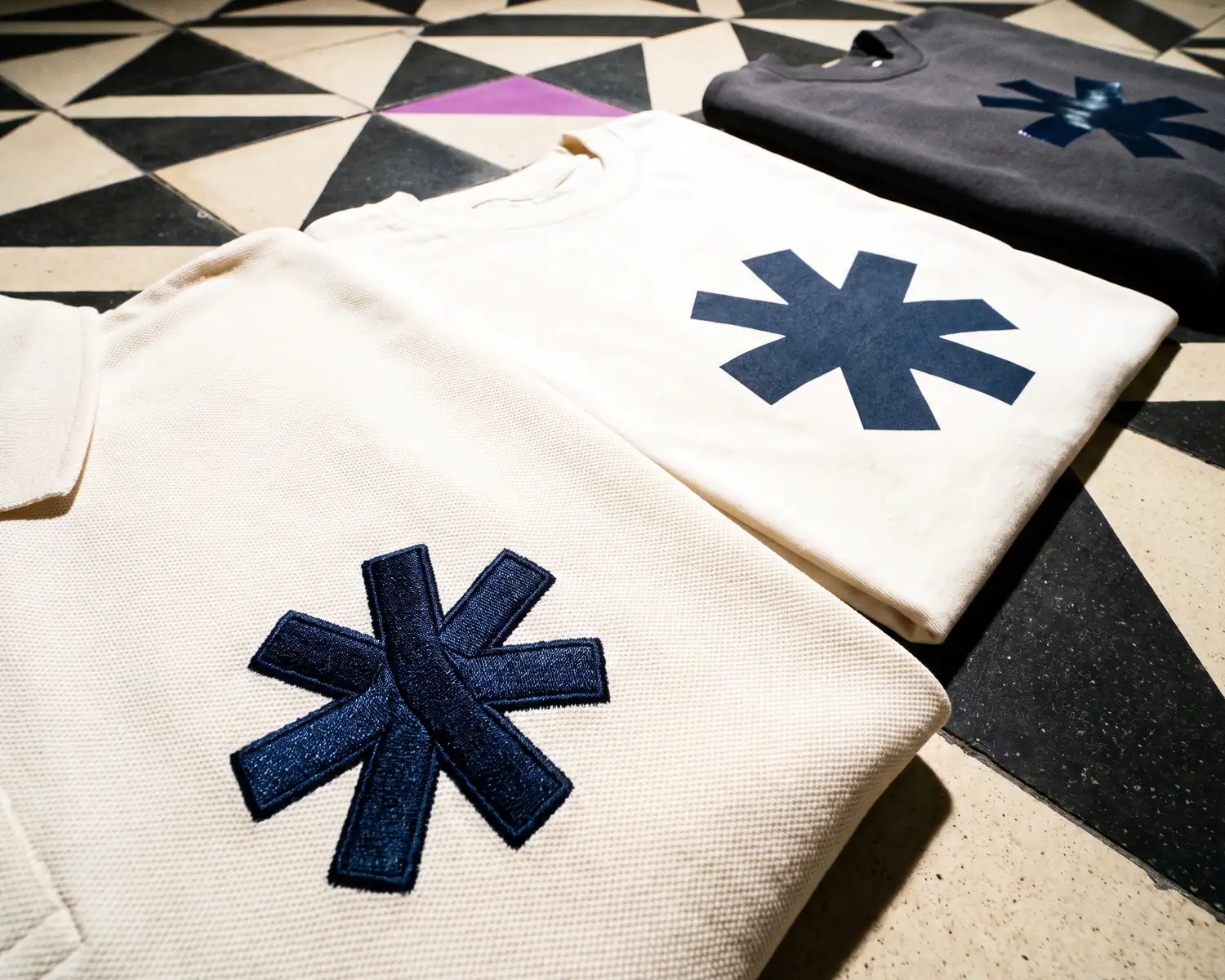
Embroidery replaces ink with thread: the logo is stitched directly into the fabric by an embroidery machine following a program, created from your vector file during digitizing.
- Quantity: from 10 pieces with us. The fixed cost is digitizing the logo into an embroidery program, paid once; after that each piece stitches quickly.
- Fabric: excellent on dense, structured materials: polos, shirts, sweatshirts, jackets, caps. On a very fine fabric it needs proper backing so it does not pucker.
- Finish and durability: this is the marking that ages best. Thread does not crack and does not peel off, and the relief immediately signals quality. On an outfit worn in front of clients, it is the dressiest finish.
- The point to watch: it likes neither tiny details nor gradients. A logo with very small text has to be simplified to stay readable in thread.
Who it is for: client-facing teams (front desk, hospitality, retail, professional practices), team polos and shirts, every outfit meant to last for seasons.
DTF transfer: the all-rounder of medium runs
DTF transfer (direct to film) prints your design digitally onto a film, dusts it with a heat-activated adhesive, then transfers it onto the garment with a heat press.
- Quantity: from 10 pieces with us. No screen to prepare, so no fixed cost per color: small volumes stay affordable.
- Fabric: very broad, cotton as well as polyester and blends, which makes it the go-to solution when one order mixes several types of garment.
- Finish and durability: digital printing allows as many colors as you want, gradients and photos included, with good sharpness. Wash resistance is solid when the application is done properly.
- The point to watch: the design sits ON the fabric, so you feel it slightly on large areas. For a very large design across the back, the hand feel is less natural than with screen printing.
Who it is for: orders of 10 to 50 pieces, multicolor logos, projects mixing several different garments in the same order.
Direct digital printing (DTG): single pieces and restocks
DTG printing (direct to garment) prints the ink straight into the fibers of the garment, the way a printer would work on paper.
- Quantity: from 1 piece with us. It is the only technique with no setup cost at all: it makes the single piece possible.
- Fabric: made for cotton and mostly-cotton textiles; on mostly polyester, it is not the right route.
- Finish and durability: the ink penetrates the fiber, the hand feel stays soft and the design can be as detailed as a photograph.
- The point to watch: on very large runs it loses its cost advantage against screen printing.
Who it is for: the sample before the run, restocking one or two pieces when someone joins the team, small cotton volumes.
The special cases worth knowing
- Sublimation: the ink turns into gas and becomes part of the fiber. It only works on light-colored polyester, but it allows a design covering the whole garment, with no color limit and no added thickness. It is the technique behind fully printed jerseys and event outfits.
- What the market still calls "flocage": historically a velvety material cut out and pressed onto the textile. You will see the word used, often wrongly, for any heat-applied marking. If a quote mentions it, simply ask which technique it actually means: digital printing, transfer, or cut vinyl.
Textile marking techniques in one table
| Screen printing | Embroidery | DTF transfer | DTG printing | |
|---|---|---|---|---|
| Threshold | from 25 pieces | from 10 pieces | from 10 pieces | from 1 piece |
| Fabrics | cotton, blends, broad | dense: polos, shirts, sweatshirts, jackets | very broad, cotton and polyester | cotton and mostly cotton |
| Colors | charged per color, bold tones | in thread, simplified logo | unlimited, gradients included | unlimited, photos included |
| Finish | opaque ink layer | thread relief, premium | crisp, sitting on the fabric | soft, inside the fiber |
| Wash resistance | very good | excellent | good | good |
| Home ground | the large run | the dressed-up team outfit | mixed medium runs | single pieces and restocks |
Choosing in three questions
The short method, in order:
- How many pieces, really? This is the minimum order quantity question. Under 10, direct digital printing is your way in. Between 10 and 25, embroidery and DTF transfer open up. Above 25 with a simple logo, screen printing becomes the most economical, and the gap widens as you go up.
- What level of dress? An outfit facing clients all day long deserves embroidery. A garment for an event or a community works perfectly well with printing.
- How many colors, and what kind of design? A one or two color logo goes everywhere. A gradient or a photograph rules out embroidery and simple screen printing straight away: head for digital.
A concrete example, the one I see most often: 40 polos for a front-desk team, two-color logo, worn all year. Answer: embroidery. The volume makes it affordable, the finish matches the level of the outfit, and it is the marking that will best survive two years of weekly washing. Another frequent case: 150 t-shirts for a festival, one-color logo, worn over one intense weekend. Answer: screen printing, without hesitation.
What really changes the price
Three levers, and none of them is the name of the technique:
- The number of colors in screen printing: each color adds a screen and a setup. A logo designed in two colors structurally costs less than a logo in five.
- The number of placements: a chest logo alone does not cost the same as a chest plus a back plus a sleeve. Each placement is one more pass through the machine.
- The quantity bracket: the price per garment drops in brackets. That is normal and healthy, but never order 100 pieces for a team of 60 just to reach a bracket.
And the comparison rule that applies to every quote you will receive: never compare a garment price and a marking price separately. The only honest figure is the price of the marked garment, delivered, for your quantity. That is why the prices in our catalog are displayed marking included up to 1,000 pieces: you know what you are paying before you commit, not at the third exchange of emails.
What to remember
There is no best marking technique, there is the technique that matches your quantity, your fabric, your use and your budget. Screen printing rules the large run, embroidery the team outfit that must last and look good, DTF transfer the multicolor medium runs, digital printing the single piece and the restock. Ask yourself the three questions in order, request a marked sample before launching the run, and insist on a price with marking included: with that, no marking quote can surprise you again.
Frequently asked questions
What is the difference between screen printing and transfer?
Screen printing lays ink directly onto the fabric through a screen, one color at a time: it pays off in a run and gives very opaque solid areas. Transfer first prints the design onto a film, then applies it with heat: it allows an unlimited number of colors and stays affordable in small quantities.
Which marking technique holds up best in the wash?
Embroidery: the design is stitched into the fabric, so it does not crack and does not peel. A well-made screen print also survives dozens of washes. In every case, the lifespan of a marking also depends on care: wash inside out, no bleach, and never iron directly on a print.
Which technique should you choose for a multicolor logo or a photograph?
The digital ones: DTF transfer and direct printing (DTG) reproduce gradients and photographs with no extra charge per color. Embroidery, by contrast, requires a simplified logo, and screen printing charges each color separately.
What is the minimum number of pieces to have garments marked?
It depends on the technique: from 1 piece in direct digital printing, from 10 in embroidery and DTF transfer, from 25 in screen printing. A small team is therefore blocked by no threshold: the technique adapts to the quantity, not the other way around.
Embroidery or printing for a company logo?
Embroidery if the outfit is worn in front of clients and has to last: its relief gives the dressiest finish. Printing is better if the design is large, multicolor, or if the garment has a shorter life (an event, a one-off operation). The level of dress of the outfit decides almost every time.
Your project, quoted within 24 hours.
Describe your garments, your decoration and your quantities: you receive a detailed quote, decoration included, within one business day.