Printing a photo on a t-shirt: the resolution and the real result
To print a photo on a t-shirt and have it come out sharp, you need at least 300 dots per inch at its real size: 2,480 × 3,508 pixels for an A4. DTF transfer renders it on any t-shirt colour, DTG printing more softly on light cotton. At tknp.io, a printed run starts at 10 t-shirts.
The photo is what makes people keep a t-shirt long after the event: the face at a 50th birthday, the team photo of the season on the club's merch, the group of friends at a hen party, an association's mascot. It still has to come out sharp, at the right size, without the organiser fronting everyone's money. Here is how to prepare the file, choose the method, read the prices and organise the order.
What resolution do you need to print a photo on a t-shirt?
A photo prints sharply if it has at least 300 dots per inch at its real size on the t-shirt. So it is the image's pixel count that decides: for an A4 photo, you need 2,480 pixels wide and 3,508 high.
| Printed format | Size on the t-shirt | Pixels needed |
|---|---|---|
| A6 | 10.5 × 14.8 cm | 1,240 × 1,748 |
| A5 | 14.8 × 21 cm | 1,748 × 2,480 |
| A4 | 21 × 29.7 cm | 2,480 × 3,508 |
| Large format | 28 × 18 cm | 3,307 × 2,126 |
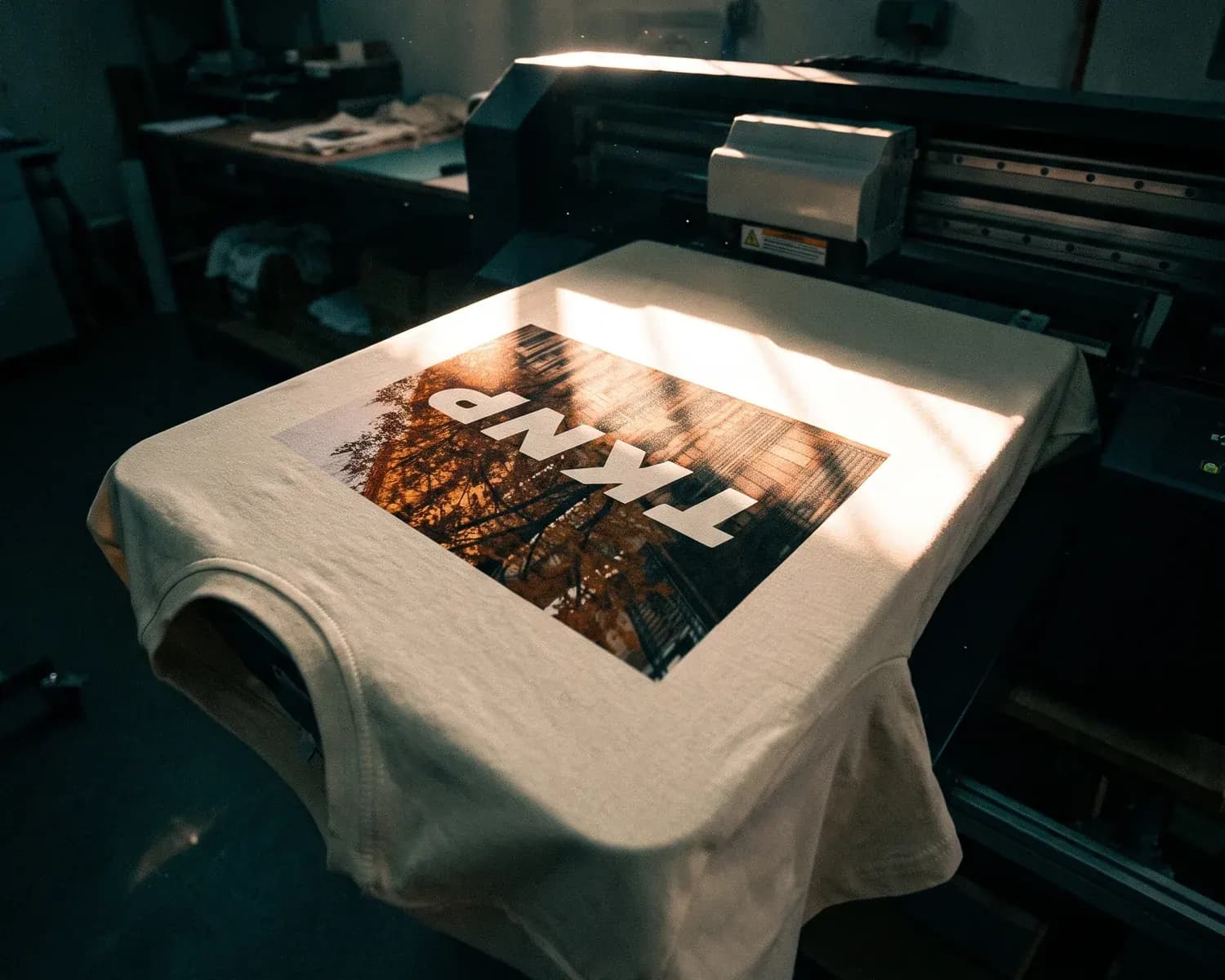
The last row matches the wave photo in our inspiration "White t-shirt printed with a wave photo": 280 × 180 mm across the chest, about 3,300 pixels wide. The 300 dots per inch threshold is the same as for a logo, as our article on file formats for textile printing points out. One big difference, though: a blurry logo can be redrawn as vectors (here is how to vectorize a logo); a photo cannot. Everything depends on the original.
Is a photo taken with a phone good enough?
Yes, if it is at full resolution: a 12-megapixel photo in 4:3 format measures 4,032 × 3,024 pixels and covers an A4 with room to spare; its resolution shows in the file's details. The trap is the copy. A photo sent through a messaging app or saved from a social network has often been shrunk along the way: ask the person who took it to send you the original file, never a screenshot.
What size should the photo be on the t-shirt?
For a photo, A4 on the back is the right starting point: below that, the faces in a group photo become too small to recognise from a few steps away. A6, on the left chest, works for a simple, tight photo, a portrait or a pet, not for a team of fifteen.
Two settings avoid the sticker effect:
- Isolate the subject: a rectangular photo placed as it is looks like a patch. The tknp.io designer accepts a PNG, JPG, WebP or SVG of up to 10 MB, and its background removal button works on a plain background. On a photo taken against a real setting, it warns you itself that automatic removal is impossible and asks for a PNG that is already transparent. So cut out the subject before sending, or keep the rectangle for a real group photo, where the setting matters.
- One design per placement: each t-shirt carries no more than two prints, both in the same method. The photo on the back and, on the left chest, the date of the event or the name of the person being celebrated, the same across the whole run, make a readable set; two photos competing for attention do not.
Playing with the logo over the photo
A style is coming back into fashion on photo t-shirts: the club's, association's or event's logo laid large over the middle of the photo, in solid white letters or see-through, like a watermark. The photo stays visible around the logo, and the t-shirt goes from a simple keepsake to a garment people want to wear. The layout is prepared before sending: place the logo, lower its opacity if you want the faces to read through it, then merge it into the photo so you send a single image, printed as one.
DTF, DTG or sublimation: what does a photo really look like?
On a light cotton t-shirt, DTG printing gives the photo the softest feel; on a dark t-shirt, or on blended fabrics, DTF transfer wins; sublimation only works on light polyester. All three print the photo in full colour with no extra cost per colour, which screen printing cannot do: its technique page notes that photo gradients are difficult. Here is what our technique pages say, as read on 9 November 2026.
| Method | What the photo becomes | On which t-shirt | How to order it |
|---|---|---|---|
| DTG printing | Photo-realism and smooth gradients, almost no feel on light cotton | Cotton and cotton-rich blends | On quote, proposal within one working day |
| DTF transfer | Unlimited colours and clean edges, a light film-like touch on big solid areas | Almost any fabric and colour | Online, from 10 |
| Sublimation | No feel at all, the ink is inside the fibre | Light polyester only, never cotton or dark fabric | On quote, 6 items in the catalogue |
The real result of a large photo as a DTF transfer shows on the wave inspiration mentioned above: the transfer keeps every shade of turquoise, from the foam to the hollow of the wave, and stays soft on the cotton. Its page also gives the advice that matters: a sharp, bright, high-definition photo, and no dark or low-contrast picture. Our DTF or DTG comparison details the durability of both methods; sublimation printing on textile has its own article, for anyone printing on a polyester sports t-shirt.
How much does a custom t-shirt with a photo cost?
At 10 units, a Stanley/Stella Creator 2.0, in organic cotton and in its base colour, white, costs €7.72 excluding VAT blank at tknp.io, and €12.64 excluding VAT with an A6 photo as a DTF transfer, on the left chest; at 100 units, this photo t-shirt drops to €8.77 excluding VAT. With the photo large across the chest (280 × 180 mm), the same t-shirt comes to €14.85 excluding VAT at 10 units and €10.15 at 100.
| Creator 2.0, white, price per t-shirt excluding VAT | 10 t-shirts | 50 t-shirts | 100 t-shirts | 250 t-shirts |
|---|---|---|---|---|
| Blank | €7.72 | €7.14 | €6.89 | €6.41 |
| A6 photo on the left chest, DTF transfer | €12.64 | €9.46 | €8.77 | €8.17 |
| 280 × 180 mm photo across the chest, DTF transfer | €14.85 | €10.67 | €10.15 | €9.02 |
Prices taken on 9 November 2026 and given for guidance only: the first two rows from the Creator 2.0 product page, the third from the wave inspiration page. Each price covers a single placement, the base colour (white here), a standard size and two weeks of lead time (the standard), without shipping or VAT; the larger sizes and a few shades cost a little more, and the quote is what counts, as the product page says. DTG printing, for its part, is priced on quote for this model.
A run starts at 10 printed t-shirts of one model, all sizes and colours combined; blanks can be ordered from a single unit.
Can you print any photo on a t-shirt?
No: you need the written consent of each person recognisable in the photo, and that of whoever took the photo, professional or not. The French government's public service website puts it plainly: written consent is required to use an image in which a person is recognisable, and that consent specifies the medium, the purpose and the duration.
For a group's t-shirts, the rule fits in one message: each person in the photo confirms in writing that they are happy to see it on the t-shirt. It is quick, and it avoids awkwardness on the day. As for the photographer, a photo belongs to whoever took it: the French Intellectual Property Code (article L111-1) gives them an exclusive right over their work, simply because they created it. A wedding portrait taken by a photographer, like a team photo taken by a club parent, therefore needs its author's permission before it is printed.
When should you order the group's photo t-shirts?
With a photo t-shirt, the time is mostly lost before the order: tracking down the photo's original file, getting written consent from each recognisable person, then collecting the sizes. Start there; after that, at the standard lead time, the t-shirt's product page counts 10 working days from the order to customise it, and the article on production lead times covers the rest, transport and options included.
A pre-order so everyone pays for their own photo t-shirt
The headache of a group order is not the photo: it is the organiser fronting the money for twenty people and chasing their sizes. For a club, a non-profit or a business, the tknp.io Store pre-order solves both: for 7 to 21 days, each member or teammate reserves their size and pays for their t-shirt online, then the run is produced in one go, at the price of the volume reached. Each t-shirt in the campaign has its threshold: below it, it switches to another method at the same price when possible, otherwise everyone is refunded in full.
Opening the Store and publishing the campaign costs nothing; the Store is open to verified organisations. The t-shirts reach you roughly three weeks after closing, each in a bag with the person's name, and sizes cannot be exchanged: a useful reminder in the invitation message. For a birthday, a family reunion or a hen party, the organiser places the order themselves, from 10 t-shirts.
Frequently asked questions
Can you print a photo on a black t-shirt?
Yes, ideally with a DTF transfer: it works on almost any t-shirt colour and, on a dark t-shirt, costs less than DTG printing at every quantity. Choose a bright photo: a dark face gets lost on a black background.
Does a printed photo hold up in the wash?
Yes: our technique pages rate wash durability "very good" for DTF transfer and DTG printing, and "excellent" for sublimation; our DTF or DTG comparison, linked above, details the first two.
Can you order a single t-shirt with a photo?
No: at tknp.io, printed t-shirts have a minimum order of 10 of the same model. Blanks can be ordered from a single unit, but a one-off photo t-shirt, as a gift, is not what we do.
Which file format should you send for a photo?
A JPG for a complete photo, with its background; a transparent PNG if the subject is cut out. Files go into the tknp.io designer as PNG, JPG, WebP or SVG, 10 MB at most, and it only removes a plain background by itself.
Your project, quoted within 24 hours.
Describe your garments, your decoration and your quantities: you receive a detailed quote, decoration included, within one business day.