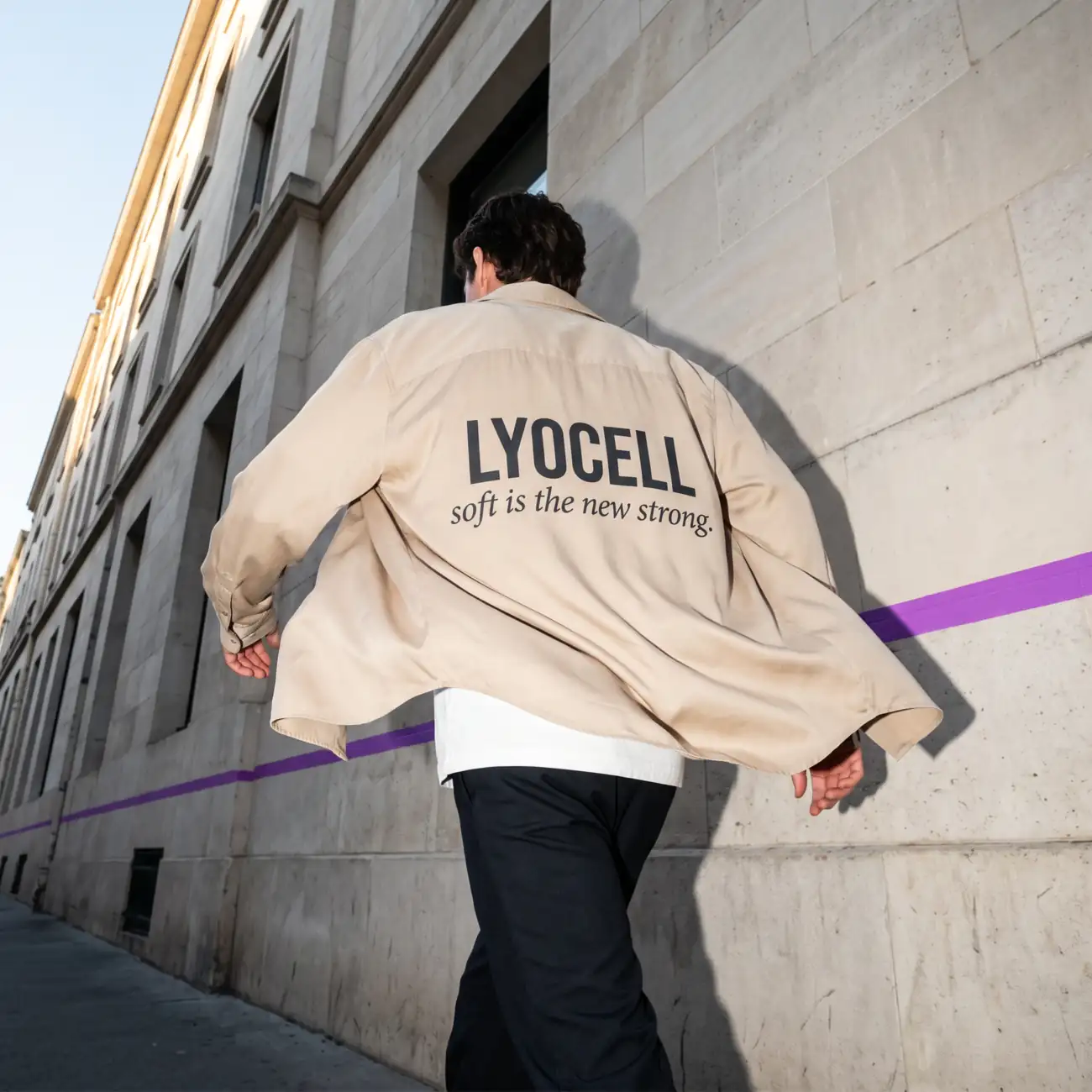
Lyocell is a regenerated cellulosic fiber, made from wood pulp with a non-toxic solvent in a quasi-closed loop. Tencel is its best-known brand. Soft, breathable and resistant, including when wet, it fixes viscose's flaws, at a higher price.
The essentials in 4 points:
- Tencel is not a fiber: it is the brand of the lyocell produced by Lenzing. On the composition label, the fiber is called lyocell.
- It fixes viscose: resistant even wet, washable regularly, clean quasi-closed-loop process.
- Facing cotton: better on moisture, softness and thermoregulation; cotton keeps the price, easy care and catalog availability.
- The buying rule: lyocell is paid at purchase and repaid in wear; the cotton/lyocell blend is the best compromise.
Lyocell is probably the fiber you will hear about most in the next five years, and the one surrounded by the most approximations: Tencel here, improved viscose there, miracle fiber everywhere. Let's put things in order, buyer's side: what lyocell really is, what it fixes, what it costs, and when it deserves a place in an order.
What is lyocell? The definition in a nutshell
Lyocell is a new-generation regenerated cellulosic fiber: like viscose, it starts from a plant material (wood pulp, often eucalyptus), transformed into yarn. The difference is the process: lyocell is made with a non-toxic solvent, in a quasi-closed loop where the solvent is recovered and reused, instead of the heavy chemistry of classic viscose. That is what earns it its reputation as an ecological fiber.
And the precision almost everyone gets wrong: Tencel is not a fiber, it is a brand. Tencel is the commercial name of the lyocell produced by the Austrian company Lenzing, the best-known manufacturer. On a composition label, the fiber is called lyocell; Tencel simply says who produced it, like a label of provenance.
What lyocell fixes about viscose
If you have read our viscose factsheet, you know its structural weakness: fragile when wet, it handles repeated washing poorly. Lyocell was born to fix that, and it does:
- It is resistant, including wet. Where viscose loses its strength in water, lyocell keeps it: it washes regularly without drama, and that is what makes it suitable for a garment worn often.
- It warps little and wrinkles less. The drape stays fluid, but the garment holds its shape over the washes.
- It is cleaner to produce. Renewable raw material AND a quasi-closed-loop process: the cellulosic fiber a responsible-purchasing argument can quote without blushing.
In short: lyocell delivers what viscose promised, the softness and drape of a plant fiber, with an endurance viscose never had.
Facing cotton: the real match
The title of this factsheet is no accident: a buyer's real question is not "lyocell or viscose" (lyocell wins), it is "lyocell or cotton".
What lyocell does better than cotton:
- Moisture management. A naturally breathable fiber, it absorbs and wicks perspiration better: a real plus for a garment worn all day, in a heated environment or in summer.
- Softness. The hand feel is silkier than a standard cotton, close to a high-end combed cotton.
- Thermoregulation. Cool when it is hot, fine when it is mild: the fiber adapts, where cotton holds moisture.
- Less wrinkling than a cotton poplin at equal weight.
What cotton keeps:
- The price. Lyocell costs noticeably more, and on a volume order the gap multiplies by the number of garments.
- Care familiarity. Cotton forgives almost everything; lyocell prefers gentle washes and air drying, even if it is far less demanding than viscose.
- Availability. Professional catalogs remain dominated by cotton and blends: 100% lyocell references are still rare, you mostly meet it in blends (cotton/lyocell), where it brings its softness and moisture management at a contained price.
The verdict for a volume order
Whether you outfit a team year-round or a group for a season, the lyocell question is a question of whether the extra cost pays off:
- Where it is justified: garments worn long and close to the body, where comfort is felt every hour: the premium tee, the front-desk shirt, the base layer of physical jobs. And in a responsible purchasing approach, it plays alongside organic cotton: two fibers that keep the promise, each on its own ground (organic cotton for everyday basics, lyocell for technical comfort and fluidity).
- The best compromise: the cotton/lyocell blend, which raises a garment's softness and moisture management without doubling its price. That is the mention to look for on the composition label of premium references.
- Where it is not justified: large event runs on tight budgets and garments under intense strain, where polyester and poly-cotton blends remain unbeatable in use-to-price ratio.
The simple rule: lyocell is paid at purchase and repaid in wear. The more hours the garment will be worn, the more rational its extra cost becomes.
Our advice for custom apparel
Let's speak frankly, as a supplier: if your project is a custom garment that must carry your logo and last, the core of your order plays out in the safe bets of the catalog. Organic and combed cotton (the Stanley/Stella references first) for the tees, polos and sweatshirts where embroidery and printing give their best; poly-cotton for wash endurance; technical polyester for sports and the field.
Lyocell, in this picture, is the refinement, not the foundation: look for it in a cotton/lyocell blend to raise the comfort of a premium tee or shirt, and prefer a light print on it (the small embroidered or printed chest logo) rather than a large solid: a fluid fiber rewards discretion. That is exactly the kind of trade-off we make with you when choosing references.
Caring for lyocell in three moves
Less demanding than viscose, more delicate than cotton: lyocell is easy to manage with three reflexes, to pass along with the garments.
- Wash at 30 degrees, normal or gentle cycle: it takes it regularly, that is its whole difference with viscose.
- Air drying preferably: the tumble dryer is not its friend over time.
- Gentle ironing if needed: it wrinkles little, most of the time a light steam is enough.
A connoisseur's detail: badly treated (washes too hot, aggressive friction), lyocell can fibrillate, a light fuzzy veil on the surface. Quality references are treated against this flaw: one more thing to check on a sample.
What to remember
Lyocell is the accomplished cellulosic fiber: the softness and drape of the viscose family, resistance on top, a clean process as a bonus, the price as the counterpart. Keep the hierarchy for your orders: viscose for occasional show, lyocell (pure or blended) for durable comfort worth its extra cost, cotton and its blends for everything else. And remember the nuance that sounds sharp in a meeting: Tencel is a brand, lyocell is the fiber.
As always: judge on a sample, after a real wash. A beautiful fiber is recognized garment in hand, and a good supplier puts the fabric in your hands before the order, not after.
Frequently asked questions
What is the difference between lyocell and Tencel?
None on the fiber side: Tencel is the commercial name of the lyocell produced by the Austrian manufacturer Lenzing, the best known on the market. On a composition label, the fiber is called lyocell; Tencel simply indicates who produced it.
Lyocell or cotton: which to choose?
Cotton and its blends for the foundation of an order: controlled price, easy care, wide availability, proven print results. Lyocell when comfort pays off: garments worn long and close to the body, moisture management, premium softness. The cotton/lyocell blend combines both.
Can lyocell go in the washing machine?
Yes, and that is its big difference with viscose: it takes regular washes at 30 degrees. Two reflexes to make it last: air drying rather than the tumble dryer, and a gentle steam if needed.
Is lyocell really ecological?
It is one of the cleanest fibers to produce: a renewable raw material (wood pulp) and a non-toxic solvent recovered in a quasi-closed loop. As always, the quality of the reference and its lifespan matter as much as the fiber: a durable garment is first a garment you keep.
Can you customize a lyocell garment?
Yes, but go straight for a light print: a small embroidered or printed chest logo, never a large solid on a fluid fiber. And let's be frank: lyocell adds complexity to a project. For a custom garment that must carry your logo and last, the catalog's safe bets (organic cotton, poly-cotton) remain the best starting point; keep lyocell for the premium touch, in a cotton/lyocell blend.
Your project, quoted within 24 hours.
Describe your garments, your decoration and your quantities: you receive a detailed quote, decoration included, within one business day.