Fleece is the thick, soft knit of sweatshirts. Two insides exist: french terry, with its visible loops, dry and breathable, the three-season sweatshirt; and brushed fleece, with its soft fuzz, warm and cozy, the winter inside. Always cross-check with the fabric weight to judge a sweatshirt.
The essentials in 4 points:
- All sweatshirts are fleece: the real question is the inside, french terry (loops) or brushed (fuzz).
- French terry is dry, neat and breathable: the choice for a sweatshirt worn year-round in heated interiors.
- Brushed fleece is warm and soft: the one people love to pull on, for winter and comfort.
- The inside gives the character, the fabric weight gives the substance: read both together on the product page.
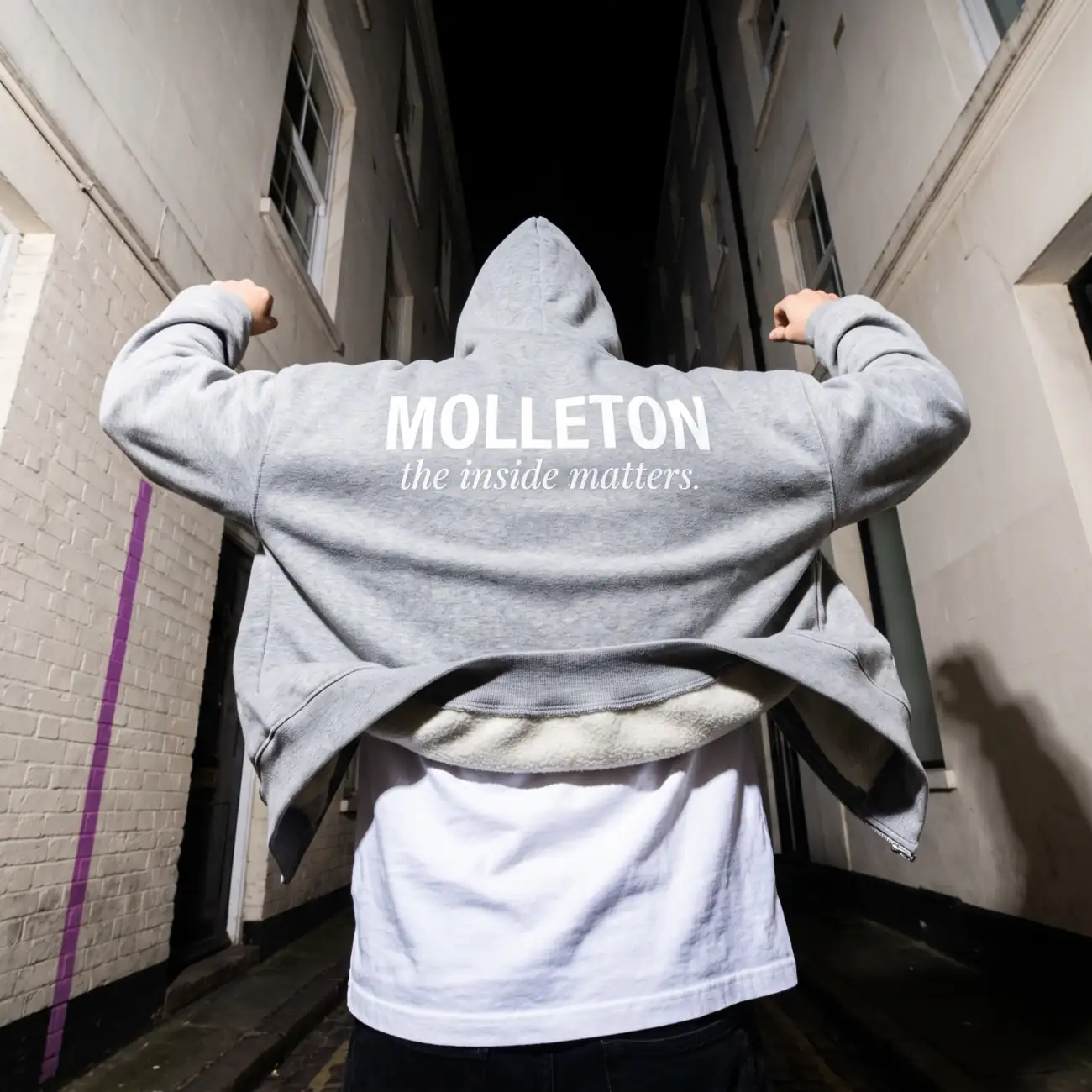
Turn any sweatshirt inside out: what you see inside decides half of what you are buying. Visible loops or a fuzzy surface, that is the whole difference between a mid-season sweatshirt and a winter cocoon, between the garment a team wears on shift and the one a group keeps for cool evenings. And yet, on product pages, these two worlds hide behind words nobody explains: french terry, brushed fleece, loopback.
Let's translate. It is simpler than it looks, and it changes your orders.
What exactly is fleece?
Fleece is the fabric of sweatshirts: a thick, soft knit, most often cotton or a cotton/polyester blend, with an inner face worked for comfort. It is what makes a sweatshirt a sweatshirt, crewneck or hoodie, and not a thick t-shirt.
One disambiguation, to avoid a common confusion: the "fleece" sold by the meter for quilt padding and sewing (batting or wadding) is a different product. Here we are talking about garment fleece, the one in your sweatshirts and hoodies.
And a buyer's real question is not "fleece or not": all sweatshirts have it. It is: which inside? There are two schools, and they do not serve the same uses.
French terry: the loops
Turn the sweatshirt inside out: if you see fine, regular loops (the "loops" of the English loopback), it is french terry. The yarn's loop is left intact on the inside.
What it gives when worn:
- More breathable and drier: the loops create air and absorb moisture: the inside of sweatshirts worn on the move, in mid-season, in heated spaces.
- A firmer hand: the fabric has body, it holds itself, it gives clean silhouettes.
- Healthy aging: no fuzzy surface to flatten: french terry ages straight.
It is the inside of three-season sweatshirts, and the one you find on many premium references.
Brushed fleece: the fuzz
The same fabric to start with, but the inside goes through brushing: the fibers are mechanically raised to create that fuzzy, soft, insulating surface, the "cocoon" you pull on when you get home.
What it gives when worn:
- Warmth: the air trapped in the fuzz insulates: the winter inside par excellence.
- Immediate softness: the cozy feeling from the first try-on: a real argument when the garment must create desire.
- The point of care: on entry-level qualities, the fuzz can flatten or pill over the washes; on good references, the brushing is dense and lasts for years. Once again, the sample decides.
How to choose for your order
The simple rule, by use:
- For a sweatshirt worn year-round in heated interiors (service, front desk, office): french terry. Drier, neater, it goes through seasons and regular washes without flattening.
- For warmth and comfort (terrace work, outdoors, event evenings, the hoodie given to mark the occasion): brushed fleece. It is the one people love to pull on, and that desire is what keeps a logo alive.
- When in doubt, cross-check with the fabric weight: a 280 gsm french terry can be warmer than a thin 240 brushed fleece. The inside gives the character, the fabric weight gives the substance: read both together on the product page.
One last reflex: serious catalogs state the construction in black and white on their product pages ("french terry", "brushed fleece", the weight in gsm). If a page does not say it, ask: it is basic information, not an industrial secret.
The product-page mini-glossary
Catalogs mix French and English: here is the translation table to read any page without hesitation.
- French terry / loopback: the inner loops: the dry, neat sweatshirt described above.
- Brushed fleece: the inner fuzz: the warm, soft version.
- Three-thread fleece: a dense construction, that of heavy high-end sweatshirts: often combined with brushing for thick winter hoodies.
- Fabric weight (gsm): the weight of the fabric, to read systematically with the construction: the duo that tells a sweatshirt's truth.
What to remember
The inside of a sweatshirt is not a connoisseur's detail: it is the first comfort criterion, therefore the first criterion of a garment people actually wear. Keep the duo: french terry = loops, dry and neat, three seasons; brushed fleece = fuzz, warm and cozy, winter and comfort. Cross-check with the fabric weight, verify on a sample that the brushing holds, and choose by the real use of your team or your group: the garment people pull on without thinking is the one that keeps a logo alive.
Frequently asked questions
What is french terry?
French terry (or loopback) is a fleece whose inside keeps its fine yarn loops visible. The result: a sweatshirt that is drier, more breathable and neater than a brushed fleece, ideal in mid-season and heated interiors.
Brushed or unbrushed fleece for a hoodie?
Brushed if the hoodie must keep warm and give that cozy feeling people love: the choice for winter and for hoodies given as gifts. Unbrushed (french terry) if the hoodie is worn year-round, on the move, indoors: it stays dry and ages straighter.
Does fleece pill?
French terry very little: its loops age well. Entry-level brushed fleece can pill or flatten over the washes; on good references, the brushing is dense and lasts for years. A point to judge on a sample, after a real wash.
What is the difference between fleece and polar fleece?
Two distinct families: sweatshirt fleece is a mostly-cotton knit, the one of sweatshirts; polar fleece is a 100% polyester knit with synthetic fuzz on both faces, lighter and more insulating, the one of warm jackets. A hoodie is sweatshirt fleece; a team's outdoor jacket is often polar fleece.
Which fleece for a custom sweatshirt?
Start from the use: french terry for the team sweatshirt worn year-round, brushed fleece for warmth and desire. On the printing side, both take embroidery and printing very well: the fabric weight and construction make the difference in render, to check on the product page.
Your project, quoted within 24 hours.
Describe your garments, your decoration and your quantities: you receive a detailed quote, decoration included, within one business day.