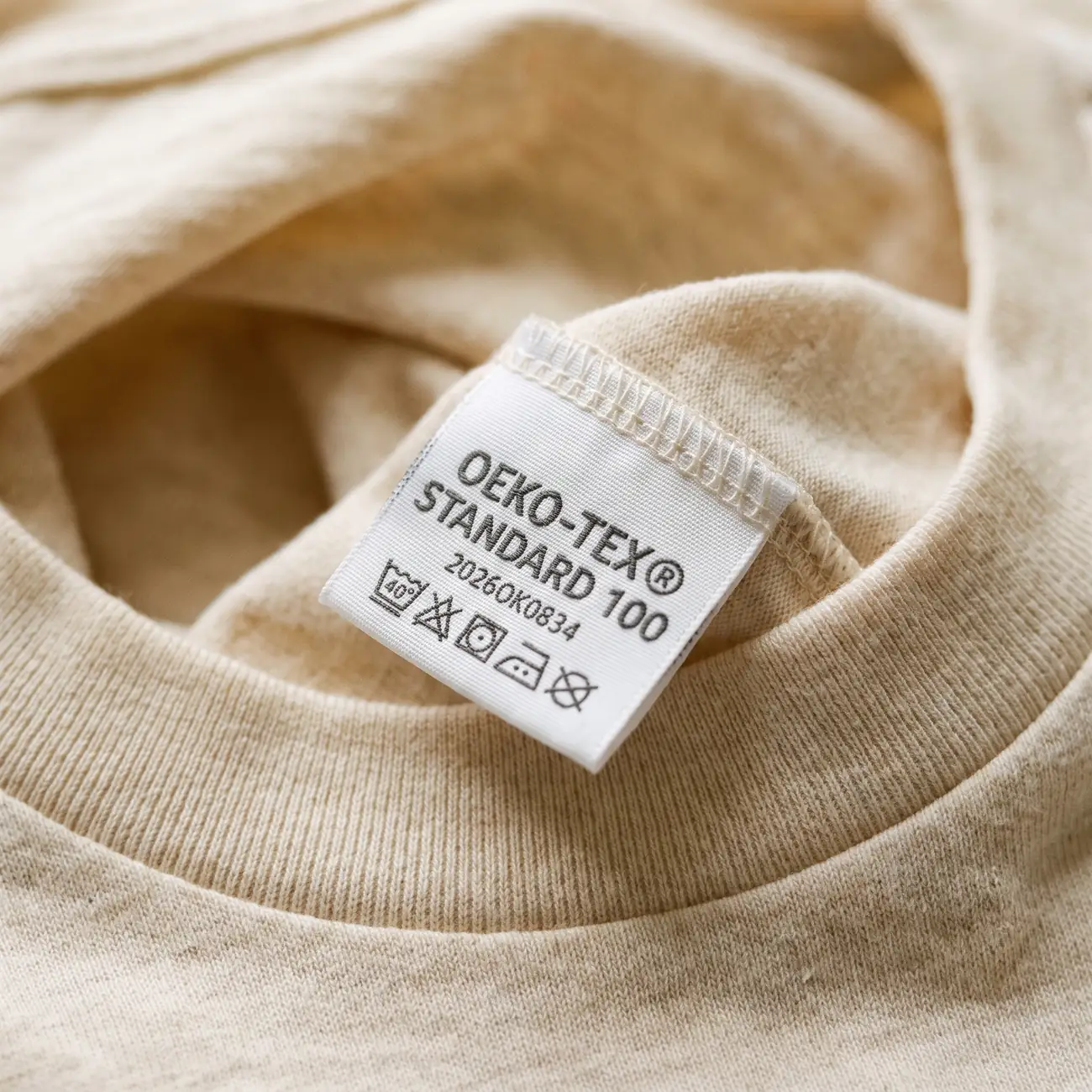
Oeko-Tex Standard 100 is a label certifying that a finished textile, tested by an independent laboratory, contains no substances harmful to health. It guarantees neither an organic fiber nor an ecological production process: it is a guarantee of harmlessness, renewed every year and verifiable online.
The essentials in 4 points:
- Certification covers the finished product and all its components: fabric, sewing thread, buttons, zipper.
- For team apparel worn against the skin (t-shirts, polos, shirts), the class that matters is Class II.
- The label says nothing about organic, ecological or social criteria: that is GOTS territory. Since April 2025, it no longer includes any organic cotton claim.
- Every certification can be verified in one minute: certificate number from your supplier, checked on the official Label Check tool, valid for one year.
You are preparing an order of custom apparel for your team, and the Oeko-Tex Standard 100 label appears on half the product pages. Your management asks for guarantees, your employees will wear these garments all day long, and you have to answer one simple question: does this label actually mean something, or is it one more logo on a tag?
Short answer: it means something precise, and it is probably not what you think. This guide explains what Standard 100 really guarantees, what it does not, and how to verify it before signing an order.
What exactly is Oeko-Tex Standard 100
Oeko-Tex Standard 100 is a label controlling harmful substances in textiles. Created in 1992, it certifies that a textile article has been lab-tested by an independent institute and does not contain substances dangerous to health beyond strict thresholds: heavy metals, formaldehyde, pesticides, allergenic dyes, among others.
The point many buyers miss: certification covers the finished product and every one of its components. The fabric, but also the sewing thread, the buttons, the zipper, the tag. If an article is Standard 100 certified, the whole assembly passed the tests, not just the main material.
It is one of the most widespread labels in global textiles, which is both its strength (widely audited, comparable) and its limit (it does not single out the best, it rules out the bad).
What the label guarantees, and what it does not
This is where your internal credibility is decided. Let's be clear.
What Standard 100 guarantees:
- The absence of harmful substances beyond defined thresholds, tested on the finished product.
- Tests by usage class: the more skin contact a garment has, the stricter the thresholds.
- Control by independent institutes, with certification renewed every year.
What it does NOT guarantee:
- That the textile is organic. A Standard 100 certified polyester is still polyester. Since April 2025, the certification no longer includes any "organic" or "GMO-free" cotton claim (Oeko-Tex official communication).
- That production is ecological. The label tests the product, not the footprint of the supply chain.
- That social manufacturing conditions are controlled. That ground belongs to other labels, GOTS first.
In other words: Oeko-Tex Standard 100 is a health label, not an ecological or ethical label. Saying this clearly to your management beats overselling it: it is a guarantee of harmlessness for your team's skin, and that is already a lot for a garment worn 8 hours a day.
The 4 product classes: which one applies to team apparel
Standard 100 tests according to 4 classes, from strictest to most lenient:
| Class | Use | Examples | Requirement |
|---|---|---|---|
| I | Babies and children under 3 | Bodysuits, childcare textiles | The strictest |
| II | Direct skin contact | T-shirts, polos, shirts, underwear | Strict |
| III | No prolonged direct contact | Jackets, belts | Intermediate |
| IV | Furnishing materials | Curtains, tablecloths | The most lenient |
For team apparel, the class that matters is Class II: t-shirts, polos and shirts are worn against the skin, all day, every day. When checking a certificate, look at the stated class: an article certified in Class I or II amply covers daily-wear use.
Why this label matters in a team order
For a consumer, Standard 100 is a comfort. For an employer, it is a three-level argument:
- The team's health. Your employees will wear these garments longer than any customer wears a t-shirt: 8 hours a day, 5 days a week, frequent washing. Substance safety is not a marketing detail, it is concrete care for the team.
- Answers to internal questions. Works council, HR, management: when someone asks "what exactly are we making the teams wear?", a verifiable certificate answers better than a supplier's promise.
- Tenders and procurement files. In a textile procurement spec, "Oeko-Tex Standard 100 certified articles" is an objective, verifiable criterion, comparable across suppliers. The kind of line that sorts offers without a debate.
How to verify a certification before ordering
This is the reflex that sets the professional buyer apart: never take a logo at face value.
- Ask the supplier for the certificate number for the exact reference you are ordering. A serious supplier provides it without hesitation.
- Check it on the official oeko-tex.com website (Label Check tool): validity, holder, product class. The verification takes one minute.
- Check the date. Certification is renewed yearly: an expired certificate guarantees nothing.
- Mind the scope. The certificate covers the blank textile article. The decoration added afterwards (inks, embroidery threads) belongs to the printer's process: ask the question if the topic is sensitive in your company.
At The Kosmos, catalog references display their certifications directly on the product pages, Standard 100 and GOTS depending on the range (see for example the Stanley/Stella Creator 2.0 product page): the information is verifiable before you order, not after.
Standard 100 is not alone: the Oeko-Tex family in brief
A point that confuses many procurement files: Oeko-Tex is a family of labels, not a single one.
- Standard 100: the one in this guide, harmful-substance control on the finished product. By far the most widespread.
- Made in Green: one step up. It builds on Standard 100 (tested product) and adds requirements on production sites (STeP label: working conditions and environmental management), with a traceability ID.
- Other variations exist (leather, chemicals) that rarely concern a team apparel order.
The simple reflex: when a product page says "Oeko-Tex", check which one. Nine times out of ten it is Standard 100, and that is fine, as long as nobody presents it as more than it is.
Oeko-Tex, GOTS, or both: how to decide
Both labels appear on most quality product pages, and they do not say the same thing:
- Oeko-Tex Standard 100: the finished product contains no harmful substances. All materials, synthetics included.
- GOTS: the fiber is organic (organic cotton first) AND the supply chain meets environmental and social criteria. It is a supply-chain label, more demanding and more expensive.
The buyer's call: Standard 100 is the reasonable baseline for any team apparel worn daily. GOTS comes on top when the company carries a stated CSR commitment and wants supply-chain proof, or when procurement requires it in a tender. Both together, on the same reference, are today's top tier.
The final word
Oeko-Tex Standard 100 is neither a gimmick nor a miracle label: it is a precise guarantee, the harmlessness of the textile touching your team's skin, controlled by independent laboratories and verifiable online in one minute. Demand the certificate, check the class, and never let it pass for an ecological label: knowing its limits is how you use it well.
Your team wears these garments 8 hours a day. The least you can do is know what is in them.
Frequently asked questions
Does Oeko-Tex Standard 100 mean organic?
No. Standard 100 guarantees the absence of harmful substances in the finished product, whatever the material: a certified polyester is still polyester. Since April 2025, the certification no longer includes any organic or GMO-free cotton claim. For an organic fiber and responsible supply-chain guarantee, the reference label is GOTS.
Which Oeko-Tex class for garments worn daily?
Class II, for articles in direct contact with the skin: t-shirts, polos, shirts. Class I (babies) is even stricter and therefore amply covers this use. Classes III and IV concern articles without prolonged contact and furnishing.
How do you verify an Oeko-Tex certificate?
Ask the supplier for the certificate number of the exact reference, then check it on the Label Check tool on the official oeko-tex.com website: validity, holder and product class are displayed. It takes one minute, and a serious supplier provides the number without hesitation.
Oeko-Tex or GOTS: which one to require for a team order?
They do not say the same thing: Oeko-Tex Standard 100 guarantees the harmlessness of the finished product, GOTS guarantees an organic fiber and a supply chain controlled on environmental and social criteria. Standard 100 is the reasonable baseline for any team apparel; GOTS comes on top when the company carries a stated CSR commitment.
How long is an Oeko-Tex certification valid?
One year. It must be renewed annually, tests included: an expired certificate no longer guarantees anything. It is the date to check systematically before an order.
What is the difference between Standard 100 and Made in Green?
Made in Green builds on Standard 100 (tested product) and adds requirements on production sites, with a traceability identifier. Standard 100 certifies the product; Made in Green certifies the product and its manufacturing.
Your project, quoted within 24 hours.
Describe your garments, your decoration and your quantities: you receive a detailed quote, decoration included, within one business day.