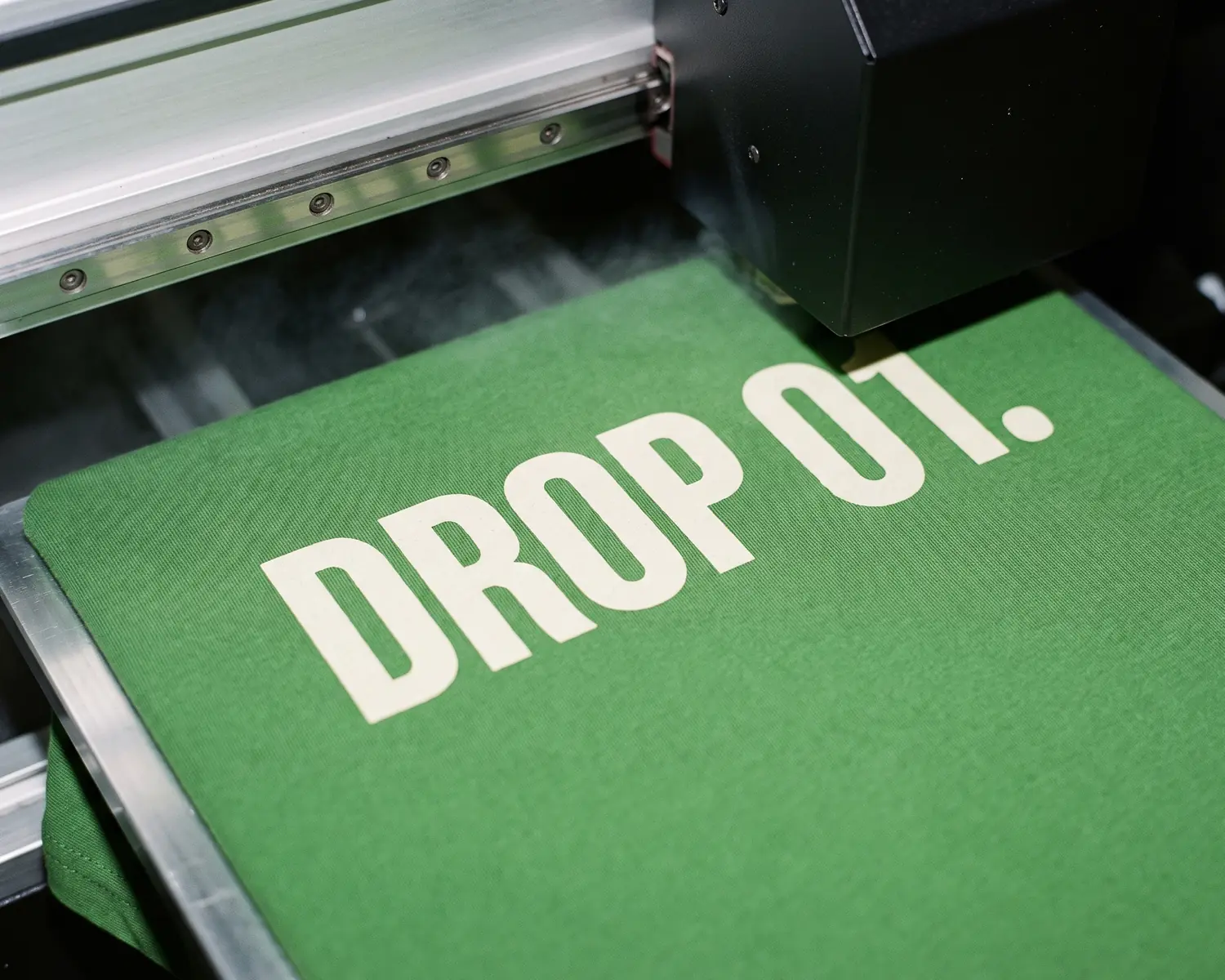
Print on demand (POD) is a made-to-order production model: the garment is only manufactured once it has been sold. No stock to finance, no minimum, from a single piece. In exchange, the unit price is higher than on a bulk order.
The essentials in 4 points:
- Nothing is produced until something is sold: no stock, no cash upfront, no leftovers.
- The threshold goes down to one piece thanks to digital printing. In volume, the other techniques keep their own minimums.
- The trade-off is the unit price, higher than on a grouped order. Price breaks still exist, by quantity tier.
- Print on demand is not dropshipping: you sell your own creation, not somebody else's catalogue.
Search for print on demand and you land on the same story repeated ten times over: build a brand, sell designs to strangers, make money while you sleep. That is a real use of the model, but it is not yours if you already have a community around you, a club, a student union, an association, an audience, a team.
In that case, print on demand is not there to find you customers: it is there to let you dress the people you already have without putting money up front. Here is how it works, what it costs, and when it is not the right tool.
What print on demand means
Print on demand translates as printing on demand. The principle fits in one sentence: production is triggered by the order, not before. You do not make a hundred sweatshirts hoping to sell them, you sell twelve and you produce twelve.
How it works, step by step
- You create. Your logo, your artwork, placed on existing catalogue products: t-shirts, hoodies, caps, accessories. Nothing to invest at this stage.
- You publish. Your products live in your Store, at an address you share in a group chat, a story or a newsletter.
- Everyone orders and pays. This is the part that changes everything: the money comes in before anything is made.
- Production starts, then shipping. Grouped for everyone, or to each person individually, depending on what you chose.
What print on demand really changes
You put nothing up front. No stock to finance, no boxes in a garage, no sizes left over. That is the difference between a project decided in three minutes and a project that needs a committee meeting and a treasurer's vote.
You produce the exact number. Twenty-three orders, twenty-three garments. It is the mistake I saw most often at the printing company where I worked: a committee ordering big to be safe, selling half of it, and keeping the rest in a storeroom for two years. Merch that ends up in a cupboard is a waste, of money as much as of material: print on demand mechanically removes the unsold pile.
You set your price. The difference between the cost and the price you display comes back to you on every sale. A collection that funds an association or a class trip is not a nice image, it is arithmetic.
You can reorder one at a time. A new arrival, a forgotten size, a second wave six months later: the Store stays open, there is nothing to relaunch.
The limits, said plainly
None of the pages selling you print on demand will tell you this, so it may as well be said here.
The unit price is higher. Producing one garment at a time costs mechanically more than producing a hundred at once: the fixed costs of setup and programming are spread over a single item. Price breaks still exist: on an entry-level crewneck sweatshirt, the catalogue shows around 23 euros per unit and drops to around 18 euros from a hundred, printing included. If you already know you will order two hundred identical garments for a fixed date, the grouped order will be cheaper.
Not every technique goes down to one piece. Digital printing is what makes single units possible. Screen printing and embroidery have their own thresholds in volume, for the same reasons of fixed costs: the detail is in the minimum order quantity guide.
You have to count the time. Once production starts, allow about two weeks before delivery. If you open a pre-order window with your community, plan on four to six weeks between the decision and the garments on people's backs. That is not long, but it cannot be improvised the week before.
The same artwork for everyone. Different first names or numbers on each garment are not part of the model: that is a separate process, with its share of mistakes and regrets.
POD, dropshipping, grouped order: do not mix them up
| What you sell | The stock | The right case | |
|---|---|---|---|
| Print on demand | your creation, on catalogue products | none, made to order | a community that already knows you |
| Dropshipping | a supplier's product, as is | none, but nothing is yours | pure resale, no identity |
| Grouped order | your creation, produced in one run | you are holding it | a known quantity, a fixed date |
When print on demand is the right choice
It is, whenever you do not know how much you will sell, and that is the general case: a launch, a drop, a back-to-school collection, an association testing an idea, a creator sounding out their audience. It is, too, as soon as sizes are an unknown, which happens beyond ten people.
It is less so when everything is already decided: two hundred identical garments, a date, an approved budget. There, the grouped order remains cheaper. The two approaches coexist perfectly well within the same year.
Frequently asked questions
Print on demand and dropshipping, what is the difference?
In print on demand, the product carries your creation and only exists once ordered. In dropshipping, you resell a supplier's product without modifying it and without ever seeing it. The first builds an identity, the second moves parcels.
Can you really order a single piece?
Yes, when the printing is done digitally: the machine has nothing to set up, producing one piece or a hundred is the same gesture. That is what sets POD apart from traditional techniques, which impose a minimum order quantity.
Is print on demand profitable?
It is when the demand already exists. The unit cost is higher than in volume, but the risk is nil: you finance nothing in advance and you keep no unsold stock. With a community that follows you, the margin you set pays from the very first sale.
How long between the order and delivery?
Allow roughly two weeks once production has started. If you open a pre-order window, plan four to six weeks in total, the time for your community to order and for the sizes to come together.
Your project, quoted within 24 hours.
Describe your garments, your decoration and your quantities: you receive a detailed quote, decoration included, within one business day.