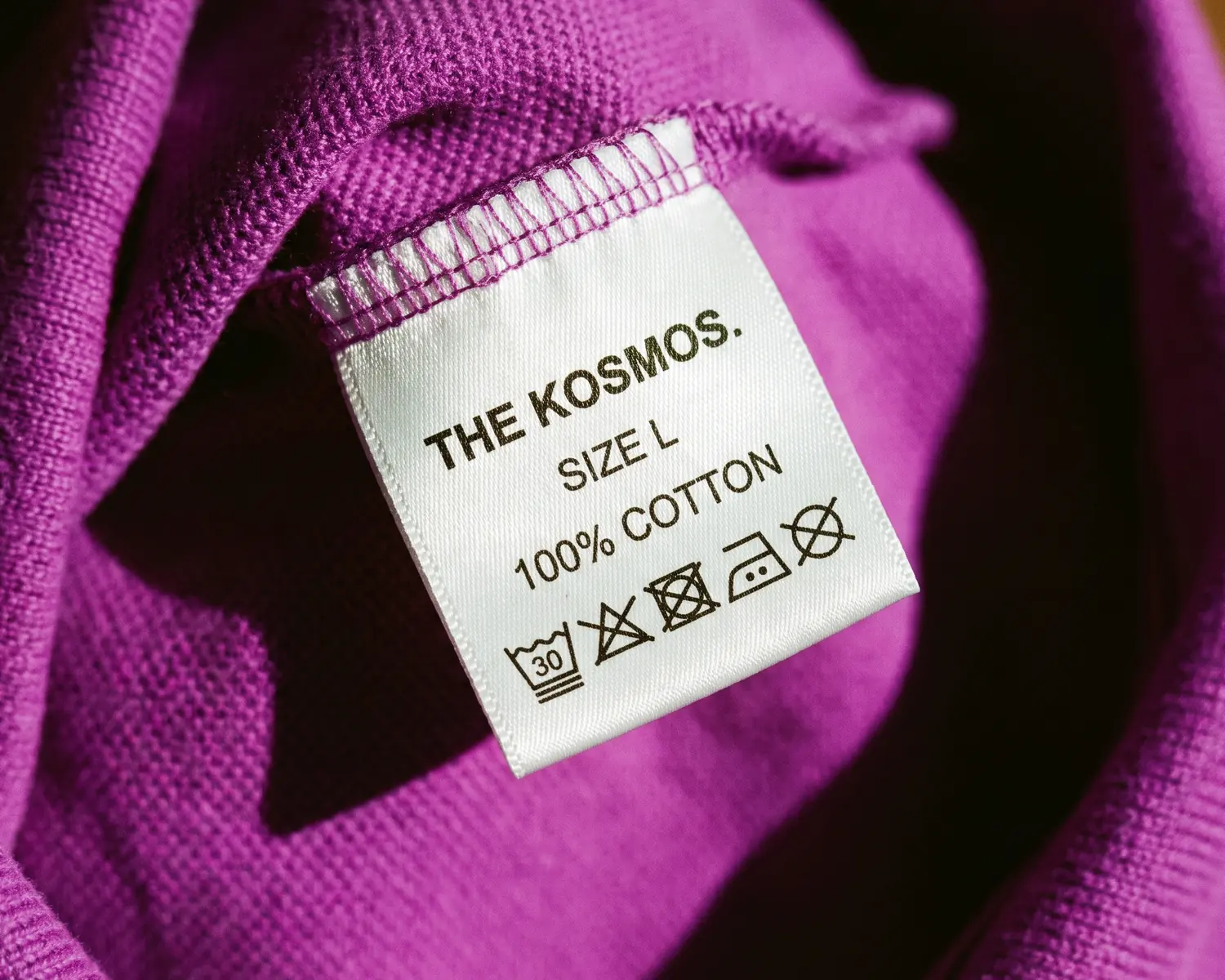
Textile care symbols come in five families, always in the same order: the washtub (washing and temperature), the triangle (bleaching), the square (drying), the iron (ironing) and the circle (professional cleaning). A crossed-out symbol means forbidden; bars call for a gentle cycle; dots indicate temperature.
The essentials in 4 points:
- Five families of standardized pictograms (ISO 3758): washtub, triangle, square, iron, circle, in that order on every label.
- Three universal codes: the cross forbids, the bars under a symbol soften the cycle, the dots count the temperature.
- The tumble dryer is the number one killer of personalized garments: a crossed circle-in-square means hanger drying, no exceptions.
- For a team outfit: wash at 30 degrees inside out, never any bleach, no tumble dryer, iron on the reverse of the marking.
A team outfit almost never dies of old age. It dies of a forbidden tumble dryer, a bleach-laced detergent or an iron pressed straight onto the logo. Yet everything was written on the care label, in a language nobody ever learned: the care symbols.
Eighteen years in textiles taught me one thing: the lifespan of a personalized garment is decided as much in the drum of the machine as in the choice of the reference. This guide decodes the five families of symbols, one by one, each time with what it changes when the garment carries your logo and outfits a whole team.
The 5 families of symbols, always in the same order
Care symbols are standardized: they are the same on every label across Europe, governed by the ISO 3758 standard and the GINETEX system. A label always reads in the same order, five pictograms from left to right:
| Symbol | Family | What it governs |
|---|---|---|
| The washtub (basin) | Washing | Machine or hand, temperature, cycle |
| The triangle | Bleaching | Bleach and whitening agents |
| The square | Drying | Tumble dryer or natural drying |
| The iron | Ironing | Maximum iron temperature |
| The circle | Professional cleaning | Dry cleaning or professional wet cleaning |
Two universal rules before the details: a symbol crossed out with an X means forbidden, and bars under a symbol call for gentleness (one bar = mild cycle, two bars = very mild).
The washtub: washing
The washtub represents the machine's basin. It is the symbol your team will see every week:
- A number in the tub (30, 40, 60, 95): the maximum washing temperature, in degrees. Washing colder is always allowed, hotter never.
- One bar under the tub: mild cycle (reduced spin). Two bars: very mild cycle, the delicate program for fragile textiles.
- A hand in the tub: hand wash only.
- Crossed-out tub: no water washing at all, off to professional cleaning.
What it changes for a team outfit: temperature decides lifespan. A 30-degree wash is enough for routine care, preserves colors and markings, and costs less in energy. Save the 60 degrees for textiles that allow it AND need it (heavily soiled laundry, kitchen hygiene requirements): it is the washing pace that wears out a team wardrobe, not the years.
The triangle: bleaching
The triangle governs bleach and whitening agents:
- Empty triangle: bleaching allowed, all agents.
- Triangle with two diagonal lines: oxygen-based agents only, never chlorine bleach.
- Crossed-out triangle: no bleaching at all.
What it changes for a team outfit: it is the easiest family to remember, because the rule is almost always the same: never any bleach on a colored or marked garment. Bleach fades dyes, yellows some whites and attacks inks. On a personalized outfit, treat the crossed-out triangle as the default rule, even when the label is more permissive.
The square: drying
The square is the family that kills the most garments, because it is the one nobody reads:
- A circle in the square: the tumble-dryer symbol, allowed. One dot in the circle: reduced temperature; two dots: normal temperature.
- Circle in the square, crossed out: tumble dryer forbidden. The most ignored and most expensive symbol.
- Lines in the square: natural drying. Vertical line: hung on a hanger or a line; horizontal line: flat drying (the reflex for knits that lose their shape); diagonal lines in the corner: in the shade.
What it changes for a team outfit: the tumble dryer is the number one enemy of markings and cuts. The heat of the drum shrinks cottons, cracks prints and tires elastane. The most profitable rule you can spread to your team fits in one sentence: the outfit dries on a hanger, not in the dryer. Bonus: a garment dried on a hanger wrinkles less, so it needs less ironing.
The iron: ironing
The iron indicates the maximum temperature, counted in dots:
- One dot: gentle ironing, 110 degrees maximum (synthetics, technical textiles).
- Two dots: 150 degrees maximum (wool, polyester/cotton).
- Three dots: 200 degrees maximum (cotton, linen).
- Crossed-out iron: no ironing.
What it changes for a team outfit: the golden rule of marked garments: never the iron directly on the marking. A screen print or a transfer ironed on the front melts or turns glossy; these garments are ironed inside out, or avoiding the logo area. Embroidery, on the other hand, handles the iron well, on the reverse there too so the relief of the thread is not crushed. And if ironing 40 shirts a week is unrealistic for your team, the choice of fabric solves the problem upstream.
The circle: professional cleaning
The circle speaks to the dry cleaner, not to your machine:
- Circle with a letter (P or F): dry cleaning allowed, the letter tells the professional which solvents are permitted.
- Circle with a W: professional wet cleaning.
- A bar under the circle: gentle treatment; crossed-out circle: no professional cleaning.
What it changes for a team outfit: you will mostly meet this family on structured pieces (jackets, front-desk blazers). For the daily life of a wardrobe of polos, t-shirts and sweatshirts, it rarely matters: a well-set machine wash does the job.
All the laundry symbols in one table
| The symbol | Its meaning |
|---|---|
| Tub 30 | Machine wash, 30 degrees maximum |
| Tub 40 with one bar below | 40-degree wash, mild cycle |
| Tub with a hand | Hand wash only |
| Crossed-out tub | No water washing |
| Crossed-out triangle | No bleach or whitening |
| Square with circle and one dot | Tumble dry at reduced temperature |
| Square with crossed-out circle | Tumble dryer forbidden |
| Square with vertical line | Hang to dry |
| Square with horizontal line | Dry flat |
| Iron with one dot | Gentle ironing, 110 degrees max |
| Crossed-out iron | No ironing |
| Circle with P | Dry cleaning |
| Crossed-out circle | No professional cleaning |
Example: a team polo's label, read in 10 seconds
Take the most common label in personalized textiles, the one on a polo from the catalog, in cotton or polycotton: a tub 30, a crossed-out triangle, a square with a crossed-out circle, an iron with two dots, a crossed-out circle.
Translation in one sentence: wash at 30 degrees maximum, no bleach, no tumble dryer, medium ironing allowed, no dry cleaning. That's it: five symbols, one rule. Most team garment labels tell a variation of this story, and once you have read this one, you can read all the others.
The reflex to build at ordering time: read the care label on the sample, BEFORE ordering the full run. If a reference demands hand washing or forbids the tumble dryer when your team will never pay attention, it is not the right reference for you, however beautiful it is. Realistic care is part of the spec sheet, on the same level as color and fabric weight.
The material decides the label
Symbols do not fall from the sky: they translate the material's behavior. Three markers to predict what the label will say before you even read it:
- Cotton handles temperatures (often 40, sometimes 60) but shrinks in the dryer and wrinkles: its label allows a hot iron and advises against the drum.
- Polyester and blends dry fast and do not wrinkle, but fear heat: 30-40 degree labels, gentle iron, and colors that hold wash after wash.
- Delicate fibers (wool, viscose, modal) demand gentle cycles, flat drying and a careful iron: gorgeous to the touch, demanding in the wash: reserve them for teams who will take care of them.
It is the same trade-off as choosing the fabric: the best team outfit is not the noblest on paper, it is the one whose real-life care, at your employees' homes, will match the label.
The rules that save a team wardrobe (to share with the team)
A team outfit is washed at everyone's home, with no instructions. That is where wardrobes die, and that is where a manager can change everything with five simple rules, valid for almost every personalized garment:
- Wash at 30 degrees, inside out. The reverse side protects the marking from rubbing against the drum and other garments.
- Never any bleach, even on whites.
- No tumble dryer: hanger drying, the outfit keeps its cut and its logo.
- Iron on the reverse, never directly on a print.
- When in doubt, the label decides: it is sewn into the garment for exactly that.
Send these five lines along with the outfit distribution (in the sizes email, or posted in the changing room): it costs zero euros, and it is probably the best durability investment of your whole order. A well-cared-for outfit doubles its lifespan; on a full team wardrobe, the difference adds up.
What to remember
Five families, always in the same order: the tub washes, the triangle bleaches, the square dries, the iron presses, the circle goes to the cleaner. A cross forbids, bars soften, dots count the temperature. You do not need to memorize every pictogram: keep this guide, post the table, share the five rules. The care label is the free instruction manual of your textile investment: a team that respects it wears impeccable outfits twice as long, and that is exactly the image your logo deserves.
Frequently asked questions
What does the square with a circle mean on a label?
It is the tumble-dryer symbol. An empty circle in the square: allowed; one dot: at reduced temperature; two dots: normal temperature. Crossed out with an X, it forbids the tumble dryer: the garment then air-dries, on a hanger or flat depending on the lines in the square.
What does the triangle mean on a care label?
The triangle governs bleaching. Empty, it allows all whitening agents; crossed by two diagonal lines, it only allows oxygen-based agents without chlorine; crossed out with an X, it forbids all bleach. On a colored or marked garment, the practical rule is simple: never any bleach.
Can you iron a garment with a printed logo?
Yes, but never with the iron directly on the print: heat melts or glosses inks and transfers. Iron the garment inside out, or around the marking area, at the temperature indicated by the dots on the iron symbol on the label.
How do you wash an embroidered garment without damaging it?
Embroidery is the most wash-resistant marking: machine at 30 degrees, garment inside out to limit rubbing, no bleach, hanger drying. When ironing, run the iron on the reverse so the relief of the thread is not crushed.
Should you wash at 30 or 40 degrees?
The number on the label is a maximum, not an instruction: washing colder is always allowed. At 30 degrees, a normally worn garment comes out clean, keeps its colors and its marking longer, and uses less energy. Save higher temperatures for heavily soiled laundry, if the label allows them.
Your project, quoted within 24 hours.
Describe your garments, your decoration and your quantities: you receive a detailed quote, decoration included, within one business day.