Textile labels: what each one really guarantees
A textile label proves one specific thing about a garment: no harmful substances, an organic or recycled fibre, a controlled factory, protected workers, or French manufacturing. None of them proves everything. The right move is to start from the claim you want to make, then pick the label that backs it up.
On a product page, three logos side by side look reassuring. You still need to know what each one covers. This guide sorts textile labels into six families, by what they guarantee, with the limit people forget for each one and how to check it before you launch your custom merch.
The main textile labels in one table
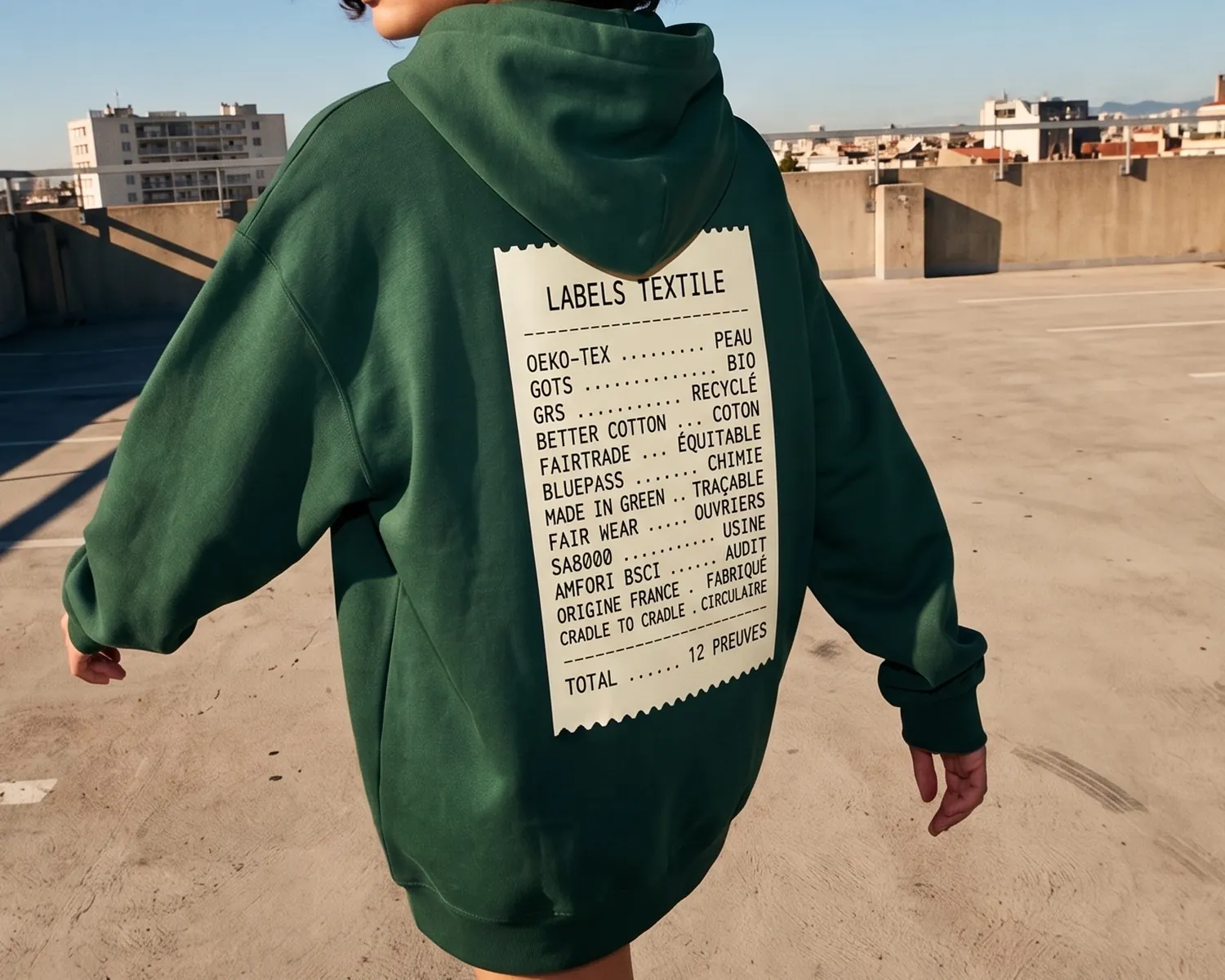
The main textile labels fall into six families: skin safety, the fibre, the factory, working conditions, origin and end of life. The table below sums up what each one guarantees and what it leaves out; every row links to our full article.
| Label | What it guarantees | What it does not say |
|---|---|---|
| Oeko-Tex Standard 100 | a textile tested for harmful substances | nothing about organic or eco-friendly production |
| GOTS | at least 70% organic fibres, the whole chain checked | nothing about a 100% synthetic garment |
| GRS | a verified share of recycled material | what the rest of the fabric is made of |
| Better Cotton | cotton grown with better practices | it is not organic cotton |
| Fairtrade cotton | a minimum price and a premium for farmers | what the fabric is made of |
| Bluesign | safer chemistry in the factory | how the fibre was grown |
| Made in Green by Oeko-Tex | a tested item, made in responsible factories, traceable | whether the fibre is organic |
| Fair Wear | a brand that has its sewing workshops audited | it is not a product logo |
| SA8000 | a factory certified on working conditions | the garment itself |
| amfori BSCI | a social audit graded from A to E | it is not a certification |
| Origine France Garantie | genuinely French manufacturing | the material and how it was grown |
| Cradle to Cradle | a product designed to be recycled or composted | the wages paid to workers |
Label, certification, standard: what's the difference?
A textile label is displayed on the product, a certification confirms that an independent body has checked a site or a supply chain, and a standard sets the rules for that check. In practice the three words get mixed up, and that is where the confusion starts.
Three cases to know. SA8000 certifies a factory, never a garment. Fair Wear recognises a member brand, with no logo sewn onto the product. And amfori BSCI is not a certification at all: it is an audit that gives a grade. Before reading a logo, ask what it targets: the product, the factory or the brand.
For the skin: Oeko-Tex
For a garment worn against the skin, the benchmark is Oeko-Tex Standard 100: this label guarantees that a textile has passed an independent laboratory test against a list of harmful substances, and that test is repeated every year. It is the one to look for on a t-shirt or polo worn all day.
Its limit fits in one sentence: it says nothing about organic cotton or the impact of manufacturing. Our Oeko-Tex label explainer details what it covers, and our complete Oeko-Tex Standard 100 guide explains its classes: for team clothing worn against the skin, class II is more than enough.
For the fibre: GOTS, GRS and Better Cotton
Three labels are about the material itself. They are not interchangeable: one covers organic, another recycled, the third a more responsible way of growing cotton.
Which label for organic cotton?
For organic cotton, the reference label is GOTS: a GOTS garment contains at least 70% organic fibres, and 95% to carry the "organic" wording. The whole manufacturing chain is checked every year by an independent body. All the detail, grades included, is in our article on the GOTS label, and why this cotton costs more in the one on organic cotton.
Which label for recycled material?
For recycled material, the label to look for is GRS (Global Recycled Standard), run by Textile Exchange. The entry threshold is 20% recycled content; the GRS logo only appears on the product from 50%. Our article on GRS certification explains the traceability it requires, and the one on recycled polyester what happens to the fibre.
Does Better Cotton mean organic?
No: Better Cotton and organic cotton are two different things. Better Cotton is a training programme for cotton farmers, focused on water, soil and pesticides. It covers about 12% of the world's cotton, in 24 countries. A garment that mentions it supports more responsible farming, with no organic guarantee; our article on Better Cotton looks at its logo.
For the factory and its chemistry: Bluesign and Made in Green
Two labels look at what happens in the factory rather than in the field. Bluesign checks manufacturing chemistry, discharges into water and air, and worker safety, across more than 850 manufacturers; its label is now called bluepass. You mostly see it on technical jackets and outdoor gear.
Made in Green by Oeko-Tex goes further on traceability: the item is tested for harmful substances, made in responsible factories, and a unique ID on the label lets you find out where it was produced.
For the workers: Fair Wear, SA8000, BSCI and Fairtrade
Four schemes check working conditions, each at a different point in the chain:
- Fair Wear: more than 120 member textile brands commit to having their sewing workshops audited.
- SA8000: a standard created in 1997 by Social Accountability International, which certifies a factory against nine requirements drawn from ILO conventions.
- amfori BSCI: a social audit used by more than 2,400 members, which grades each site from A to E.
- Fairtrade cotton: farmers get a guaranteed floor price for their cotton, and their cooperative receives an extra premium; our article on Fairtrade cotton explains how it works.
For merch that wants to make a social point, a Fair Wear member brand is often the simplest benchmark to check.
For origin: Origine France Garantie
The Origine France Garantie label proves that a garment is genuinely made in France: its key manufacturing steps are carried out in France, and French costs make up at least half of its cost price, checked by an independent body. It is stricter than the plain "Made in France" wording, which requires no audit. Our article on Origine France Garantie explains the difference.
For end of life: Cradle to Cradle
Cradle to Cradle targets the circular economy: a certified product was thought through from the design stage so its materials can go round again, recycled or composted. It scores products on five criteria, from a Bronze level up to Platinum; our article on Cradle to Cradle goes through them.
How do you check that a label is genuine?
To check a textile label, ask for the number that comes with it and look it up on the label's official website: a logo on its own proves nothing. The certification belongs to the manufacturer, and its number is what makes it verifiable.
Depending on the label, the step differs slightly:
- Oeko-Tex: the certificate number can be checked with the Label Check tool on the official website, and a certificate is valid for one year (step by step in our guide).
- GOTS: the licence number is listed in the standard's public database (details in our GOTS article).
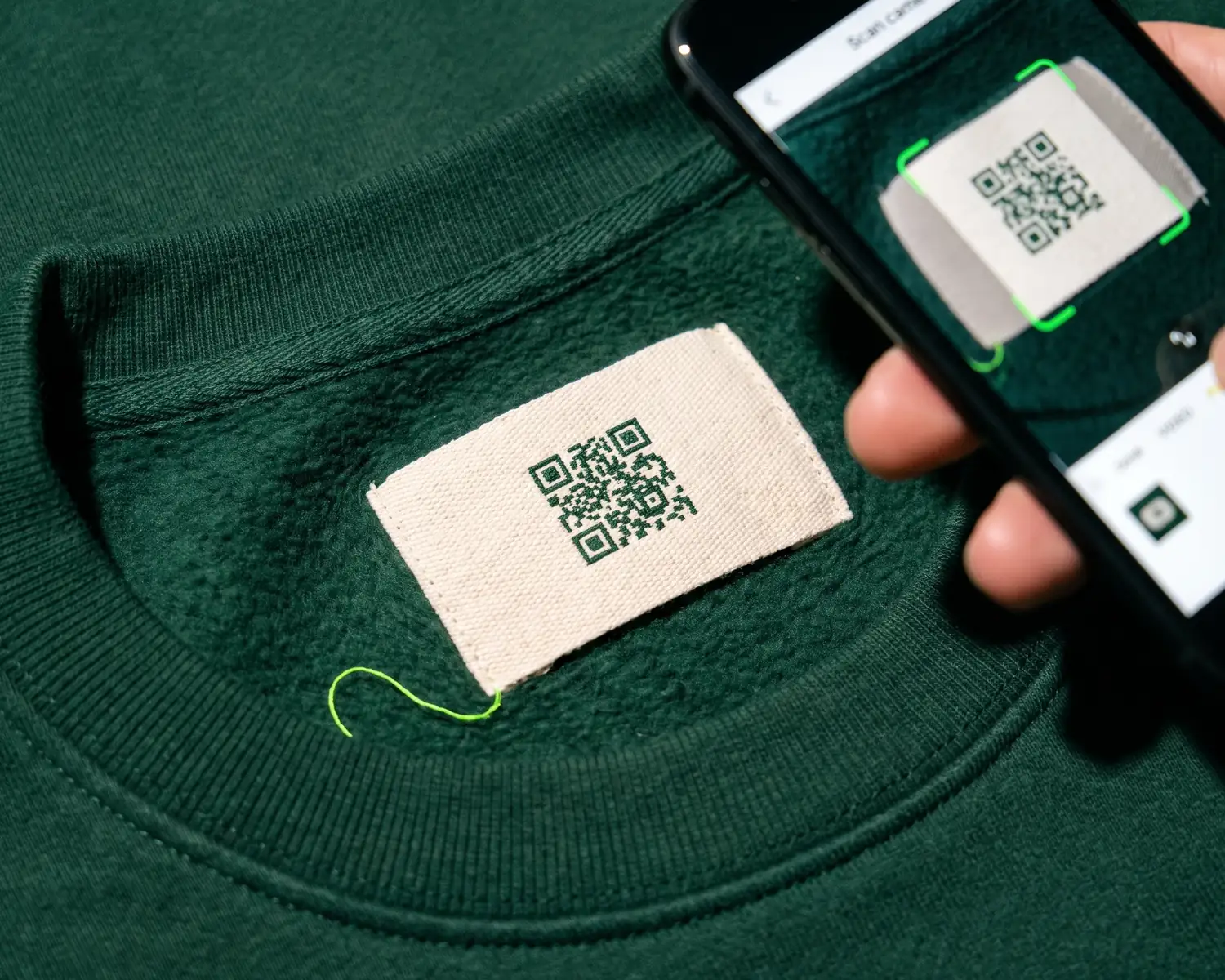
- bluepass (formerly Bluesign): a QR code on the label leads to a verification page (see our Bluesign article).
- Made in Green: the unique ID on the label traces where the item was produced (explained here).
Which label should you choose for custom merch?
For custom merch, pick the label depending on what you want to say about your garments: Oeko-Tex for the health of the people wearing them, GOTS for organic cotton, GRS for recycled material, a Fair Wear member brand for working conditions. One garment can carry several labels.
One last point: none of these labels is mandatory. What is mandatory in Europe is composition labelling, listing the fibres of every garment sold, and written in French for the French market.
Labels on TKNP catalogue pages
On tknp.io, when a garment is certified, its product page says so in the description, before any customisation. At Stanley/Stella, the Creator 2.0 tee is a good example: this t-shirt is GOTS and OEKO-TEX certified, and its brand is a Fair Wear Foundation member. Three families covered at once: the fibre, the skin and working conditions.
To compare one certified garment with another, each page shows a printed price next to the blank price (unit price excluding VAT, for one print position): you can see the price gap between two items before you even ask for a quote, which remains the final reference.
Key takeaways
- Each textile label proves one thing only: the skin (Oeko-Tex), the fibre (GOTS, GRS, Better Cotton), the factory (Bluesign, Made in Green), the workers (Fair Wear, SA8000, BSCI, Fairtrade), the origin (Origine France Garantie) or end of life (Cradle to Cradle).
- A logo is not enough: the certificate number, checked on the label's website, is what counts.
- For your merch, start from what you want to claim, then look for the label that proves it.
Frequently asked questions
Is a textile label mandatory?
No, no textile label is mandatory in Europe. The composition label is: it lists the garment's fibres as percentages, and in France it must be written in French.
Can a garment carry several labels?
Yes, and it is common. The Stanley/Stella Creator 2.0 is GOTS and OEKO-TEX certified, and its brand is a Fair Wear Foundation member: the fibre, health and working conditions are covered together.
Is a logo on the label enough to prove a certification?
No. A logo can be copied; what proves the certification is its number, to be checked on the label's official website (Label Check for Oeko-Tex, the public database for GOTS).
Your project, quoted within 24 hours.
Describe your garments, your decoration and your quantities: you receive a detailed quote, decoration included, within one business day.