
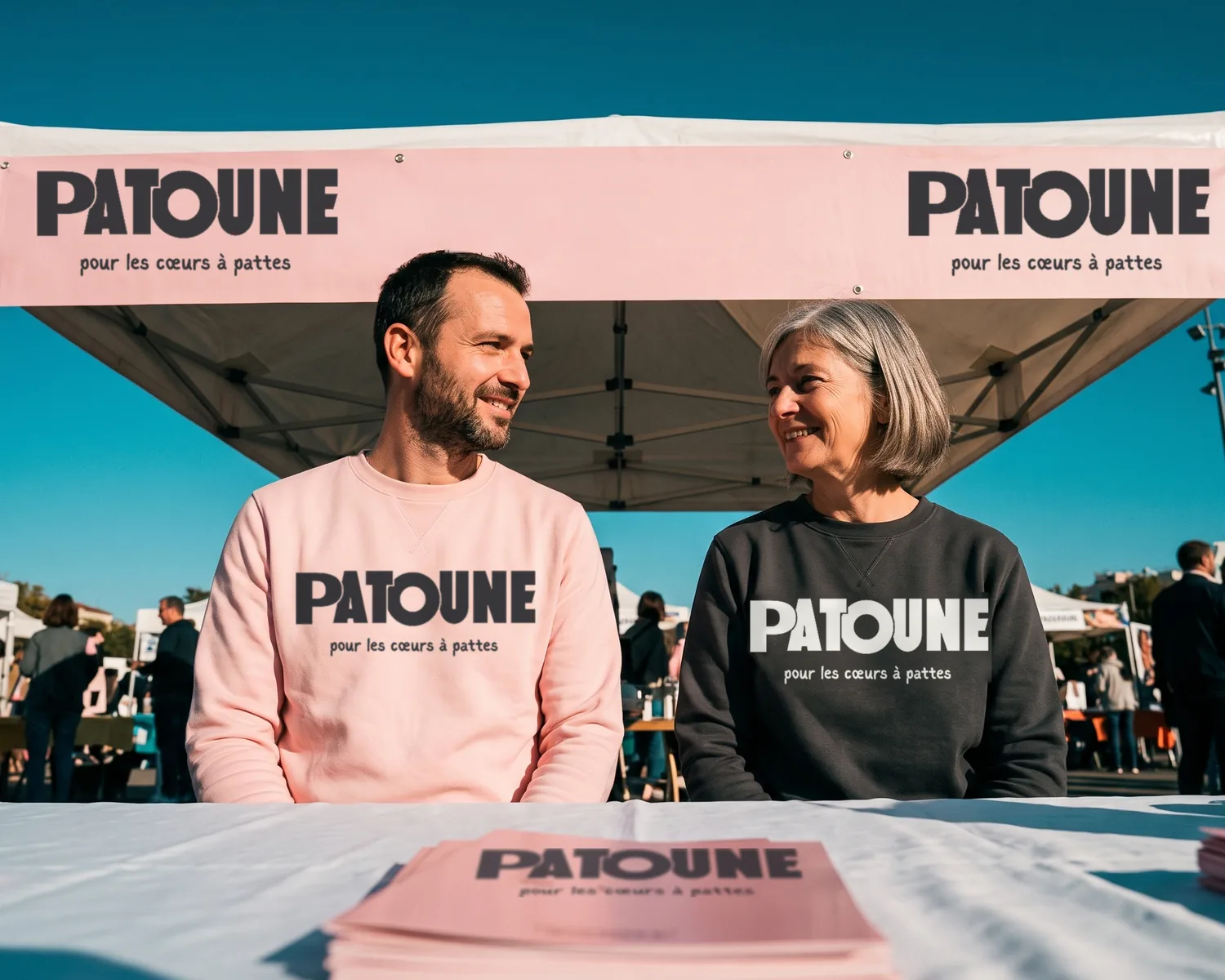
Brand guidelines for an association or a club: the simple template
An association's or a club's brand guidelines fit on one page: the logo and its single-colour version, two or three colours with their codes, one or two typefaces, three usage rules and the address of the folder that holds the files. Once approved, they make the association recognisable everywhere, from the raffle poster to the volunteers' sweatshirt, even when the team changes.
In short:
- One page is enough: six headings, from the logo to who holds the file access.
- French association law (the 1901 Act) says nothing about brand guidelines: your statutes decide who approves them.
- Two or three colours are enough, and each one has a print cost: at 50 units, a one-colour logo in screen printing comes to about €2.50 of printing per coloured sweatshirt, against €4.50 in four colours (indicative prices).
- The files live in a folder owned by the association, and its access changes hands at every handover.
Every new school year, the same scene plays out: a new committee, a poster to redo for the associations fair, and nobody can find the logo in good quality. The only file going around is a blurry screenshot, and the former secretary kept everything on their own computer. Simple brand guidelines (a "graphic charter", as the French say) solve this for good, as long as a volunteer opening them for the first time understands them in two minutes.
Why does an association need brand guidelines?
An association needs brand guidelines because the people who make its materials keep changing: a new committee every year, volunteers who come and go, partners asking for the logo for their own brochures. The guidelines keep the same visual identity whoever is at the keyboard, and everyone saves time: nobody has to ask again for the right colour or the right file.
They don't need to be thick: one page that people actually open beats a booklet nobody reads. The full definition and what professional guidelines contain are in our guide to graphic charters; here, we build the association version, the one that fits on a single page.
What should an association's brand guidelines include?
An association's brand guidelines come down to six headings: the logo, the colours, the typefaces, the usage rules, the files and the sign-off. Copy this template into a shared document, fill in each line, and your guidelines exist.
| Heading | What you write | Example |
|---|---|---|
| Logo | the main version, a single-colour version, a white version for dark backgrounds | blue logo on a light background, white logo on the navy sweatshirt |
| Colours | two or three colours, each with its hex code (screen) and its Pantone reference (print) if you have one | blue #1D3557, yellow #F4C430 |
| Typefaces | one typeface for headings, one for body text, with their exact names | headings in Montserrat, body text in Lato |
| Usage rules | three don'ts, each shown with a crossed-out example | don't stretch the logo, don't change its colours, don't place it on a busy photo |
| Files | the address of the shared folder and the formats stored in it | SVG and PDF for print, PNG for social media |
| Sign-off | who approves a new item, who holds the access | the committee approves, the chair and the secretary keep the access |
Who creates an association's brand guidelines?
Three kinds of people can create an association's brand guidelines: a member who is comfortable with design, an outside volunteer or a professional graphic designer. The right choice depends on the state of the logo: if it exists and people like it, a member can build the page around it; if it needs redrawing, a professional eye saves time.
Nobody on the team? In France, the government volunteering platform JeVeuxAider.gouv.fr also lists missions such as "I create a logo and brand guidelines for an association", to be done from home.
Who approves the brand guidelines: the committee or the general meeting?
The French 1901 Act on associations says nothing about brand guidelines, nor about an association's governing bodies: your statutes share out the powers between the general meeting, the board and the committee. If day-to-day management sits with the committee, it can adopt the guidelines on its own.
A new logo still deserves a moment at the general meeting: that is where members make it their own. Show it on a garment rather than as a file, using the voting method described in our guide to student union logos. Then write in the guidelines the date of approval and the body that decided: the next committee will know where they come from.
How many colours should an association keep, and what do they cost on a sweatshirt?
An association's brand guidelines are better off with two or three colours, because each colour has a print cost: at 50 units in screen printing, a one-colour logo comes to about €2.50 of printing per coloured sweatshirt, against about €4.50 in four colours. Across 50 sweatshirts, the gap is close to €100 (indicative prices from our screen printing grid as of 6 October 2026, subject to change).
Start with the colours people already know you by: a club that has played in green and white for as long as anyone remembers has no reason to change. Add a single-colour version of the logo, the one you will use on garments, rubber stamps and black-and-white documents: in screen printing, each colour of the design needs its own screen, a fixed starting cost.
Finally, check that the logo stands out on the colour of the garments: the white version on a dark sweatshirt, the full-colour version on a light t-shirt. Our guide to sweatshirt colours helps you make that choice.
Which typefaces should an association choose?
Choose two typefaces at most: one for headings, one for body text, both easy to read from a distance. Google Fonts typefaces are released under open licences: an association can use them free of charge, on its posters as well as on its merch.
Be wary of very thin or very ornate typefaces: they work on a screen, much less on textile. Our embroidery page says it plainly: text smaller than 5 mm loses legibility there. So plan in the guidelines a version of the logo without text for small placements, and keep the association's name large enough in the main version.
Where should the brand files live so they outlast the committee?
Store the brand files in a shared folder opened in the association's name, never on a volunteer's personal computer or account: the day they leave the committee, the logo stays with the association. At every handover, the outgoing committee passes on the folder access together with the association's other access.
The folder holds the logo in vector format (SVG or PDF) for print, in PNG for social media, the one-page guidelines and the names of the typefaces. If your only file is a JPG, our guide to vectorising an image gives the options, three of them free, and the one on logo formats that work on a garment tells you which file to supply for custom textile.
A sports club's brand guidelines: where the sponsors go
A sports club adds one heading to its guidelines: sponsors. Decide once and for all where they go and in what form, so that each new partner finds its place without blurring the club's image.
Three rules are enough: the club's logo stays the most visible; sponsor logos are shown in a single colour, the club's or white; they always sit in the same area, for example a band across the back. Also plan a simplified version of your crest, without the finest details: it embroiders cleanly on the chest of a sweatshirt or on a cap. Our guide to logo placement helps you position each one.
The tknp.io Logothèque: the logo and its colours, in the association's name
No logo yet, or one that needs redoing? In the Logothèque (the logo library) of your tknp.io account, type the association's name, its website address or the link to an image: it finds your logo, or suggests several logos, each with its own colour palette, which you can edit. You can also upload the file you already have.
Open this free account with the association's email address rather than a committee member's: logos and colours then stay with the association when the team changes. When the first collection is ready, the association offers it to its members on the tknp.io Store, through a presale campaign, with no upfront cost and no stock: our article on selling t-shirts to fund an association gives the numbers.
Frequently asked questions
Should an association register its logo with the INPI?
It isn't mandatory. Registering a trademark protects the association's name or logo for the goods and services you list when filing. In France, an association can file a trademark with the INPI, the national intellectual property office: filing online costs €190 for one class of goods or services, plus €40 per additional class (fees as of 2 July 2026).
Can the volunteer who drew the logo take it back?
Without a written agreement, they keep the rights to their drawing: under French law, copyright protects a creation from the moment it exists, with no formality. Ask them for a written agreement assigning the association the right to use and reproduce the logo, on every medium, garments included. Their name stays attached to the drawing: moral rights cannot be assigned.
Can an association change its brand guidelines?
Yes, and guidelines that are used get updated. The right moment is the start of the school year or the season, when the committee changes and new materials are being prepared; date each version in the document. Keep the old one in the shared folder: the sweatshirts already in people's wardrobes will stay around for a while, and that is perfectly fine.
Your project, quoted within 24 hours.
Describe your garments, your decoration and your quantities: you receive a detailed quote, decoration included, within one business day.