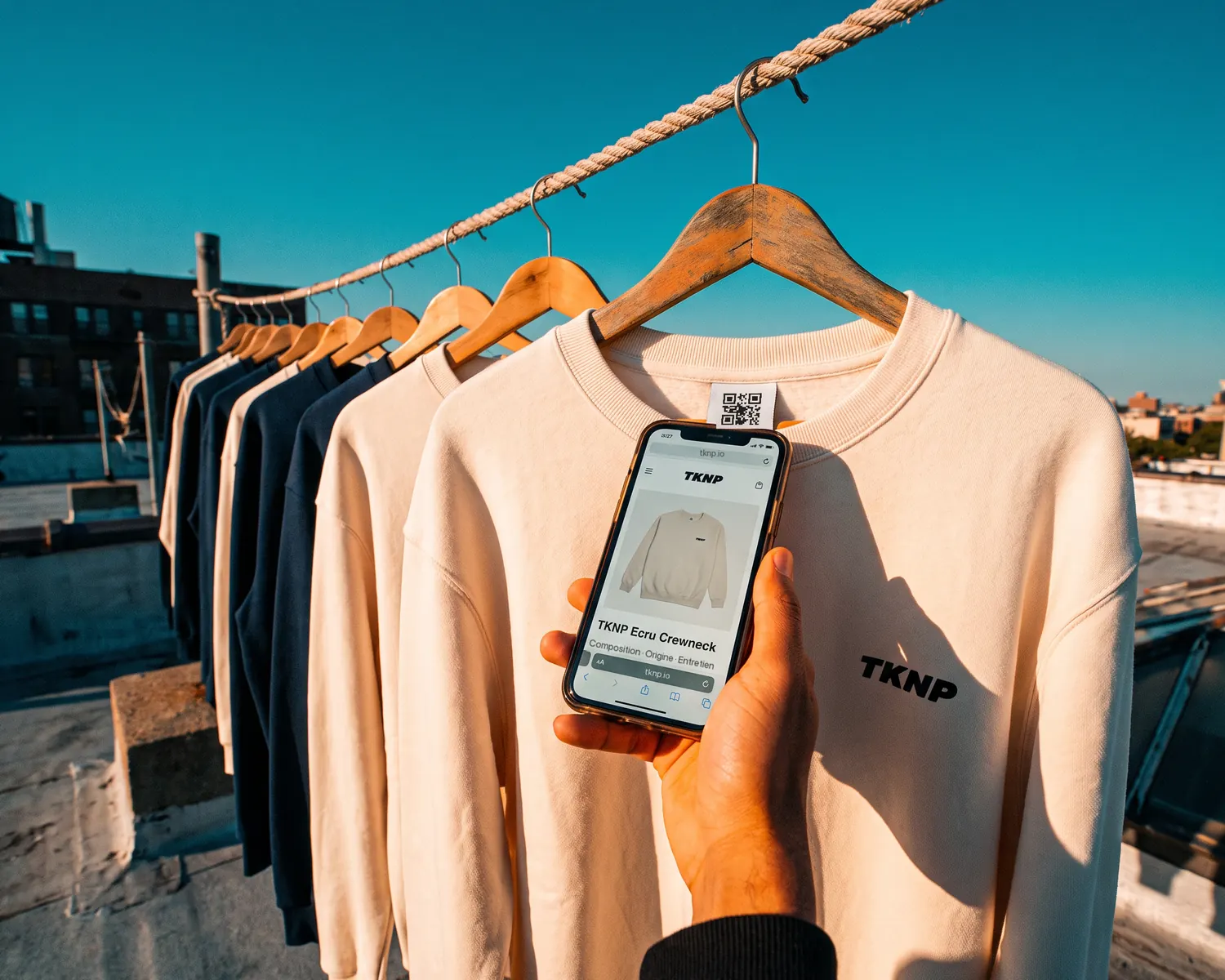
Digital product passport: what changes for clothing
The digital product passport is an online identity record, linked to each product by a data carrier such as a QR code, which the European Union will make mandatory one product group at a time. For clothing, the Commission plans to adopt the rules at the end of 2027, and in principle they will only apply at least 18 months after their entry into force: your brand has time to prepare properly.
You often read that the digital product passport will be "mandatory from 2027". For textiles, that is when the European Commission plans to write the rules, not when they will apply. Here is what the texts actually say, and what they change for a brand that sells clothing under its own name.
What is the digital product passport?
The digital product passport (DPP) is a set of data about a product, available online from a data carrier placed on the product. It is created by EU Regulation 2024/1781 on ecodesign for sustainable products, known as the ESPR: in time, a product in scope can only be placed on the market if its passport is available, with data that is "accurate, complete and up to date".
The regulation does not set the content of the passport once and for all. For each product group, a Commission delegated act will specify the data to provide, the carrier to use and where it goes, and whether the passport applies to a model, a batch or each item. The Commission was also due to set up, by 19 July 2026 at the latest, a digital registry of passports.
When will the digital product passport become mandatory for clothing?
By our calculation from the texts, the digital product passport will not be mandatory for clothing before 2029. The European Commission plans to adopt the textile rules in the fourth quarter of 2027, adding that this timeline may still change.
Once those rules are adopted, the regulation sets a delay: their date of application cannot be earlier than 18 months after their entry into force, except in duly justified cases. That delay must take account of the needs of small and medium-sized enterprises, in particular micro-enterprises. Counting adoption at the end of 2027 plus those 18 months, the obligation for a garment does not arrive before 2029: that is our calculation from the texts, and the exact date will be set by the delegated act.
Does the digital product passport apply to your brand?
Yes, in principle: a brand that sells clothing under its own name will be responsible for the passport of that clothing, even if it does not make it itself. The regulation says so plainly: an importer or distributor is considered the manufacturer when it places a product on the market "under its name or trademark". That may also apply to a brand selling its merch under its own name; the delegated act will specify who creates the passport.
The Commission explains that manufacturers or importers must make the passport available; distributors must make sure it exists. The text provides no general exemption for small brands: it requires deadlines to take account of the needs of SMEs, in particular micro-enterprises.
What will a garment's passport contain?
The exact content of a garment's digital product passport will depend on the textile delegated act, which the Commission is still preparing. Among the possible data, the Commission lists product identification and characteristics, fibre composition, origin, and the identification of the economic operators involved.
The regulation also lists what delegated acts may require: a unique product identifier, a GTIN-type item code, customs codes, conformity documents, instructions, and information on the manufacturer and importer. The passport will have to be available before purchase, including for online sales.
Where will the passport go on a garment?
The digital product passport will be linked to the garment by a data carrier placed on the product itself, such as a QR code. Its exact form and position will be set by the textile delegated act.
If your brand already plans a QR code on its clothing, the size and readability rules of any printed code already apply, pending what the delegated act sets: our guide to the QR code on a t-shirt covers them. And the composition label, already mandatory under EU Regulation 1007/2011, remains the basis of the information to gather.
Unsold goods: what the destruction ban says
Since 19 July 2026, save for the derogations set out in the text, large companies may no longer destroy their unsold clothing, clothing accessories and footwear: that is Article 25 of EU Regulation 2024/1781 (ESPR). Micro and small enterprises are exempt from this European ban, and medium-sized enterprises will be covered from 19 July 2030.
In France, another rule has applied to clothing since 1 January 2022, whatever the size of the brand: the AGEC anti-waste law requires producers, importers and distributors of new non-food products to donate, reuse or recycle their unsold goods rather than dispose of them, save for the exceptions set out in the law (Article L541-15-8 of the French Environment Code). A breach can cost a company a fine of up to 15,000 euros. An unsold garment is therefore already a problem to manage, not just a loss.
Digital product passport and environmental labelling: what is the difference?
The digital product passport and environmental labelling are two separate schemes. The digital product passport is a European obligation that will arrive one product group at a time; displaying the environmental cost is a voluntary French scheme, which we explain in our article on environmental labelling for textiles.
What your brand can prepare right now
Without waiting for the textile delegated act, a brand can already gather the information for the future digital product passport that the Commission lists for textiles.
- The composition of each garment. It is already on the mandatory label; keep it up to date, model by model.
- The record of each base garment. Note the brand, reference, composition and certifications (GOTS, OEKO-TEX) of the garments you have customised: on tknp.io, the composition and, where there are any, the certifications appear on the product page.
- The origin. Ask your suppliers where each garment was made, and keep their answers: the same data already feeds the calculation of the environmental cost.
- An identifier per product. A GTIN-type item code is among the data the rules may require.
- Where the QR code goes. Think about where a code could sit when you design your labels.
One note of caution: until the textile delegated act is published, nobody can guarantee that a passport created today will comply tomorrow.
Producing the exact number, with no unsold stock to manage
The simplest way to avoid unsold clothing is to make only what has already been sold. For a collection under your brand, ecru and navy sweatshirts for example, the pre-sale of the tknp.io Store reverses the usual order: your customers reserve their size and pay first, then, once each garment's threshold is reached, one single run is launched, in the exact number of garments reserved. No stock to clear, no box of surplus.
Frequently asked questions
Will the digital product passport be mandatory for clothing in 2027?
No. The European Commission plans to adopt the textile rules in the fourth quarter of 2027, and the regulation then provides, except in duly justified cases, at least 18 months before they apply. By our calculation, and if that timeline holds, the obligation will therefore not arrive before 2029.
Does the digital product passport apply to a small clothing brand?
Yes, in principle: a brand that places clothing on the market under its own name is considered its manufacturer and will have to make its passport available. The regulation provides no general exemption, but requires deadlines to take account of the needs of small businesses.
What does DPP stand for?
DPP stands for Digital Product Passport, the passport created by EU Regulation 2024/1781 on ecodesign for sustainable products (ESPR).
Does the EU ban on destroying unsold goods apply to small brands?
Not the one in the EU ESPR regulation: it has applied to large companies since 19 July 2026, will cover medium-sized ones from 19 July 2030, and exempts micro and small enterprises. In France, however, the AGEC law has required every brand since 2022, whatever its size and save for the exceptions set out in the law, to donate, reuse or recycle its new unsold goods rather than dispose of them.
Your project, quoted within 24 hours.
Describe your garments, your decoration and your quantities: you receive a detailed quote, decoration included, within one business day.