Size breakdown: our figures for 25, 50 and 100 garments
Without a size list, build the order around M and L. At tknp.io, we split a group like this, based on our orders: 5% XS, 15% S, 30% M, 30% L, 15% XL and 5% XXL. For 100 garments, that comes to 5 XS, 15 S, 30 M, 30 L, 15 XL and 5 XXL.
Key points:
- Our breakdown: M and L together make up 60% of the order, S and XL 15% each, XS and XXL 5% each.
- In our size tool: on our product pages, it suggests this breakdown on every garment that comes in sizes (not on one-size items such as caps or tote bags), as soon as you choose a quantity; 3XL, 4XL and 5XL start at zero, with their surcharge shown.
- Other sources: other print shops and sellers also land at about 60% M and L, but disagree on the top size and on the share of XXL.
- The real answer: as soon as you know who the people are, ask them for their size. A breakdown is for when there is nobody to ask.
T-shirts for a company off-site, hoodies for volunteers, merch for a stand: sometimes you have to order before you know who will wear what. Our breakdown applies to a group where men and women are not counted separately. For a mostly male or mostly female group, we have no figures of our own: further down we give another print shop's, and say so.
What size breakdown for 20, 25, 50 and 100 garments?
For 25 garments, our size tool suggests 1 XS, 4 S, 8 M, 7 L, 4 XL and 1 XXL; for 100, it suggests 5 XS, 15 S, 30 M, 30 L, 15 XL and 5 XXL. These two rows are the ones our tool shows, based on our order data; for 20 and 50 garments, we applied the same percentages, rounded to whole garments.
| Quantity | XS | S | M | L | XL | XXL | 3XL and above |
|---|---|---|---|---|---|---|---|
| 20 | 1 | 3 | 6 | 6 | 3 | 1 | 0 |
| 25 | 1 | 4 | 8 | 7 | 4 | 1 | 0 |
| 50 | 2 | 8 | 15 | 15 | 8 | 2 | 0 |
| 100 | 5 | 15 | 30 | 30 | 15 | 5 | 0 |
The 25 and 100 rows were read in our size tool on 18 November 2026. The 20 and 50 rows are our calculation: at 20 the percentages divide exactly; at 50 we rounded the way the tool does at 25, S and XL up, XS and XXL down, and the total stays at 50.
3XL, 4XL and 5XL stay at zero in this suggestion: add them by hand if your group needs them, and their surcharge shows next to the size. Every row can be changed before you order, and the minimum of ten counts across the whole model, all sizes together.
What other print shops say
Other print shops and sellers publish their own breakdown, and the order of magnitude matches ours: M and L at around 60% of the order. These are not our figures: we quote them for comparison, and for the cases where we have no data.
| Source and date | What it is | XS | S | M | L | XL | XXL |
|---|---|---|---|---|---|---|---|
| Our figures (tknp.io), 18 November 2026 | our size tool, based on our order data | 5% | 15% | 30% | 30% | 15% | 5% |
| A textile print shop in the Vaucluse, 24 October 2026 | recommendation published on its website, mixed group | not given | 10% | 30% | 30% | 20% | 10% |
| A sports jersey manufacturer based in China, 16 May 2026 | recommendation published on its website, based on its past orders | 5% | 10% | 45% | 25% | 10% | 3% |
| A British custom clothing seller, 14 December 2023 | its average t-shirt order | not given | 10% | 28% | 32% | 19% | 8% |
| A Portuguese clothing seller, 14 January 2026 | 2025 sales, all garments, together with another seller's | 2% | 12% | 23% | 20% | 10% | 4% |
M and L together make up 60% with us, at the Vaucluse shop and at the British seller, and 70% at the jersey manufacturer; at the Portuguese seller they account for 43% of the total, or about 60% of sizes XS to XXXL alone, by our calculation, because 28% of its sales are in "other sizes" (children's, women's cuts, workwear). The gaps lie elsewhere: the top size is M at the jersey manufacturer and the Portuguese seller, L at the British seller, and XXL runs from 3% to 10% depending on the source.
For a mostly male or mostly female group
Our data does not separate men and women. The Vaucluse shop, for its part, publishes a breakdown for each case, on unisex garments: 5% S, 25% M, 35% L, 25% XL and 10% XXL for a mostly male group; 20%, 35%, 25%, 15% and 5% for a mostly female group.
| Group (the Vaucluse shop's figures) | Quantity | S | M | L | XL | XXL |
|---|---|---|---|---|---|---|
| Mostly men | 20 | 1 | 5 | 7 | 5 | 2 |
| 50 | 2 | 13 | 18 | 12 | 5 | |
| 100 | 5 | 25 | 35 | 25 | 10 | |
| Mostly women, in a unisex cut | 20 | 4 | 7 | 5 | 3 | 1 |
| 50 | 10 | 18 | 13 | 7 | 2 | |
| 100 | 20 | 35 | 25 | 15 | 5 |
The percentages are that shop's, checked again on its website on 18 November 2026; the quantities are our calculation, with half garments rounded in favour of M and L.
Sweatshirts, polo shirts, women's cuts: does the size breakdown change?
Our data does not break the split down garment by garment. Among the other sources, only one publishes a shifted breakdown for sweatshirts, and none gives figures for polo shirts or women's cuts.
The size breakdown for sweatshirts
A promotional products seller suggests for a unisex sweatshirt 10 to 15% S, 25 to 30% M, 35 to 40% L, 20 to 25% XL and 5 to 10% XXL and above (article dated 23 October 2024). The British seller says the opposite: in its view, its t-shirt breakdown also holds for hoodies and jackets. The Vaucluse shop observes that people tend to pick their hoodie a size larger, yet leaves its proportions as they are.
Before you shift the whole order up a size, look at the measurements of the model. In our catalogue, the Stanley/Stella Cruiser 2.0 hoodie measures 59 cm across the chest in M, laid flat, against 53.5 cm for the same brand's Creator 2.0 t-shirt in the same size: the extra room is already built into the hoodie's cut.
The size breakdown for polo shirts
None of the sources we read publishes a breakdown for polo shirts specifically. The only figure that includes them comes from the British seller, for all its garments except trousers and children's sizes: 1% XS, 12% S, 29% M, 32% L, 20% XL, 5% XXL and 2% 3XL, with no detail per garment. For a polo shirt, our breakdown therefore remains the benchmark: the B&C Polo Id.001, for example, can be ordered from XS to 4XL.
The size breakdown for women's cuts
None of the sources we read gives figures for a women's cut: the Vaucluse shop's "mostly women" breakdown applies to a unisex garment. That shop and the promotional products seller agree, without a figure: someone who wears M in a unisex model often moves to L in a women's model.
Our product pages confirm it in centimetres. The unisex Creator 2.0 measures 53.5 cm across the chest in M; the Stella Muser, a women's t-shirt from the same brand, measures 51 cm in M and 54 cm in L. So if you order a women's cut, shift the breakdown up by one size, and check the largest size on offer: the Stella Muser stops at 3XL, while the Creator 2.0 goes all the way from XXS up to 5XL.
A loose fit, on the other hand, shifts nothing: its width comes from the pattern, and our guide to cuts compares the shapes one by one.
Trying a blank M and L before you fix the breakdown
With us, the model you plan to have decorated can first be bought blank, starting with one unit: that is how we advise you to make sure of the size before you commit to a run. Take it in M and in L, have a few people in the group try it on, and you will know whether to lean towards the top or the bottom of our breakdown before you set the quantities.
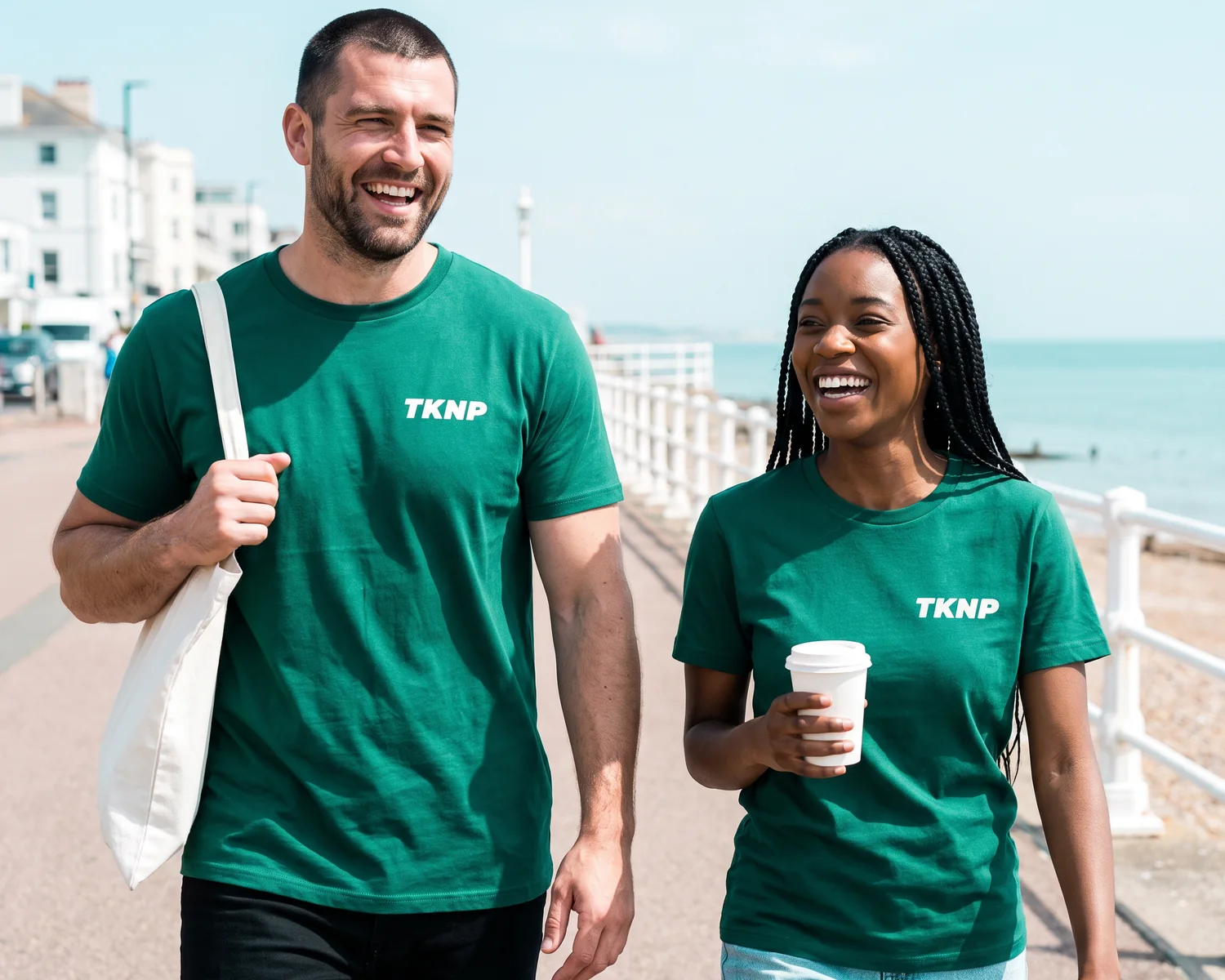
The decorated run then starts at ten units of one model, all sizes together: your size breakdown does not change the price tier. A Creator 2.0 decorated with a DTF transfer in the 10 × 15 cm format costs €12.64 per t-shirt, excluding VAT, for 10 units, then €9.46 for 50 and €8.77 for 100, whichever standard sizes you choose. These are our prices as of 18 November 2026, for guidance only: for a single print position, in the cheapest colour, with the standard lead time, shipping excluded. The emerald green in our photo is one of its 58 colours, Verdant Green.
Two things to check before you confirm. Some larger sizes carry a brand surcharge: our product pages do not say which ones in advance, the amount appears when you select the size, and our guide to quality textiles shows where to read that note under the price grid. And a women's model is a different product reference from the unisex one: with us, the minimum of ten is counted per reference, so each of the two has to reach it.
The size breakdown is only one of the seven steps of a t-shirt order, from choosing the model to the lead time. For other garments, our guide sets out the price and minimum for a team order, from t-shirts to windbreakers. If your order mixes several models, describe the group in a couple of sentences on the quote request page: a priced quote comes back within 24 hours on working days.
When should you ask for real sizes instead of estimating them?
Ask for real sizes as soon as the people are known: employees, members, a team that has signed up. An estimated breakdown only makes sense for an audience with no names, such as visitors to a stand, volunteers not yet recruited or stock meant for sale.
Two of the sources say so themselves: for the Vaucluse shop, a short online questionnaire beats any estimate, and the promotional products seller keeps its own for giveaways where the recipients are not known in advance. For what comes next, our method for collecting sizes for a group order has everyone enter their own, once.
Frequently asked questions
What is the most ordered size for custom clothing?
At tknp.io, M and L, level: 30% each in the breakdown our size tool suggests based on our order data. Among other sources, M comes first at a sports jersey manufacturer (45%) and a Portuguese clothing seller (23% of 2025 sales, all garments together), L at a British seller (32% of t-shirt orders).
How many XXL should you plan in an order of 50 garments?
Two or three XXL for 50 garments, by our breakdown, which gives them 5%: our calculation keeps 2, with 8 S and 8 XL. Other sources range from 3% (a sports jersey manufacturer) to 10% (a print shop in the Vaucluse), or 2 to 5 XXL.
Should you order XS and 3XL without knowing the sizes?
XS, a few: our breakdown gives it 5%, or 5 XS for 100 garments. 3XL, 4XL and 5XL start at zero in our size tool: add them only if you know your group needs them, and their surcharge shows on our product pages.
Does mixing sizes change the price of an order on tknp.io?
Not the price tier: at tknp.io, a decorated run needs at least ten units of a single reference, whatever sizes and colours they are split into, and the price per item follows the total quantity. Only a few larger sizes add a small surcharge, shown on our product pages when you pick them.
Your project, quoted within 24 hours.
Describe your garments, your decoration and your quantities: you receive a detailed quote, decoration included, within one business day.