Quality textiles: the 8 criteria to check before ordering a batch
A quality textile is worn for a long time, and gladly. Before ordering a batch, check eight criteria, starting with fabric weight: at least 160 g/m² for a t-shirt worn often, 280 g/m² for a sweatshirt. Then the composition, the yarn, the seams, washing, pilling, labels and a blank sample.
The essentials in 4 points:
- Fabric weight is on the product page: among the t-shirts featured on our T-shirts page on 6 November 2026, 27 out of 53 weigh 180 g/m² or more; on the sweatshirt side, 27 out of 49 weigh 280 g/m² and 19 at least 300 g/m².
- The yarn matters as much as the weight: combed cotton has lost its short fibres, the ones that come out as pills. 15 of these t-shirts and 19 of these sweatshirts state it.
- A label covers the blank garment as its brand makes it, never the logo added afterwards.
- A blank sample can be ordered from one piece at tknp.io, the decorated run from 10 of the same model: the first becomes the reference for the second.
In their photos, two sweatshirts in the same royal blue look like two peas in a pod. Their product pages, however, do not say the same thing: one weighs 280 g/m², the other 350; one blends cotton and polyester, the other is cotton only. It is in those lines, and then in your hands, that you can tell before ordering which sweatshirt will hold up best.
This guide sets out the eight criteria of a quality textile in the order you check a batch of custom merch. For each one: what to read, the threshold to aim for, and what the product pages say for the 54 t-shirts and 51 sweatshirts featured on our T-shirts and Sweatshirts pages on 6 November 2026, a selection from a much wider catalogue (767 t-shirt models, 675 sweatshirt models). To decode a product page from top to bottom, keep the guide that reads a textile product page line after line close at hand.
1. Fabric weight: what to aim for on a t-shirt and on a sweatshirt?
A quality t-shirt weighs at least 160 g/m² if it is to be worn often, and a sweatshirt 280 g/m² to be worn all year round. Fabric weight, in grams per square metre, is on the Weight line of the product page: the higher it is, the denser the fabric and the better it keeps its shape.
Of the 54 t-shirts featured on our T-shirts page, 53 give their weight on 6 November 2026, from 130 to 300 g/m²; 27 weigh 180 g/m² or more, 22 stay under 160 g/m². Of the 51 sweatshirts on the Sweatshirts page, 49 show it, from 250 to 350 g/m²; the most frequent weight, 280 g/m², comes up on 27 models.
The right weight follows the life of the garment: under 160 g/m², a light t-shirt serves a one-day event or the summer; above 200 g/m², it dresses a collection that has to last. The benchmarks, use by use, are gathered in the heavyweight t-shirt guide. On the sweatshirt side, the choice between the two most common weights is made with our guide to sweatshirt weight.
2. 100% cotton or a blend: which composition to choose?
The composition of a quality textile is chosen for the use, not on principle: 100% cotton for the feel, a cotton and polyester blend for a more stable fleece. It is given in percentages on the Composition line, or in the description when that line is missing.
On a sweatshirt, the blend is the rule: on 6 November 2026, 39 of the 51 sweatshirts featured on our Sweatshirts page mention polyester in their fabric, against 13 of the 54 t-shirts on the T-shirts page. Some pages say where it sits. Six sweatshirts state an outer face in cotton, like the WU600 Set In Sweatshirt by B&C, whose page credits its stability in the wash to that combed cotton face and to the polyester thread slipped between the two layers.
What each fibre changes to the feel, the care and the decoration, from one garment to the next, is compared in our comparison of textile fabrics.
3. Combed or carded cotton: how do you judge the yarn?
Combed cotton is the surest sign of a quality yarn: combing removes the short fibres before spinning, and those are the ones that end up as pills. On the product page, it shows up as "peigné" or "combed".
On 6 November 2026, 15 of the 54 t-shirts and 19 of the 51 sweatshirts featured on our pages state a combed cotton. Of the 54 t-shirts, three are instead in carded or open-end cotton, like the Freestyler by Stanley/Stella (240 g/m²), whose page describes a "slightly textured" jersey with "a thick weight with a dry handle": a different feel, not a flaw.
What combing, ring spinning and semi-combing change when you wear the garment is detailed in our article on combed cotton.
4. Which seams and finishes should you look at?
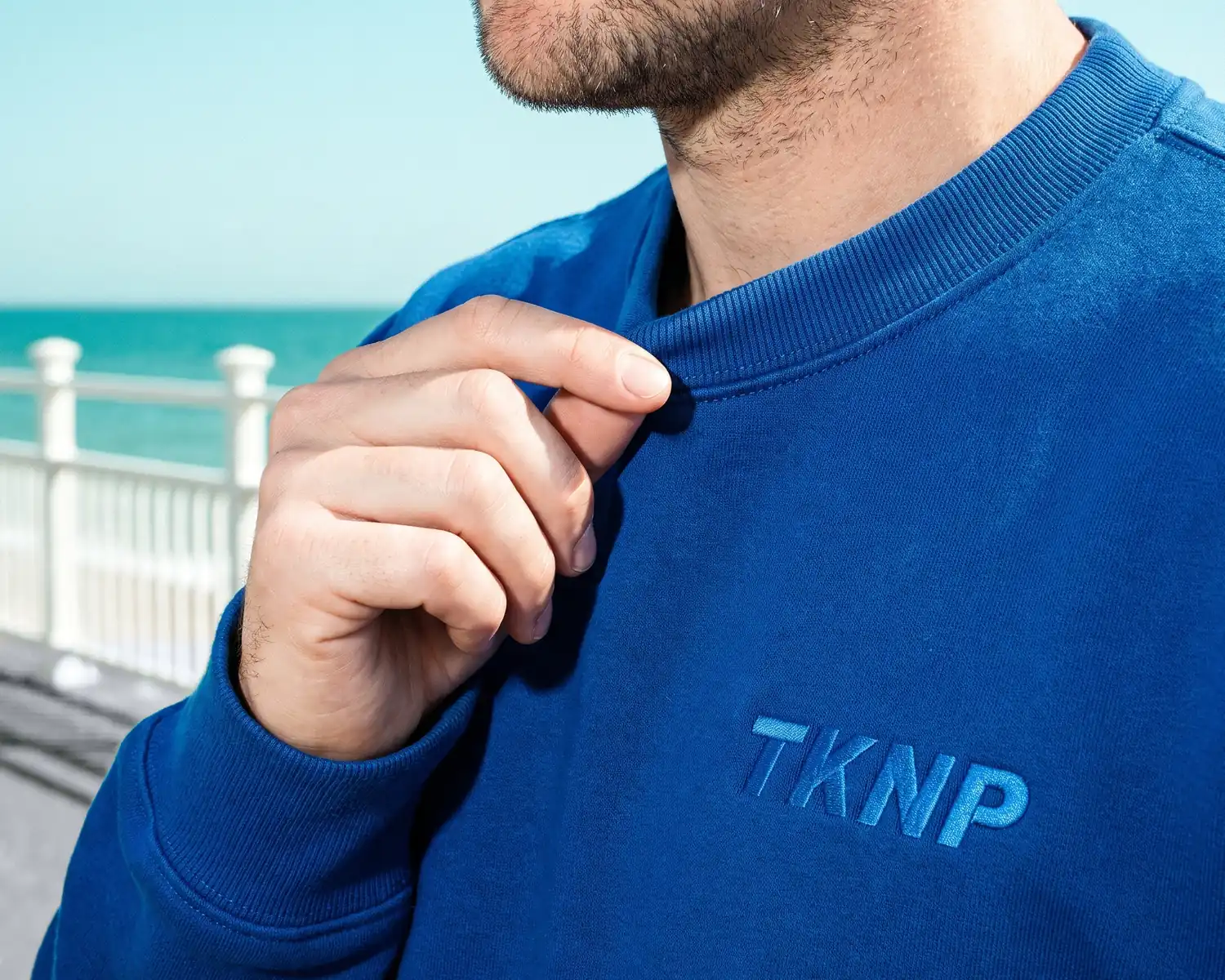
Double seams on the hems and a neck tape at the collar point to a garment built to last: they reinforce the areas that work the hardest. The page of the Man Regular T-Shirt by JHK puts it in its own way, with double stitching that strengthens its neck, shoulders and waist.
These finishes are in the description or on the Construction line. On the Creator 2.0 by Stanley/Stella, the Construction line lists a wide double topstitch at the sleeve and bottom hems and a neck tape inside the collar. On 6 November 2026, among the models featured on our pages, 25 t-shirts out of 54 and 12 sweatshirts out of 51 state double seams, 20 t-shirts and 14 sweatshirts a neck tape.
How the body is assembled, on the other hand, does not separate two t-shirts: a tubular model, cut with no side seams (10 in this selection), and a side-seamed model (12) are two ways of doing it, and no page ranks one above the other. The steps that lead from yarn to finished t-shirt, and what each one leaves on the product page, can be followed in the article that tells how a t-shirt comes to be.
5. How do you know whether the garment will hold up in the wash?
A garment that holds up in the wash often says so on its page, through two clues: the word "pre-shrunk" and a high washing temperature. On 6 November 2026, among the models featured on our pages, 12 t-shirts and 7 sweatshirts are described as pre-shrunk cotton, and four pages state a 60 °C wash, among them the Sof Tee page at Tee Jays: its pre-shrunk cotton is said to take that temperature.
Pre-shrunk means the fabric will shrink less, not that it will never move at all. What can still change, and the drying habit that limits it, are explained in the article on why a garment shrinks.
6. How do you avoid a textile that pills?
To limit pilling, aim for a combed yarn and a dense fabric, with a high weight; for a sweatshirt, also look at the inside of the fleece, brushed or looped. No page promises it in so many words: on the pages of the 105 t-shirts and sweatshirts featured on 6 November 2026, the word pilling appears nowhere.
For a sweatshirt, the description says whether the inside is brushed (or raised) or looped: of these 51 sweatshirts, 35 are brushed or raised, which are warmer, and 3 are looped, two finishes that do not react to friction in the same way. Why friction creates those little balls, and how to rescue a sweatshirt that is already pilling, is explained in our article on pilling.
7. Which textile labels should you look for?
On our product pages, the two labels to look for are OEKO-TEX, for harmful substances, and GOTS, for organic cotton; each proves one precise thing about the blank garment, never its lifespan nor your decoration. They appear on the Certifications line of the product page, or in its description.
On 6 November 2026, among the models featured on our pages, the Certifications line appears on the 24 Stanley/Stella t-shirt and sweatshirt pages: OEKO-TEX on all 24, GOTS on 19. Eight B&C t-shirts mention the Better Cotton farming programme, which is not an organic label. Nothing in these mentions extends to the inks or threads of the decoration added afterwards: the label stays that of the model as its brand makes it.
What each label guarantees, and the limit people forget, is set out in our guide to textile labels.
8. Keep a blank sample as the reference for the batch
Trying a blank sample, ordered before the batch, checks in your hands what the product page announces. At tknp.io, an undecorated garment can be ordered from one piece, to see before any run whether size, fabric and colour suit you, as our FAQ intends; the decorated run begins at 10 pieces per reference, all sizes and colours counted together. Our terms of sale set the price of that sample: the price of the first step of the grid, i.e. €6.97 excl. VAT for a blank Sof Tee by Tee Jays on 6 November 2026 (excluding shipping and VAT, as an indication).
That day, 81 of the 105 t-shirts and sweatshirts featured on our pages offer this blank on their product page, with a separate add-to-basket button below the customisation ones. Once the sample arrives, run it through the criteria of this guide: does the sewn-in label give the same composition as the page? Do the hems carry the double seams announced? Does the fabric have the body its weight promised?
Then keep it as it is, without washing or wearing it: it is your reference. If you also want to test it in the wash, take two, one for the test, the other for the comparison. The sample also settles the question of the fit, before the team gives its sizes.
How many sizes does it take to dress the whole team?
Count the sizes of the model before you choose it: on five product pages that we read on 6 November 2026, sizes run from 6 sizes (S to 3XL, WU600 Set In Sweatshirt by B&C) to 10 (XXS to 5XL, Creator 2.0 by Stanley/Stella). In between, the College Hoodie by Just Hoods offers 9 (XS to 5XL), the Freestyler 8 (XXS to 3XL), the Authentic Classic T by Russell 7 (S to 4XL).
A team with someone who wears XXS or 4XL therefore reads the Sizes line before anything else, to dress everyone in the same reference. Once the model is chosen, collecting sizes without mistakes, step by step avoids copying errors.
What should you check when a batch of custom garments arrives?
When a batch of custom garments arrives, place a few garments from the run next to the blank sample kept before ordering and compare the colour, the feel and the label, then check the decoration, the sizes and the count. Our FAQ sets the time limit: "Any defective piece is replaced or refunded: write to us within 30 days of receipt."
Our terms of sale set out the steps: a conformity claim goes to support@tknp.io, "with photographs of the pieces concerned", and garments that do not match the validated order are taken back at our expense. A customised garment with no defect, on the other hand, cannot be returned or exchanged.
What does a batch of quality t-shirts cost?
A batch of 100 t-shirts that clear the 160 g/m² threshold costs, in this table, from €4.91 excl. VAT per t-shirt (#E190 by B&C, 185 g/m²) to €8.77 excl. VAT (Creator 2.0 by Stanley/Stella, 180 g/m² combed organic cotton), for an A6 logo printed by DTF transfer, according to our product pages on 6 November 2026. The two lighter models at the top of the table serve as a starting point: every criterion you gain has a cost, but not the same one.
| T-shirt | Yarn and composition | Weight | Seams and washing | Label on the blank model's page | 100 t-shirts, A6 DTF transfer (excl. VAT) |
|---|---|---|---|---|---|
| #E150 Men, B&C | pre-shrunk ring-spun cotton | 145 g/m² | tubular | Better Cotton | €4.14 |
| Man Regular T-Shirt, JHK | pre-shrunk cotton | 155 g/m² | tubular, double stitching | none | €4.57 |
| #E190 Men, B&C | pre-shrunk ring-spun cotton | 185 g/m² | tubular | Better Cotton | €4.91 |
| Authentic Classic T, Russell | semi-combed cotton | 180 g/m² | tubular, twin needle | none | €5.05 |
| Sof Tee, Tee Jays | pre-shrunk combed ring-spun cotton | 185 g/m² | side seams and double seams, 60 °C wash | none | €8.20 |
| Creator 2.0, Stanley/Stella | organic, combed and ring-spun cotton | 180 g/m² | double topstitch, neck tape | GOTS, OEKO-TEX | €8.77 |
Prices excl. VAT read on 6 November 2026 on our product pages, per t-shirt with decoration included: 100 pieces of one model, logo in A6 DTF transfer in a single position, most accessible colour, standard size, production at the standard two-week production time; shipping and VAT on top; as an indication, only the quote being binding.
Fabric weight costs little: from the #E150 to the #E190, same brand and same yarn, 40 g/m² more add €0.77 per t-shirt. Moving to a combed cotton, from another brand, weighs more: the Sof Tee costs €3.29 more than the #E190, at the same weight. On a t-shirt worn all year with the team's logo, those 3 to 4 euros buy a feel and a hold that people want to come back to.
On a sweatshirt, the gap grows with the fabric. Under the same conditions, for 100 pieces in A6 DTF transfer: at Just Hoods, the College Hoodie, mostly cotton and at 280 g/m², costs €14.69 excl. VAT; at Stanley/Stella, the Drummer 2.0, with 85% combed organic cotton and 280 g/m² as well, whose page carries the OEKO-TEX mention, €26.27 excl. VAT; the Cruiser 2.0, in 100% combed organic cotton at 350 g/m², which its maker has certified GOTS and OEKO-TEX, €31.99 excl. VAT. Seven sweatshirts are set side by side, price and weight included, in our ranking of sweatshirts to customise.
Frequently asked questions
Is a more expensive t-shirt always better quality?
Not always: the price also follows the range and the feel you are after. For 100 pieces in A6 DTF transfer, the Freestyler by Stanley/Stella, 240 g/m² carded organic cotton with a dry, textured feel, costs €16.05 excl. VAT, and the Creator 2.0, 180 g/m² combed organic cotton, €8.77 excl. VAT, according to our product pages on 6 November 2026: two t-shirts from the same brand, two feels, not a quality ladder. Judge first the criteria that matter for your use, then the price.
Do you need a blank sample of each colour in the batch?
Yes, if the batch mixes several colours and the shade matters: one blank per colour lets you judge each in your hands, as our FAQ intends for colour, and each one is charged at the price of the first step of its grid under our terms of sale. The minimum for the decorated run, for its part, stays at 10 pieces per reference, colours mixed.
Does the OEKO-TEX label tell you whether a garment will last?
No. OEKO-TEX Standard 100 is about harmful substances, so about the skin, not about wear. The EU Ecolabel, for its part, also tests how a garment holds up in the wash; otherwise, lifespan is read in the weight, the yarn and the seams.
Do the large sizes in a batch cost more?
A little more, yes. Our grids start from the basic colour in a standard size, and the note under each grid says so: the brand's extra on some colours and on the large sizes is added when you tick them. The minimum of 10 pieces, for its part, counts all sizes together.
Your project, quoted within 24 hours.
Describe your garments, your decoration and your quantities: you receive a detailed quote, decoration included, within one business day.