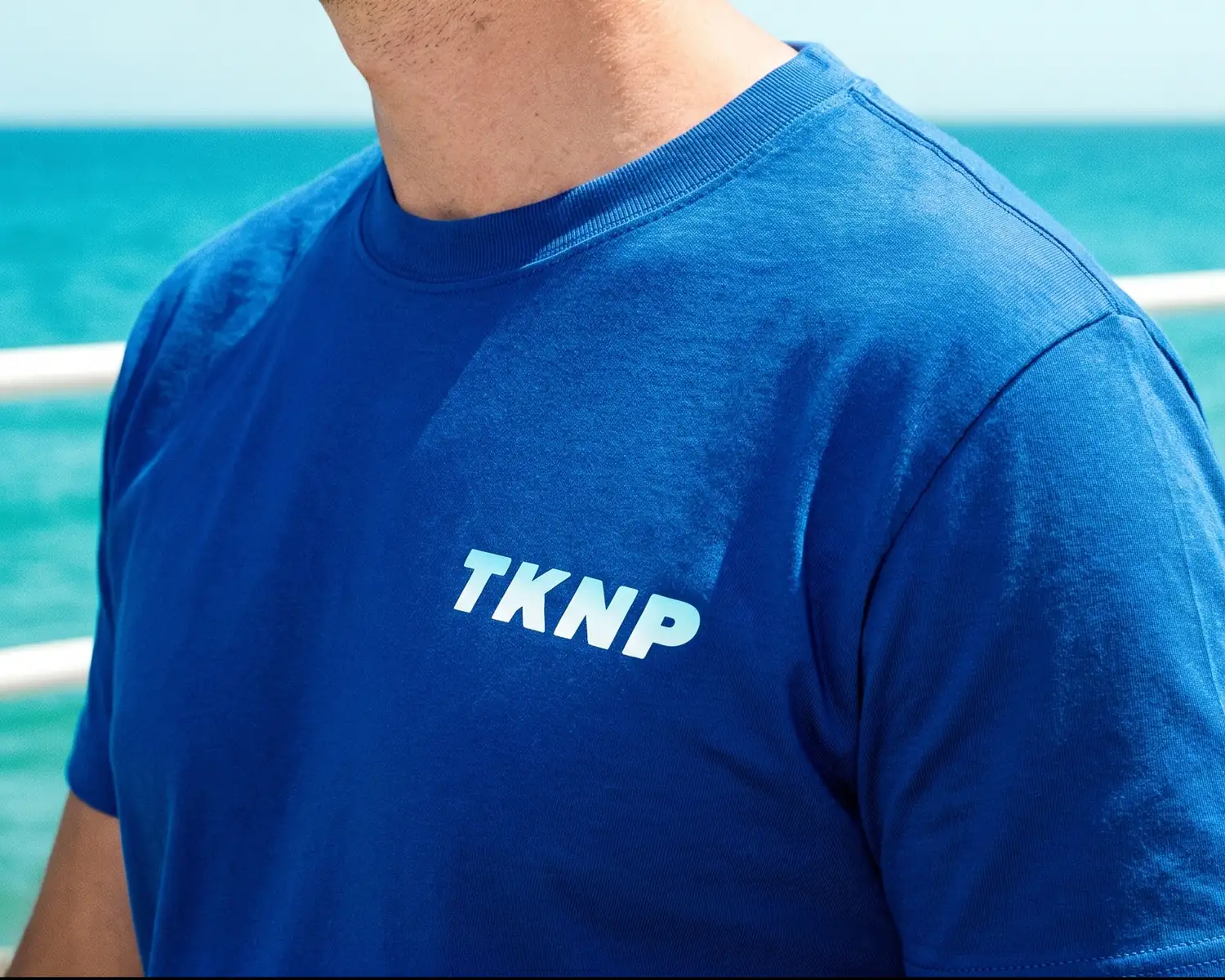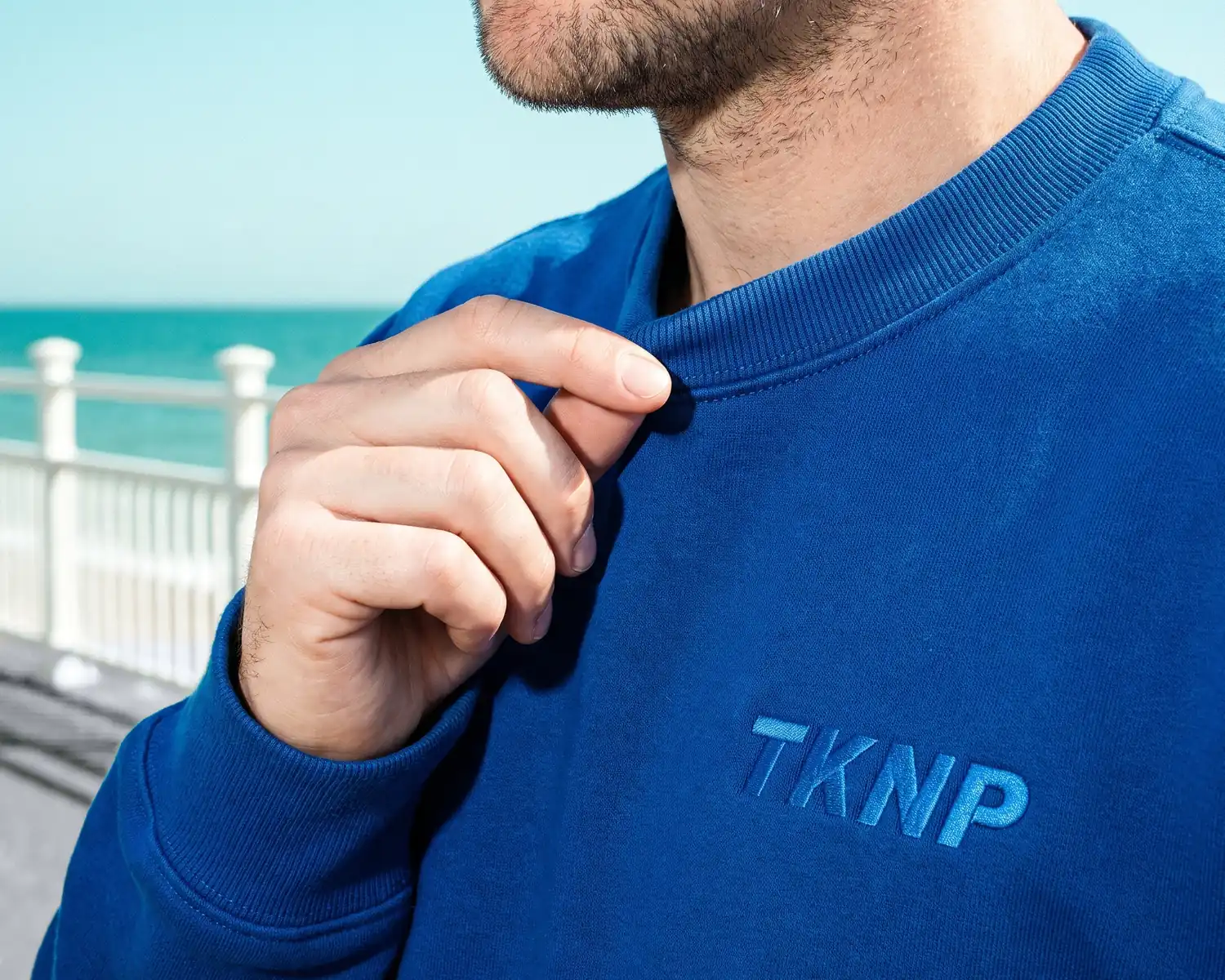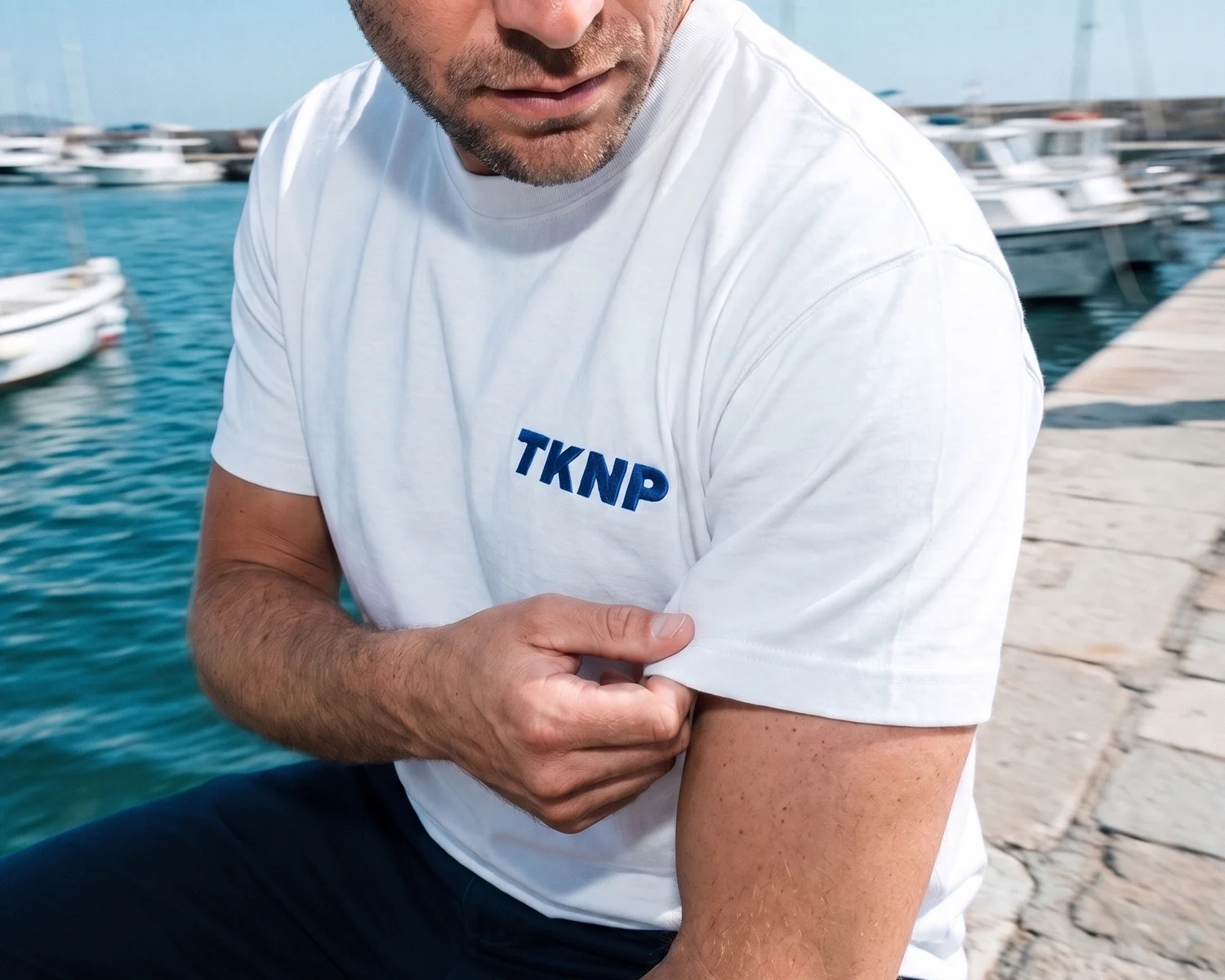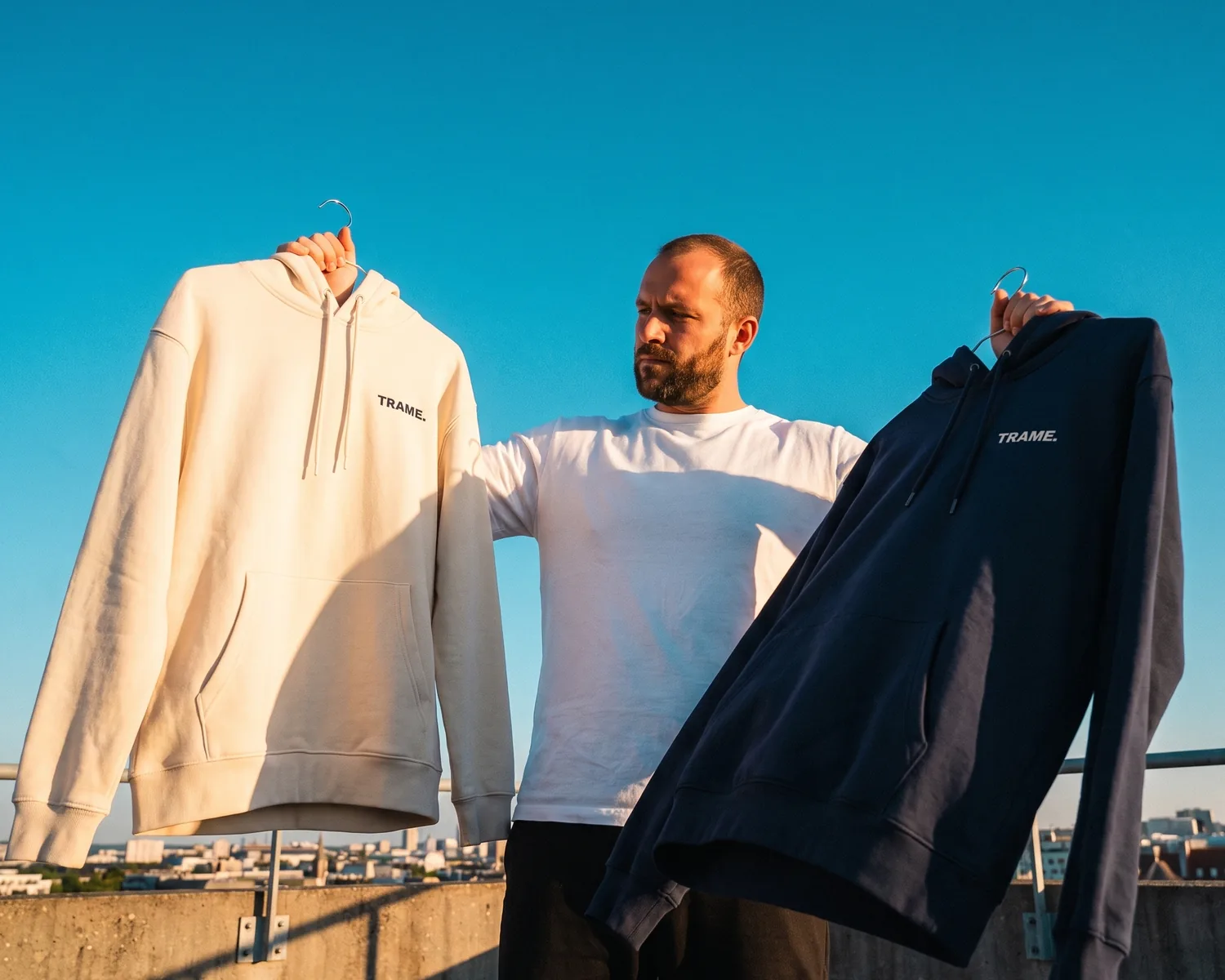
For a sweatshirt or hoodie worn all year, aim for 280 gsm: soft and dense enough to last, it is the weight of 27 of the 51 sweatshirts on tknp.io. For a heavy one that keeps its shape for years, or one to sell, go up to 350 gsm.
The fabric weight is shown on the product page, in g/m² (49 of the 51 tknp.io sweatshirt product pages give it). That number says a lot about how thick a custom sweatshirt is and how well it holds up, but not everything: the inside of the fleece, the fabric content and the fit matter just as much. Here is how to read it, use by use, with prices.
What is a sweatshirt's fabric weight?
A sweatshirt's fabric weight is the weight of one square metre of its fabric, in grams per square metre: g/m², or gsm. The higher the number, the denser and thicker the fleece. A 350 gsm sweatshirt is therefore cut from a fabric 25% heavier than a 280 gsm one.
The number does not give the weight of the finished sweatshirt: it measures the fabric, not the garment with its hood, ribbed trims and seams. It is there to compare how thick two fleeces are, whatever the size of the sweatshirt.
Some brands, mostly American ones, show the weight in ounces (oz): a sweatshirt sold as 8 oz is about 270 gsm, a 10 oz one about 340 gsm. The conversion rule, along with the benchmarks for t-shirts, is in our guide to the heavyweight t-shirt.
280, 300 or 350 gsm: sweatshirt fabric weights
In the tknp.io sweatshirt catalogue, fabric weights range from 250 gsm, for a children's sweatshirt, to 350 gsm, and 280 gsm leads by far: 27 models out of 51 (two product pages do not show theirs), crew neck and hoodie alike. The table places each step, on the body and in use.
| Weight | How it wears | What it is for | Catalogue examples |
|---|---|---|---|
| 260 gsm | light and fluid, slips under a jacket | between seasons, zip sweatshirt | Velilla's two-tone zip-neck sweatshirt, the lightest adult sweatshirt in the catalogue |
| 280 gsm | soft, dense enough to last | the team sweatshirt worn all year | Stanley/Stella Roller and Drummer 2.0, Just Hoods College Hoodie, B&C Id.222 |
| 300 to 330 gsm | more structure, more warmth | loose fits, winter sweatshirts | Stanley/Stella Stella Alma and Stella Nora (300), JHK Kangaroo Oversize (320), Build Your Brand Fluffy Hoody (330) |
| 340 to 350 gsm | heavy, structured, keeps its shape | the sweatshirt kept for years, or sold | Stanley/Stella Cruiser 2.0, Changer 2.0, Radder 2.0 and Slammer 2.0, B&C Influence Hoodie (350), Just Hoods Vision Heavyweight Hoodie (340) |
Market benchmarks point the same way: around 260 gsm, a sweatshirt gets more fluid; around 360 gsm, it becomes heavy and holds its shape. Between 240 and 270 gsm, it counts as a lightweight sweatshirt.
The right fabric weight for how your team wears it
Aim for 280 gsm for a sweatshirt worn all year, 300 gsm and up for one worn outdoors in winter, 350 gsm for one to keep or to sell, and 320 to 350 gsm for an oversized fit. The weight follows the way the team will wear the sweatshirt.
A sweatshirt worn all year: 280 gsm
For a sweatshirt worn at the office, at the club or on campus, from September to June, 280 gsm is the right call. It is thick enough to take washes and seasons, soft enough to wear every day, on its own or under a jacket. It is the weight of the class sweatshirt, the club sweatshirt and the company sweatshirt people pull on without thinking.
A sweatshirt worn outdoors in winter: 300 gsm and up
For volunteers by a pitch in November, a front-of-house team working outside or supporters in the stands, aim for 300 gsm and up, with a brushed inside that holds the warmth. At Stanley/Stella, the Roller and Drummer 2.0 (280 gsm) as well as the Changer 2.0 and Cruiser 2.0 (350 gsm) are made of brushed fleece: with the same inside, the 350 gsm ones keep you warmest.
A sweatshirt to keep for years, or to sell: 350 gsm
When the sweatshirt is the merch of an association, a venue or a brand, and you want to see it still worn in three years, go up to 350 gsm. The dense fleece gives the sweatshirt the structured drape of a brand garment and helps it keep its shape. It is also the weight to favour for a sweatshirt sold to your community through the tknp.io Store: whoever reserved it judges it the moment it arrives.
An oversized fit: 320 to 350 gsm
A loose fit needs a fleece that carries the volume: too thin, an oversized sweatshirt hangs instead of draping. The oversized sweatshirts in the catalogue have a fabric weight of 320 gsm for JHK's Kangaroo Oversize hoodie, and 350 gsm for Stanley/Stella's Radder 2.0 (crew neck) and Slammer 2.0 (hoodie).
How much does a heavier sweatshirt cost?
At Stanley/Stella, going from 280 to 350 gsm costs EUR 3.96 to 5.94 more per sweatshirt, excluding VAT, for 50 embroidered sweatshirts (tknp.io product pages of 5 November 2026, for guidance only). The brand lends itself to the comparison with two pairs of sweatshirts, the Roller and the Changer 2.0 as crew necks, the Drummer 2.0 and the Cruiser 2.0 as hoodies: 280 gsm in organic cotton and recycled polyester on one side, 350 gsm in 100% organic cotton on the other.
| Sweatshirt | Weight | Style | 50 embroidered, price per sweatshirt excl. VAT |
|---|---|---|---|
| Roller | 280 gsm | crew neck | EUR 24.29 |
| Changer 2.0 | 350 gsm | crew neck | EUR 28.25 |
| Drummer 2.0 | 280 gsm | hoodie | EUR 29.56 |
| Cruiser 2.0 | 350 gsm | hoodie | EUR 35.50 |
For 50 sweatshirts embroidered at 8 × 10 cm, prices per sweatshirt excluding VAT read on our product pages on 5 November 2026, for guidance only: one logo placed once, in the cheapest shade, regular sizing, two-week standard production, delivery not included. The gap pays for both the extra 70 grams per square metre and the move to 100% organic cotton. The same sweatshirts at 10, 25 or 100 units, and with the other techniques, are priced in the guide to custom sweatshirt prices, break by break.
Is a 350 gsm sweatshirt always more expensive?
No: from one brand to another, a 350 gsm sweatshirt can cost less than a 280 gsm one. For 50 embroidered sweatshirts, B&C's Influence hoodie (350 gsm) and Just Hoods' Vision Heavyweight Hoodie (340 gsm) come to EUR 24.49 and EUR 24.47 excluding VAT, EUR 5.07 and EUR 5.09 less than Stanley/Stella's Drummer 2.0 (EUR 29.56) in 280 gsm and 85% organic cotton (product pages of 5 November 2026, for guidance only: an 8 × 10 cm embroidered logo on one placement, base colour, shipping extra). Seven sweatshirts are compared on every criterion in our selection of the best sweatshirts to customise.
What fabric weight does not tell you
Two sweatshirts of the same weight can differ in warmth and in feel. Three pieces of information sit next to the number, usually on the same product page.
- The inside of the fleece: a brushed inside keeps the warmth, French terry loops breathe better. At equal weight, the inside changes the comfort: our guide to sweatshirt fleece compares the two side by side.
- The fabric content: the Changer 2.0 and Cruiser 2.0 are 100% organic cotton (the Heather Haze marl colour blends 20% recycled cotton into its organic cotton), two models certified GOTS by their maker; the Roller and Drummer 2.0 combine 85% organic cotton with 15% recycled polyester; Just Hoods' College Hoodie blends 80% cotton and 20% polyester.
- The fit: at Stanley/Stella, the Changer 2.0 and Cruiser 2.0 (350 gsm) are slightly roomier (relaxed medium fit) than the Roller and Drummer 2.0 (280 gsm, medium fit).
What is left is the shape of the garment: our page on sweatshirt or hoodie for a team helps you decide, and the crewneck guide covers the crew neck sweatshirt.
Can you embroider a 280 gsm sweatshirt?
Yes: a 280 gsm sweatshirt takes embroidery with no difficulty, and all 51 sweatshirts in the tknp.io catalogue offer an 8 × 10 cm embroidery from 10 sweatshirts, alongside DTF transfer and screen printing. Fabric weight mostly guides the size of the embroidered design: a 350 gsm fleece holds the relief of dense embroidery better, and below 280 gsm the fabric distorts more quickly under the stitches, so a small design works best. The cost of embroidery in volume, from the threshold to lead times, is covered in our guide to embroidery on clothing.
Check the embroidery size on the proof, according to the sweatshirt's weight
On tknp.io, the size of an embroidery is first set in the designer, opened from the sweatshirt's product page, whose preview lets you see where the embroidery falls and at what size; the proof (BAT) then arrives online and is approved almost straight away, with no email back-and-forth. It is the last moment to check that this size suits the chosen fleece: dense, raised embroidery on a 350 gsm, a lighter design on a thin sweatshirt. The designer's visual remains a simulation, according to our terms of sale: it does not show how the fabric will react under the stitches, which is why the size of the design is best chosen from the fabric weight rather than from the screen.
Frequently asked questions
What is the fabric weight of a standard sweatshirt?
A standard sweatshirt has a fabric weight of 280 gsm: it is the most common fabric weight, the one of 27 of the 51 sweatshirts in the tknp.io catalogue, crew neck and hoodie alike.
Is a 280 gsm sweatshirt thick?
It is a medium thickness: dense enough for a sweatshirt worn all year, softer than a 350 gsm sweatshirt, the heaviest weight in the tknp.io catalogue.
Does fabric weight give the weight of the sweatshirt?
No: fabric weight measures one square metre of the fabric, not the finished sweatshirt with its hood, ribbed trims and seams. It is there to compare how thick two fleeces are.
What fabric weight for a hoodie?
The same benchmarks as for a crew neck sweatshirt: 280 gsm for a hoodie worn all year, 350 gsm for a heavy hoodie. In the tknp.io catalogue, hoodies range from Just Hoods' College Hoodie (280 gsm) up to the Cruiser 2.0 (350 gsm) by Stanley/Stella.
Your project, quoted within 24 hours.
Describe your garments, your decoration and your quantities: you receive a detailed quote, decoration included, within one business day.