Organic Content Standard: what does the OCS label guarantee?
The OCS (Organic Content Standard) label certifies that a garment contains organic fibres, tracked from the farm to the finished product. Managed by Textile Exchange, it has two levels: OCS 100, from 95% organic fibres, and OCS Blended, from 5%. On tknp.io, twelve SOL'S organic cotton product pages show it.
What to know:
- The OCS follows an organic material from the farm to the finished product; every site in the chain is audited once a year by an independent body.
- OCS 100 requires at least 95% organic material, with no conventional cotton mixed into the organic cotton; OCS Blended accepts any blend, from 5% organic material.
- The label checks neither dye chemistry nor working conditions, two points that GOTS does cover.
- An OCS certification is checked on the Textile Exchange website, using the company's certificate or the one for the delivery.
A sweatshirt can carry the OCS label with 80% organic cotton, a t-shirt with 100%, and their product page does not always say which of the two levels applies. This label is precise on one point, the presence of organic cotton and its share, and silent on the rest. For a brand, a company or an association that wants custom merch in organic cotton, it is often the right proof of the material, as long as you know how to read it, check it and what it lets you say.
What is the OCS (Organic Content Standard) label?
The OCS label, short for Organic Content Standard, is an international, voluntary standard that follows a material from a certified organic farm all the way to the finished product. It is managed by Textile Exchange, a non-profit organisation in the textile industry, with a stated goal: to grow organic agricultural production.
The OCS answers a single question: does this garment really contain organic fibres, and in what proportion? Its current version, OCS 3.0, has applied since 1 March 2020, and a document Textile Exchange published in April 2026 still cites it as the reference. The standard covers any product that contains at least 5% organic material, calculated on the whole product, excluding accessories and trims.
OCS 100 or OCS Blended: what is the difference?
OCS 100 and OCS Blended are the two levels of the OCS label, and they differ in their share of organic material, expressed as a percentage of the product. An OCS 100 product contains at least 95% organic material, with no mixing of certified and non-certified fibre of the same kind: no conventional cotton slipped into the organic cotton, but up to 5% of another fibre. An OCS Blended product contains at least 5% organic material and accepts any blend, including conventional cotton alongside the organic cotton.
Below 5% organic material, no certification is possible. Each level has its own round logo with a green leaf, marked "organic 100" or "organic blended". Sometimes the composition settles it: a sweatshirt with 80% organic cotton can only be OCS Blended, since 80% stays below the 95% threshold.
What does the OCS label check, from farm to garment?
The OCS label checks the path of the organic fibre, link by link along the supply chain, starting from a farm certified under a recognised organic standard: the US organic programme (USDA NOP), the EU organic regulation (EU 2018/848) or a standard from the IFOAM family. Every site that handles the material is audited once a year by an independent body.
- The farm: the material enters the chain with the farm's certificate and a transaction certificate issued by an accredited body.
- The first processor: for cotton, this is the gin, which separates the fibre from the seed; it must verify that all the organic cotton it receives comes from a certified farm.
- The following sites: manufacturing (spinning, knitting or weaving, sewing), packaging, labelling, storage and shipping are certified, up to the seller in the last business-to-business transaction.
- The paperwork: each delivery from one certified site to another travels with its supporting documents, under the Content Claim Standard, the traceability rule shared by Textile Exchange's standards.
What does the OCS label not guarantee?
The OCS label guarantees nothing about how the fabric is processed. Textile Exchange says so in its own review of version 3.0: the standard addresses neither the use of chemicals nor social conditions during processing, because it only verifies the organic content.
For your merch, that leaves three blind spots, which other textile labels cover:
- Chemistry: dyes and finishes are outside the OCS. Harmful substances in the finished garment are the job of another label, Oeko-Tex Standard 100.
- Social conditions: working conditions in the factories are not audited.
- The rest of the composition: no requirement applies to the other fibres of an OCS Blended product, which can make up to 95% of the garment.
OCS or GOTS: which one should you choose for organic cotton merch?
For organic cotton merch, the OCS is enough to prove the material and its traceability; GOTS also checks the manufacturing, from dye chemistry to working conditions. Our article on the GOTS label details its requirements; here is what separates the two.
| OCS | GOTS | |
|---|---|---|
| Managed by | Textile Exchange | Global Standards gGmbH |
| Share of organic fibres for the label | 95% (OCS 100) or from 5% (OCS Blended) | 95% (organic) or from 70% (made with organic) |
| Traceability from farm to product | yes | yes |
| Dye chemistry and wastewater | not checked | checked |
| Working conditions | not checked | checked |
| Site audits | once a year | once a year |
The right choice depends on what your merch needs to be able to say. If the argument is the material, organic cotton and its share, the OCS is enough. If your brand also wants to answer for the dyeing and the sewing workshop, go for a GOTS-certified model: in our catalogue, the product page of the Creator 2.0, a t-shirt made by Stanley/Stella, shows GOTS and Oeko-Tex. The two labels are not mutually exclusive: three OCS product pages in our catalogue also show GOTS.
Who issues the OCS label?
The OCS label is issued by independent certification bodies, approved by Textile Exchange, which owns and manages the standard. Ecocert, for example, certifies the OCS. These bodies audit each site once a year and issue two documents:
- the scope certificate: it confirms that a company is able to produce and sell OCS products, and it is valid for one year at most;
- the transaction certificate: it confirms that a specific delivery, from one company to another, complies with the standard.
How do you check that a supplier or a garment is OCS certified?
To check an OCS certification, ask your supplier for the certificate and verify it on the Textile Exchange website: its certificate policy, published in April 2026, makes it the only official source. Four steps are enough.
- The number: the scope certificate shows the certified company's ID, in the format TE- followed by eight digits.
- The official page: look the company up on Textile Exchange's "Find a Certified Company" page, the only one that counts to authenticate a scope certificate.
- The dates: check that the certificate's validity period covers the date of your order.
- The delivery: for a specific batch, the transaction certificate is authenticated on the "Authenticate a Transaction" page. Certificates issued under this policy, in force since 1 October 2026, also carry a link or a QR code to their record on the Textile Exchange website.
Can you put the OCS logo on your own merch?
No, not on your own initiative: the OCS logo on a sewn-in label or a hangtag is reserved for products certified up to the seller in the last business-to-business transaction, with artwork approved by a certification body, and only a certified company may attach it to the garment. That is rule B2.1.1 of the standard. A brand that buys OCS garments without being certified itself therefore has no say over this logo.
Rule B2.1.2 leaves a door open: a company that buys certified products may mention the OCS in its general communication, provided transaction certificates prove it. The exact wording is governed by the logo use and claims guide published by Textile Exchange. Without these documents, stick to what the garment's composition label says: "100% organic cotton" is information about the material, not a label.
Which garments in the tknp.io catalogue show the OCS label?
Among the organic cotton models in the tknp.io catalogue, twelve product pages show the OCS label as of 20 October 2026, all from the SOL'S brand: six t-shirts, three polo shirts and three sweatshirts, in men's, women's, unisex and kids' cuts. All of them also show Oeko-Tex and PETA Vegan, and three add GOTS: the Pioneer Women and Crusader Women t-shirts, and the Planet Men polo shirt.
None of these pages states the level, OCS 100 or OCS Blended. For a 100% organic cotton model, both remain possible, and only the certificate settles it.
Is an OCS garment always 100% organic cotton?
No: an OCS garment can blend organic cotton with another fibre. At SOL'S, the Comet sweatshirt and the Stellar hoodie contain 80% organic cotton and 20% recycled polyester, with a 100% organic cotton outer face, the one you see and the one you print on. At 80%, they can only fall under the OCS Blended level. If your merch makes organic part of its message, choose a 100% organic cotton model: your message and the composition label will then say the same thing.
How much does an OCS model from the catalogue cost, customised on tknp.io?
On tknp.io, the SOL'S models whose product page shows the OCS label can be customised: for 50 garments screen printed over 50 cm², the Crusader Men t-shirt costs €4.14 excluding VAT, the Planet Men polo shirt €8.43 and the Comet sweatshirt €15.28. These are our prices, read on 20 October 2026 in each product page's price grid: excluding VAT, per garment, shipping extra, with a logo in one spot on the garment, for the cheapest base shade and the usual sizes. A few colours and the biggest sizes add a small surcharge, visible when you select them. They are given for guidance only: each product page shows the current rate.
| SOL'S model on tknp.io | Garment | Composition on the page | Labels on the page | Price excl. VAT for 50, 50 cm² screen print |
|---|---|---|---|---|
| Crusader Men | t-shirt | 100% organic cotton | OCS, Oeko-Tex, PETA Vegan | €4.14 |
| Pioneer Men | t-shirt | 100% organic cotton | OCS, Oeko-Tex, PETA Vegan | €5.02 |
| Pioneer Women | t-shirt | 100% organic cotton | GOTS, OCS, Oeko-Tex, PETA Vegan | €5.02 |
| Planet Men | polo shirt | 100% organic cotton | GOTS, OCS, Oeko-Tex, PETA Vegan | €8.43 |
| Pegase | polo shirt | 100% organic cotton | OCS, Oeko-Tex, PETA Vegan | €9.70 |
| Comet | crewneck sweatshirt | 80% organic cotton, 20% recycled polyester | OCS, Oeko-Tex, PETA Vegan | €15.28 |
| Stellar | hoodie | 80% organic cotton, 20% recycled polyester | OCS, Oeko-Tex, PETA Vegan | €20.47 |
What minimum order and what lead time for an OCS model from the catalogue?
On tknp.io, the minimum order for a SOL'S model whose product page shows OCS, branded with your logo, is 10 garments of the same model; the run can mix sizes and colours. As for lead time, at the standard pace, your run leaves, decorated, in 10 working days; in rush mode, in 5 working days. The estimated delivery date then appears in your basket.
Test an OCS model from the catalogue before you launch your run
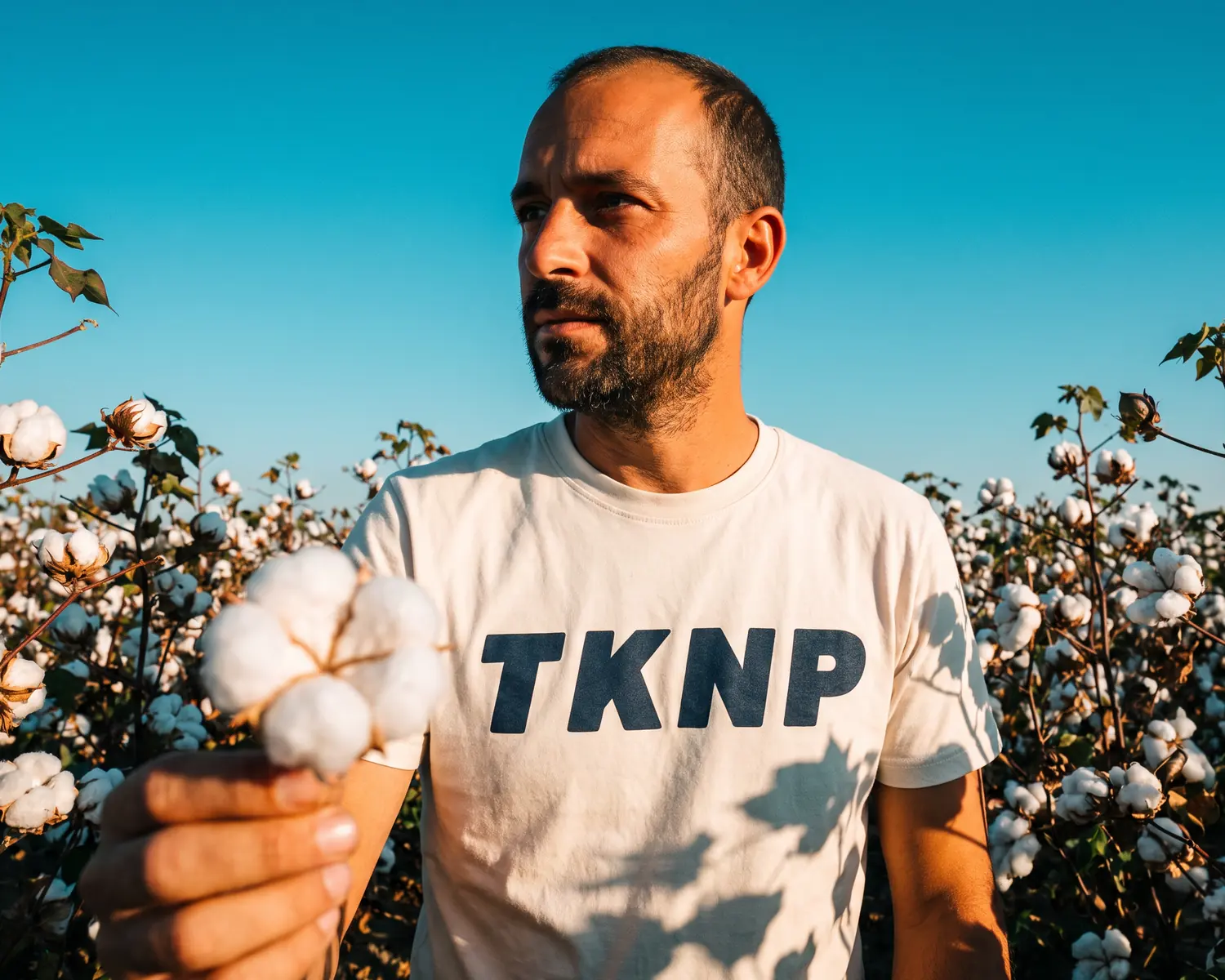
A label is checked on a certificate; a material is judged by hand. On tknp.io, the seven SOL'S models in the price table, from the Crusader Men to the Stellar, can be ordered blank from a single garment: €3.84 excluding VAT for a blank Pioneer Men t-shirt, an indicative price taken from the FAQ on its product page on 20 October 2026. You feel the jersey, you read the composition label, you try the size. The Pioneer Men's product page offers it in the Ecru colour, among others, the shade of the t-shirt in our photo.
From the product page, "Customise online" then opens the designer: you place your logo on the chosen model and see the result before launching the run. And if your brand sells this merch to its community, the tknp.io Store runs it as a pre-sale: everyone reserves their size, then everything is produced in a single run.
Frequently asked questions
Does the OCS label guarantee GMO-free cotton?
The OCS standard requires organic cotton to be tested for GMOs, under Textile Exchange's OCS-103 protocol (requirement C2.1 of the standard). The certified companies that receive this organic cotton must cooperate with these tests and carry them out.
Can "in-conversion" cotton carry the OCS label?
In-conversion cotton, from a farm that has not yet completed its switch to organic, can enter the OCS chain if that farm's agricultural standard allows it. A product made from this material, however, falls into the "OCS no label" category: it can carry neither the OCS 100 logo nor the OCS Blended logo, unless it contains enough material that is already certified organic.
Does the OCS cover fibres other than cotton?
Yes: the OCS applies to any material from a certified organic farm, not only cotton. The standard sets, for example, a rule for organic wool: it must come from sheep that have not undergone mulesing, or from farms that have stopped the practice.
Will the OCS label disappear with the Materials Matter Standard?
No, not as things stand. Textile Exchange is bringing several of its standards, including GRS, into a new framework, the Materials Matter Standard, which takes effect on 31 December 2026 and becomes mandatory a year later. Its transition policy, published on 1 April 2026, leaves the OCS out: it continues to operate in parallel.
Your project, quoted within 24 hours.
Describe your garments, your decoration and your quantities: you receive a detailed quote, decoration included, within one business day.