Between flex and screen printing, choose screen printing: the ink, printed then heat-cured, lasts as long as the t-shirt itself: it is worth it from about twenty t-shirts and becomes the cheapest from 50. Below 25 t-shirts, take DTF transfer. Flex, a plastic film glued onto the fabric, is best avoided: it needs delicate care and limits the logo to one colour per cut.
| Screen printing | DTF transfer | Flex ("flocage") | |
|---|---|---|---|
| How it works | ink pushed through a screen, colour by colour, then heat-cured | design printed onto transfer film, then applied with a press | plastic film cut along the drawing, then bonded with a press |
| Colours | one screen per colour | all colours at once | one colour per cut |
| Wash resistance | dozens of washes without losing sharpness | holds well at 30-40 °C | wash inside out, at low temperature, no tumble dryer |
| B&C #E150 t-shirt, 25 units | about 7.50 euros | about 5.50 euros | not offered |
| Same t-shirt, 100 units | about 3.50 euros | about 4 euros | not offered |
| At tknp.io | yes, from 10 units | yes, from 10 units | no |
Prices from the B&C #E150 product page, read on 12 October 2026 and indicative only: excluding VAT, one-colour logo in A6 format for the transfer, one print position, delivery extra. They may change.
The print is the part of a custom t-shirt people look at first, and the part they see age first. A logo that cracks or lifts after the third wash is enough to send a t-shirt to the back of the wardrobe: choosing the technique means choosing how long your merch will be worn.
"Flocage", a word used wrongly
In French textile printing, "flocage" is a misnomer: the word now covers, in the vast majority of cases, a flex transfer, that is a plastic film cut then bonded with a press, not the original technique, which glued on fibres with a velvet feel. Our page on textile flocking tells the story of this confusion; in the rest of this article, "flex" is what French buyers call flocage.
What is the difference between flex and screen printing?
Flex glues a plastic film onto the fabric, screen printing pushes ink through a screen. For flex, a machine cuts the design out of vinyl film, one colour per cut, then a press bonds it to the t-shirt with heat: the logo remains a film added onto the fabric.
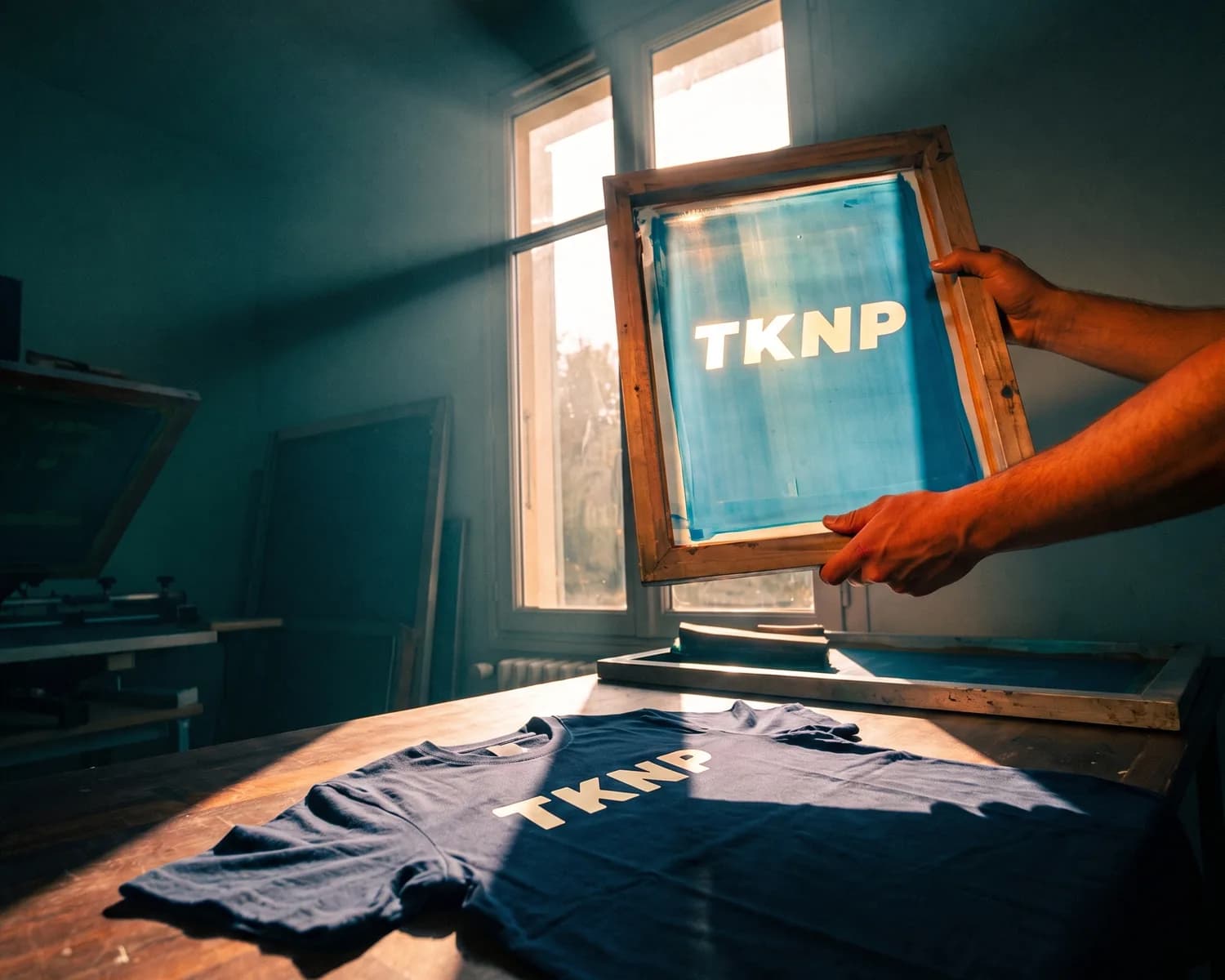
In screen printing, the ink passes through a screen engraved for each colour of the design, then is heat-cured. It gives dense, opaque colours, even on a dark t-shirt.
Screen printing or flex: which one lasts longer?
Of the two, screen printing lasts best: along with embroidery, it is the decoration that goes through dozens of washes without losing sharpness, and a screen-printed logo in practice lasts as long as the t-shirt carrying it. That is why it remains the reference for team, festival or association t-shirts you want to see worn for several seasons.
Flex, on the other hand, needs care at every wash: the t-shirt goes in inside out, on a cool cycle, and never into a tumble dryer, because its heat ends up detaching a film that was bonded with heat. In a t-shirt's real life these rules are rarely followed, and that is when the logo starts lifting at the edges.
How much does screen printing cost compared with transfer?
On the B&C #E150, screen printing a one-colour logo costs about 7.50 euros excluding VAT per t-shirt at 25 units, against 5.50 euros as a DTF transfer; the two meet at around 4.50 euros at 50 units, then screen printing pulls ahead, at around 3.50 euros at 100 and 3 euros at 250.
From 25 t-shirts, screen printing therefore costs only about 2 euros more per t-shirt than the transfer, for a print that lasts as long as the garment: that is where we recommend it when the t-shirt is meant to be worn for a long time. Below that, at 10 or 20 units, its price doubles and DTF transfer remains the sensible choice.
The gap comes from the cost of the screen, engraved once per colour: our articles on t-shirt screen printing and DTF transfer work through that calculation technique by technique.
A multi-colour logo: which technique?
For a multi-colour logo, screen printing engraves one screen per colour and our grid goes up to six; DTF transfer prints every colour at once, gradients and photos included. Flex, for its part, needs one cut per colour, which limits it quickly as soon as the logo gets more complex.
Why tknp.io doesn't offer flex
tknp.io doesn't offer flex because it combines two drawbacks: delicate care, and a single colour per cut. For a small run, DTF transfer takes its place: like flex, it is a heat-applied film that also needs gentle washing and holds well at 30-40 °C, but it prints every colour at once, can be ordered from 10 units and works on almost every fabric. Only a very large solid area keeps a slightly filmy feel. From 25 t-shirts, and to really last, it's screen printing.
Players' names and numbers, different from one jersey to the next, raise a separate question, covered in our guide to jersey flex printing.
See on the product page when screen printing pulls ahead
Take the #E150: its product page grid shows the price of screen printing and DTF transfer at each tier, from the first 10 units up to 1,000, decoration included: you can see at a glance from what quantity screen printing becomes the cheapest, for the model and the run you have in mind.
Frequently asked questions
Which technique should you choose for 25 t-shirts?
For 25 t-shirts, choose screen printing if the t-shirt is meant to last: on a B&C #E150, it comes to about 7.50 euros excluding VAT per t-shirt, against 5.50 euros as a DTF transfer, so 2 euros more for a print that lasts as long as the t-shirt. Below 25, its price doubles and DTF transfer is the more sensible choice.
Why do French buyers say "flocage" for a printed t-shirt?
Out of habit: the word meant a technique that glued on velvety fibres, then it was taken over for flex transfer, and today for almost any decoration applied to a t-shirt. Before ordering, always ask which technique is hidden behind the word.
Does DTF transfer last as well as screen printing?
Not quite: DTF transfer holds up well in the wash between 30 and 40 °C, but less under repeated industrial washing, whereas screen printing goes through dozens of washes without losing sharpness. For a t-shirt you want to keep for years, screen printing remains the best choice.
Your project, quoted within 24 hours.
Describe your garments, your decoration and your quantities: you receive a detailed quote, decoration included, within one business day.