Water-repellent or waterproof: what does a team jacket promise?
Water-repellent means that water beads up on the surface of a treated fabric and rolls off without soaking in: a water-repellent jacket lets a shower run off. Waterproof means that water does not get through: a membrane stops it, and the jacket keeps out lasting rain when its seams are sealed.
The key points before you choose:
- Water-repellent: a treatment applied to the surface of the fabric, and it is not permanent; wear, detergents, sunscreen and dust break it down.
- Waterproof: a membrane or a coating stops water inside the fabric, and a garment described as waterproof also has its seams sealed.
- Care: washing, drying, then heating the jacket revives the water-repellent finish, if its care label allows heat.
- At tknp.io: embroidered (8 × 10 cm) in one position and ordered by 25, a jacket whose product page calls it water-repellent or waterproof costs from €36.41 to €75.81 excl. VAT per jacket, depending on the model, as of 30 October 2026, at standard lead time, in base colour and usual sizes, excluding delivery, as a guide only.
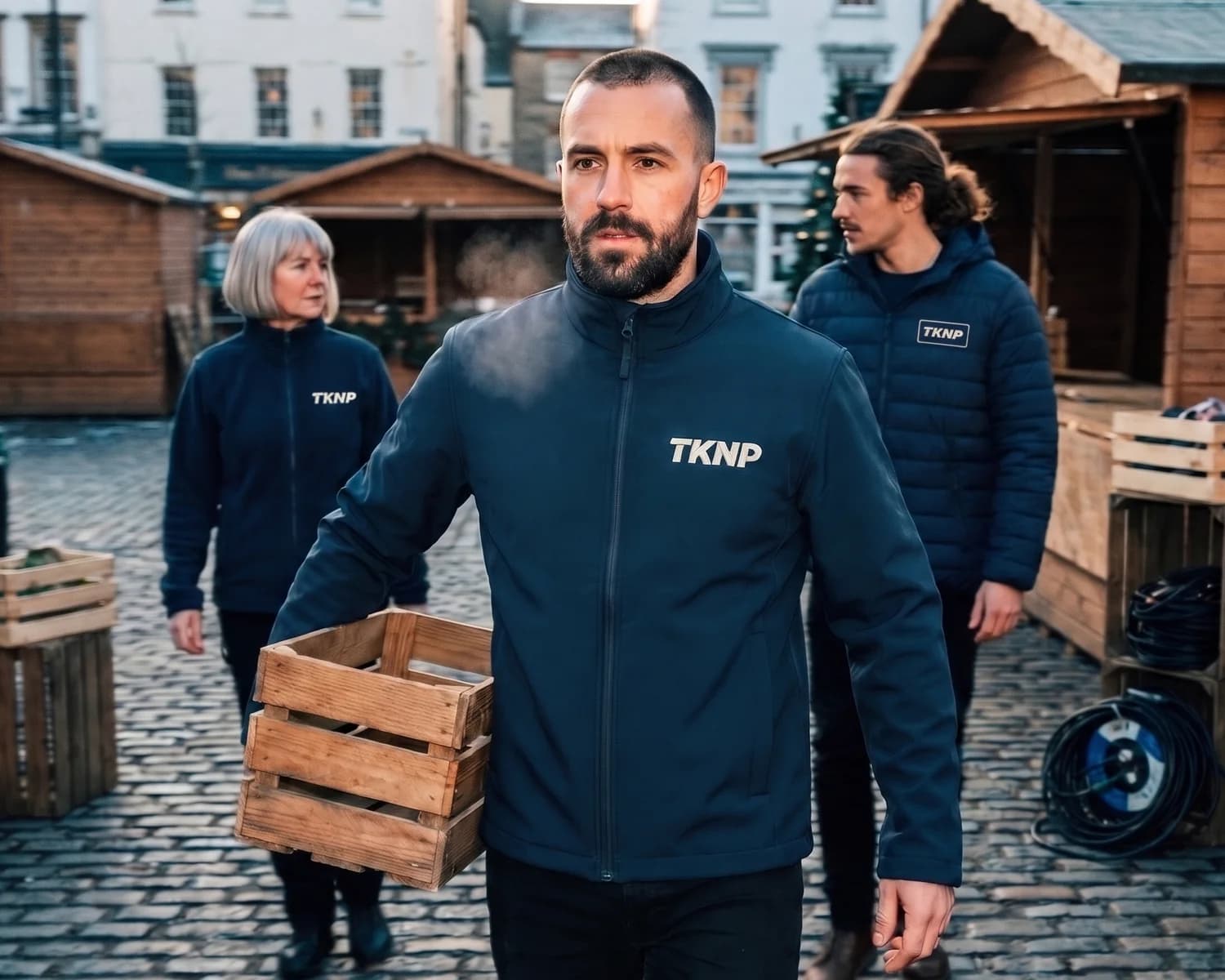
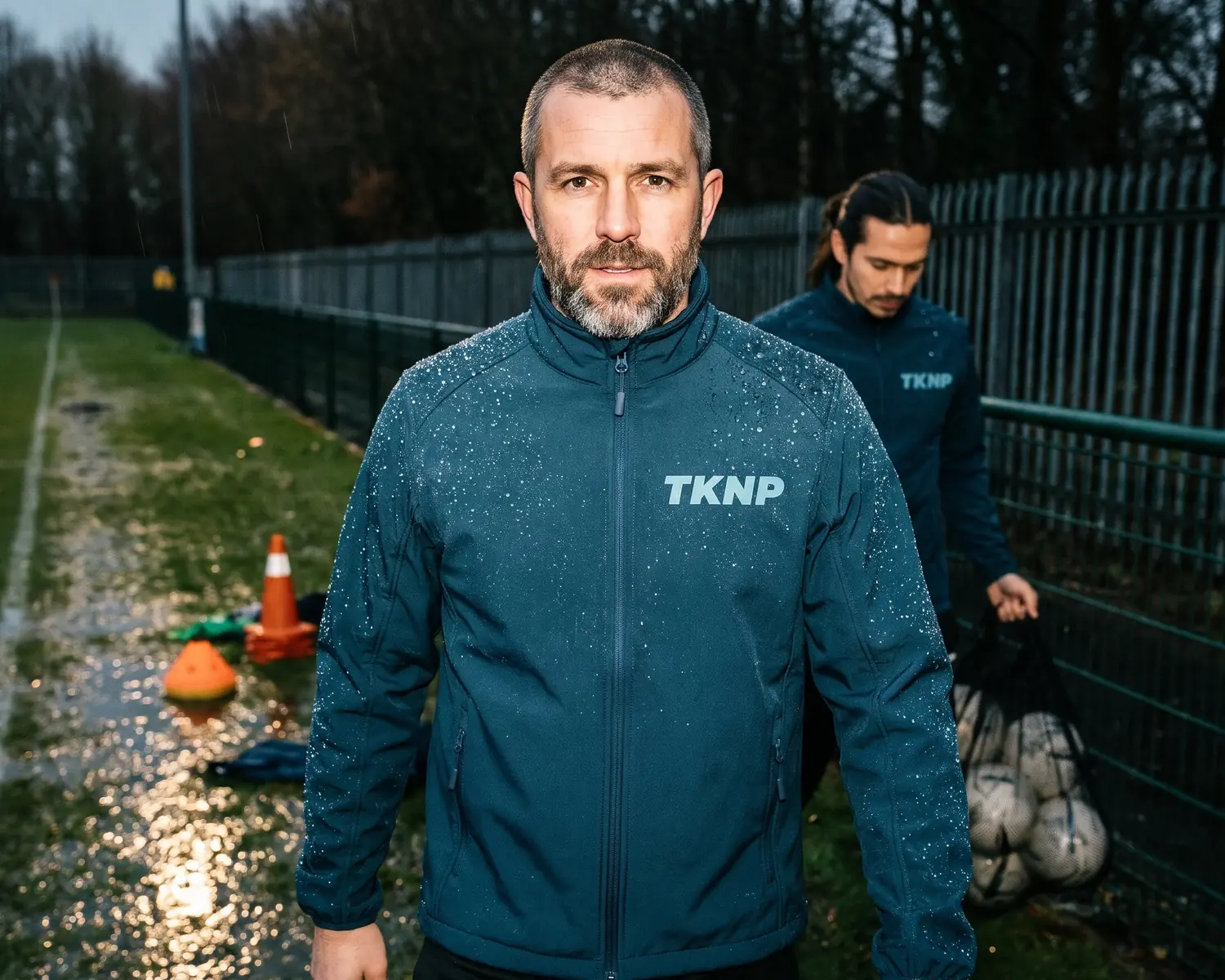
Sunday's match in the drizzle, welcoming festival-goers in a shower, the crew setting up a site in November: the team jacket spends its life outdoors, and your merch logo with it. On its product page, one word decides what you can tell the people who will wear it: water-repellent, waterproof, or both. Here is what each one means, what wears a water-repellent finish down, how to revive it, and what it changes when you add your logo.
What does "water-repellent" mean?
By definition, water-repellent describes a fabric treated so that water stays on its surface: drops gather into beads and roll off instead of soaking into the fabric. According to the French Wikipedia article on water repellency, it is a treatment, not a property of the fabric or the weave: it lasts for a limited time, and a water-repellent fabric gives way when it gets too much water.
In technical clothing, this treatment is often called DWR, for durable water repellent. The GORE-TEX garment care sheet, published by W. L. Gore & Associates, describes it as a very thin polymer treatment applied to the surface that lowers surface tension: water simply beads up and slides off.
So a water-repellent fabric is not a separate material: it is a polyester, a nylon or another fabric that has received this finish. On our product pages, the same idea appears as a water-repellent finish (B&C's Reset Puffer), a DWR water-repellent coating (B&C's Reset Bodywarmer) or a water-repellent treatment (Stanley/Stella's Puffer 2.0).
Water-repellent or waterproof: what is the difference?
The difference lies in where the water stops. A water-repellent fabric pushes it back at the surface; a waterproof fabric stops it from getting through with a membrane or a coating, even when its surface is wet. Our custom softshell jackets page puts it plainly for your teams: the water-repellent finish handles a shower for a few minutes and does not stand in for a rain jacket.
The word "waterproof" first describes the fabric. For a whole jacket to keep out long rain, its seams must also be sealed with tape: according to Wikipedia, this is the mark of a garment described as waterproof, and Gore requires this taping over the seams of every garment made with its membrane. The encyclopedia also mentions garments whose fabric exceeded a 20,000 mm water column and still leaked through the zips, the hood or the seams.
The two can be combined: on GORE-TEX garments, Arc'teryx explains, even when the outer fabric is completely wet, the waterproof membrane still keeps water out. On our product pages, each product page states its own properties: the Atlantic Men by Pen Duick has a "breathable and waterproof membrane", while the Stanley Discoverer by Stanley/Stella has a recycled TPU membrane fabric described as "windproof, water-repellent and breathable", without the word waterproof. How a softshell is built, layer by layer, is described in our softshell definition.
| Water-repellent | Waterproof | |
|---|---|---|
| Where water stops | on the surface of the fabric, as beads | inside the fabric, at the membrane or coating |
| What does it | a treatment applied to the surface of the fabric | a membrane or a coating, plus sealed seams for the garment |
| What to expect | a shower, drizzle | longer rain, depending on the fabric's water column and sealed seams |
| How to check | water beads on the shoulder | a value in mm on the product page, sealed seams |
Water-repellent, waterproof, water-resistant: the words on our product pages
On the tknp.io jacket product pages checked on 30 October 2026, water is described in five ways, and each one points to a different construction. "Water-repellent" there means a surface treatment, "waterproof" a fabric that stops water, and a value in millimetres the water column of that fabric. "Water-resistant" is the vaguest: according to Wikipedia, a water-resistant garment may handle water a little better than one simply treated against showers, but it is not rated for any water column. Here are the words, as worded on our English product pages where they exist.
| The word on the page | Example jackets | What it describes |
|---|---|---|
| water-repellent | Stanley Discoverer (Stanley/Stella): "windproof, water-repellent and breathable"; Soft Padded Jacket (Result): "Water-repellent, breathable and windproof" | a surface treatment: water beads up |
| water-resistant | Mens Printable Softshell Jacket (Result), a two-layer jacket: "Water-resistant. Breathable. Windproof." | some resistance to water with no rated water column; here a two-layer jacket, polyester outer and microfleece lining |
| waterproof | Atlantic Men (Pen Duick): "breathable and waterproof membrane"; Reset 3Lr Softshell (B&C): a waterproof and windproof TPU membrane, according to its French product page | a fabric whose membrane stops water |
| a value in mm | Softshell Jacket (JHK): "Waterproofing: 3000mm"; Prime Outdoor Vest (Pen Duick): "Waterproofing: 4000-5000mm" | the water column the fabric holds (see the FAQ) |
| PFAS-free, fluorocarbon-free | Reset Puffer (B&C): a PFAS-free water-repellent finish, according to its French product page; Stanley Voyager 2.0 (Stanley/Stella): "fluorocarbon-free water-repellent finish" | a water-repellent finish stated to be free of these compounds |
Read the whole description rather than a single word: "waterproof" there describes the fabric or its membrane, and a value in millimetres measures that fabric, not the seams. For an event, our custom jackets page points rather to the windbreaker, light and packable; choosing its fibre is compared in our article polyamide or polyester.
How long does a water-repellent finish last?
A water-repellent finish has no fixed lifespan. According to the care guides of Arc'teryx and GORE-TEX, it is not permanent: how long it lasts depends on how the jacket is used, stored and cared for, and it wears with use, detergents, sweat, dirt, smoke, sunscreen, dust or insect repellent. Our softshell page adds that it weakens with each wash.
The sign to watch for: water no longer beads, the outer fabric soaks up water, and you feel damp under the jacket, to the point of thinking it leaks.
For a team jacket worn all winter, reviving the water-repellent finish therefore becomes part of its care, just like washing.
How do you revive the water-repellent finish of a jacket when washing and drying?
According to the care guides of Arc'teryx and GORE-TEX, the water-repellent finish of a jacket is revived by washing it to remove what clogs it, drying it fully, then heating it. First of all, the model's care label rules, because not every jacket tolerates heat.
- Read the care label. The manufacturer's instructions come first; they are usually on the inside label. On our product pages, the Stanley Discoverer's care line says it is not suitable for the tumble dryer and must not be ironed: for that one, no dryer and no iron.
- Wash gently, without fabric softener. Zips closed, a small amount of pH-neutral detergent, no fabric softener, which can impair waterproofness and the performance of the water-repellent finish, then a good rinse in clean water.
- Dry, then heat. Heat is what reactivates the finish: a cycle in the tumble dryer at low or moderate temperature, on a delicate setting, if the care label allows it.
- Test. Spray a little water on the jacket, on the shoulder for example: if it beads, the finish is back.
- Reapply if water no longer beads. When washing and drying are no longer enough, apply a new water-repellent product, then heat the jacket again.
A decorated jacket adds its own instruction, the logo's. The care line of the Stanley Voyager 2.0 puts it in its own way: do not iron the print, wash and iron inside out. The rule to follow between the garment's label and the decoration's is explained in our guide on caring for a decorated garment.
A PFAS-free water-repellent finish: what does it change?
A PFAS-free water-repellent finish does without per- and polyfluoroalkyl substances, and may need more frequent care. Arc'teryx, which says it completed the phase-out of PFAS from its products in 2025, warns that the jacket may need to be machine washed and tumble dried more often to keep the same level of performance.
On our product pages, B&C states a PFAS-free water-repellent finish for its Reset Puffer jacket, and Stanley/Stella a "fluorocarbon-free water-repellent finish" for the Stanley Voyager 2.0 quilted jacket, as well as a "fluorocarbon-free water-repellent treatment" for the Puffer 2.0 puffer jacket. All three are made of recycled nylon, a fibre presented in our article on polyamide. A PFAS-free or fluorocarbon-free mention is information the brand gives when it has it: its absence from a product page proves nothing about the jacket.
What does French law say about PFAS in clothing?
In France, Law No. 2025-188 of 27 February 2025 created article L524-1 of the Environmental Code, whose text in force can be read on Légifrance. Since 1 January 2026, it has banned the manufacture, import, export and placing on the market, free of charge or not, of "any clothing textile product, any footwear and any waterproofing agents for clothing textiles and footwear intended for consumers" that contain PFAS (our translation). The text exempts clothing and footwear designed for the protection and safety of people, notably for national defence or civil security, whose list is set by decree.
On 1 January 2030, the ban extends to any textile product containing PFAS, except textiles needed for essential uses, those contributing to national sovereignty with no substitute, and technical textiles for industrial use, listed by decree. Neither ban applies to products whose PFAS content stays at or below a residual value set by decree.
Can you customise a water-repellent jacket?
Yes, but not with just any ink, because the water-repellent finish pushes ink away just as it pushes water away. Our custom softshell jackets page explains it: ink printed straight onto the fabric slides off the finish, whereas a transfer grips it.
That is what softshell printing does: the logo is printed in full colour onto a film, backed by a white base and an anti-migration coat that keeps the fabric's dye from rising into the design, then heat pressed onto the jacket. Our technique page sums it up: on a water-repellent fabric, the printed film grips where ink applied straight onto the fabric fails to take. To know which technique holds on polyester, the fibre of the Mens Printable Softshell Jacket and the Atlantic Men, and why, read our guide to printing on polyester.
On the five product pages in our price table, the "Available markings" line is the same: "Softshell print Online · Embroidery Online · Patch On quote". Where to place the logo, and whether to embroider or print, jacket by jacket, is decided with our comparison softshell, fleece or puffer jacket.
How much does a custom water-repellent jacket cost?
At tknp.io, a jacket whose product page calls it water-repellent or waterproof costs, for 25 jackets embroidered at 8 × 10 cm, from €36.41 excl. VAT (Pen Duick's Atlantic Men, "waterproof" membrane) to €75.81 excl. VAT (Stanley/Stella's Stanley Discoverer, "water-repellent"), according to four product pages checked on 30 October 2026; with softshell printing A5, from €42.72 to €82.12 excl. VAT. Result's Mens Printable Softshell Jacket, which its product page only calls "water-resistant", comes to €22.24 excl. VAT embroidered and €28.55 excl. VAT printed, under the same conditions.
Unless stated otherwise, every price in this table assumes a single run, a single model and the same logo in the same position, at the public price displayed on each jacket's product page. The amounts were read on 30 October 2026 and are a guide only. They exclude VAT, include the jacket and its decoration, for one position, with the standard lead time of two weeks, base colour, usual sizes, shipping billed separately.
Five decorated jackets, and what their product page says about water: price per jacket excl. VAT, for 10 and for 25 units
| Model | What the page says about water | Embroidery 8 × 10 cm, 10 | Embroidery 8 × 10 cm, 25 | Softshell printing A5, 10 | Softshell printing A5, 25 |
|---|---|---|---|---|---|
| Mens Printable Softshell Jacket (Result), 280 g/m² | two-layer, "water-resistant" | €23.31 | €22.24 | €31.24 | €28.55 |
| Atlantic Men (Pen Duick), 340 g/m² | "breathable and waterproof membrane" | €37.94 | €36.41 | €45.87 | €42.72 |
| Prime Outdoor Vest (Pen Duick), bodywarmer | "Waterproofing: 4000-5000mm" | €45.71 | €43.94 | €53.64 | €50.25 |
| Stanley Voyager 2.0 (Stanley/Stella), quilted jacket | "fluorocarbon-free water-repellent finish" | €76.71 | €73.20 | €84.64 | €79.51 |
| Stanley Discoverer (Stanley/Stella), 342 g/m² | TPU membrane, "water-repellent and breathable" | €79.43 | €75.81 | €87.36 | €82.12 |
On these five product pages, patches are priced on quote. Three of them, the Atlantic Men, the Stanley Voyager 2.0 and the Stanley Discoverer, flag a brand surcharge on some colours and on larger sizes. For a team of 25, the embroidered Atlantic Men comes to €910.25 excl. VAT, and the "water-resistant" Mens Printable Softshell Jacket to €556.00 excl. VAT. As for quantity, the decorated jacket is ordered from 10 per product, mixing sizes and colours. To build the full outfit of a team working outdoors, in several layers, see our guide to custom workwear.
Test the water beading on a blank jacket before the run
Before kitting out the whole team, a jacket with no decoration lets you judge the water-repellent finish in your hands. The tknp.io FAQ provides for it: a blank garment can be bought as a single item, precisely to see its size, fabric and colour before launching the run. The product pages of Result's Mens Printable Softshell Jacket, a "water-resistant" two-layer jacket, and Pen Duick's Atlantic Men, a three-layer jacket with a "waterproof" membrane, both offer to add a blank to the basket.
The test takes three steps. Spray water on the shoulder and sleeve, and see whether it beads. Wear the jacket for one session in the drizzle. Then wash it according to its care label and test again: you will see how the finish behaves before you choose the model.
The run is then launched from the chosen model's product page, with the "Customise online" button: from 10 of the chosen jacket, embroidered or with softshell printing, sizes and colours mixed.
Frequently asked questions
What does a 3,000 mm water column mean on a jacket?
A 3,000 mm water column means that the fabric holds a 3-metre column of water placed on top of it before water starts to seep through. Wikipedia's article on hydrostatic head gives the example of 5,000 mm: 5 metres of water held back, but no more. On our product pages, JHK's Softshell Jacket states 3,000 mm, and Pen Duick's Prime Outdoor Vest 4,000 to 5,000 mm. This value measures the fabric; the seams and the zips are not part of it.
Is a water-repellent jacket breathable?
The water-repellent finish helps a jacket breathe. According to Arc'teryx, once water stops beading and the outer surface is soaked, the jacket's breathability is compromised and condensation builds up inside, "making you feel wet, clammy, and cold". JHK's Softshell Jacket puts a figure on its breathability on its product page, 3,000 g/m²/24h, and the product pages of the Mens Printable Softshell Jacket and the Stanley Discoverer call their jacket breathable.
Why does water no longer bead on the shoulders of a jacket?
Because the water-repellent finish wears first where the jacket rubs: Arc'teryx names the back, the shoulders and the cuffs as the areas where it most often breaks down. Wash and dry the jacket according to its care label, then spray water on the shoulder; if it still does not bead, it is time to reapply a water-repellent product.
Should you use a spray-on or a wash-in water-repellent product?
Both exist: the GORE-TEX care sheet leaves the choice between a spray and a wash-in treatment, followed by 20 minutes in the tumble dryer to activate the product, or an iron set to "delicate", without steam, if the care label allows ironing. Arc'teryx finds the spray more effective, and it lets you target the most worn areas.
Your project, quoted within 24 hours.
Describe your garments, your decoration and your quantities: you receive a detailed quote, decoration included, within one business day.