Fair Wear Foundation: what the label guarantees, and what it doesn't cover
The Fair Wear Foundation scores its 90 or so member brands every year on eight ILO-based labour standards, in the workshops where their clothes are sewn, and publishes the score: 84 out of 100 for Stanley/Stella. It certifies no specific garment, and it looks at neither the cotton nor the fabric.
People call it the Fair Wear label, and the word is useful: it points to a brand that opens its sewing workshops to outside scrutiny. But that scrutiny has a precise scope. Knowing it keeps you from crediting a t-shirt with a guarantee it doesn't carry, and helps you ask the right questions before you choose the brand of the custom garments for your merch.
What Fair Wear guarantees: eight standards in the sewing workshops
Fair Wear describes itself as a multi-stakeholder initiative, bringing together brands, suppliers, workers and their representatives. According to its website, more than 90 brands are active members, and around 1.3 million people work in their supply chains. A member brand commits to upholding Fair Wear's Code of Labour Practices in the workshops that make its clothes. The code draws on ILO texts and on the Universal Declaration of Human Rights. Its eight standards:
- Freely chosen employment: no forced, bonded or prison labour.
- No discrimination in hiring, pay, training or dismissal.
- No child labour: never before the end of compulsory schooling, and in no case under 15.
- Freedom of association and the right to bargain collectively.
- A living wage: at least the legal minimum, and always enough for the basic needs of workers and their families.
- Reasonable hours: no more than 48 hours a week on a regular basis, one day off in seven, overtime that is voluntary, paid at a premium and capped at 12 hours a week.
- Safe and healthy working conditions, free from violence and harassment.
- A legally binding employment relationship, with no sham apprenticeships used to dodge labour law.
The checking is done on the brand. Every year, the Brand Performance Check measures what it does to identify, prevent and fix breaches of these standards at its suppliers, and the report is published. On fairwear.org, Stanley/Stella, a member since 2011, has an overall score of 84; SOL'S, a member since 2014, has 72, the members' average. Fair Wear also runs a complaints mechanism open to workshop employees, and the outcomes are made public.
What the Fair Wear label doesn't cover
This is the part product pages leave out. On these five points, Fair Wear tells you nothing, or says so itself.
- The cotton and the fabric. Fair Wear's Brand Performance Check guide (2019 edition) defines the scope as "everything after fabric": cutting, sewing and the operations around them (embroidery, screen printing, washing, ironing, packing). Cotton growing, spinning, then weaving or knitting the fabric and dyeing it stay outside. For the material, a label such as GOTS gives the answer.
- A specific garment. Fair Wear says it in its FAQ: it certifies no product. And its guide adds that it never declares a brand, a factory or a garment "100% Fair", not even among the best-rated brands.
- A single factory on its own. A factory cannot become a Fair Wear member: only buying brands can. To judge one specific production site, other tools exist, such as SA8000 certification or the BSCI audit grade.
- Choosing a supplier. Fair Wear publishes no list of recommended suppliers. Its list of member brands is public, but it doesn't rank workshops.
- The decoration on your merch. On a product page, the Fair Wear mention is about the garment leaving the brand's workshop, still without a logo. tknp.io is not a Fair Wear member: the logo we add afterwards is not part of that scrutiny.
To see where Fair Wear sits among the other mentions on a label, our guide to textile labels groups them by what they check: the skin, the fibre, the factory, the workers, the origin.
Why the Fair Wear logo is often missing from the label
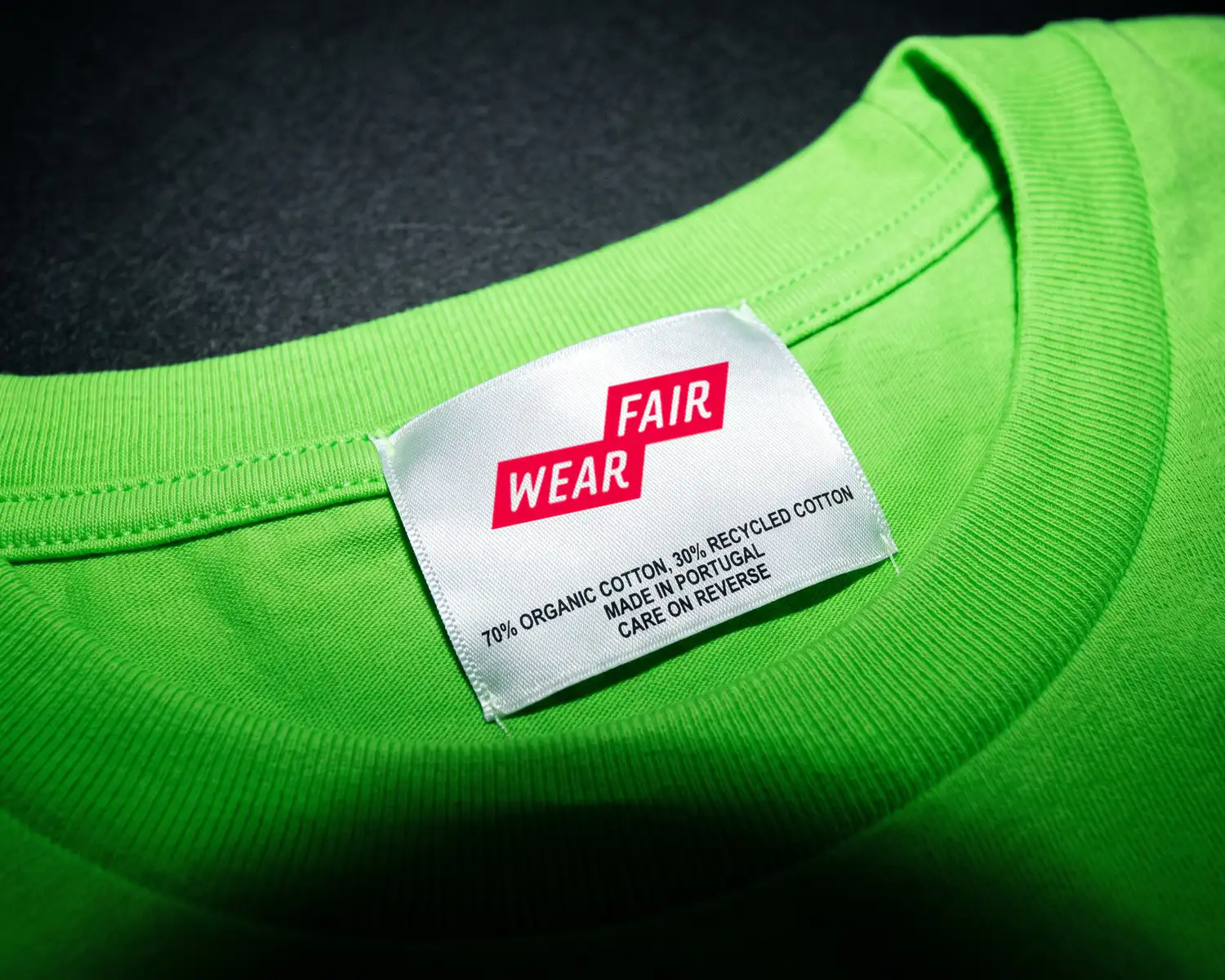
Because its use is controlled. According to Fair Wear's FAQ, only member brands that reach a given performance level may display the logo to the public. The 2019 guide kept the on-garment logo (label, hangtag, mention next to the product online) for brands rated Leader, the best of the four categories at the time (Leader, Good, Needs Improvement, Suspended). Fair Wear has announced a new communication framework for 2026, whose details cannot yet be read on its website.
The same FAQ sets a rule for resellers: when they mention Fair Wear, they must name the member brand the garment comes from. That is why we write "a Stanley/Stella t-shirt, a Fair Wear member brand", never "a Fair Wear t-shirt".
Fair Wear garments on tknp.io
On 8 November 2026, 48 of the 161 Stanley/Stella product pages in our catalogue mention Fair Wear in their description: t-shirts such as the Creator 2.0 or the Crafter, sweatshirts, shirts, beanies and bags. The mention often sits next to GOTS and OEKO-TEX, two labels about the material.
SOL'S also appears on the member list published by Fair Wear, but none of its 130 product pages mentions it today. The right habit applies to every brand: before you feature Fair Wear in your communication, check the brand's name on fairwear.org and read its latest report.
Frequently asked questions
Is Fair Wear a logo you find on the garment?
Not always. Fair Wear certifies no product: it assesses brands. Only member brands that reach a given performance level may display its logo to the public, and many garments from member brands carry none.
Is Stanley/Stella a Fair Wear member?
Yes, since 2011 according to fairwear.org, with an overall Brand Performance Check score of 84; its latest report was published on 31 March 2026. On tknp.io, 48 of its product pages mention it.
What does Fair Wear not check?
Fabric production: cotton growing, spinning, weaving or knitting and dyeing stay outside its scope, which starts after the fabric. Fair Wear doesn't certify a specific garment or a single factory either.
How many brands are Fair Wear members?
More than 90 active member brands according to fairwear.org on 8 November 2026. The figure of 120 companies the site also shows adds those taking its due diligence training.
Your project, quoted within 24 hours.
Describe your garments, your decoration and your quantities: you receive a detailed quote, decoration included, within one business day.