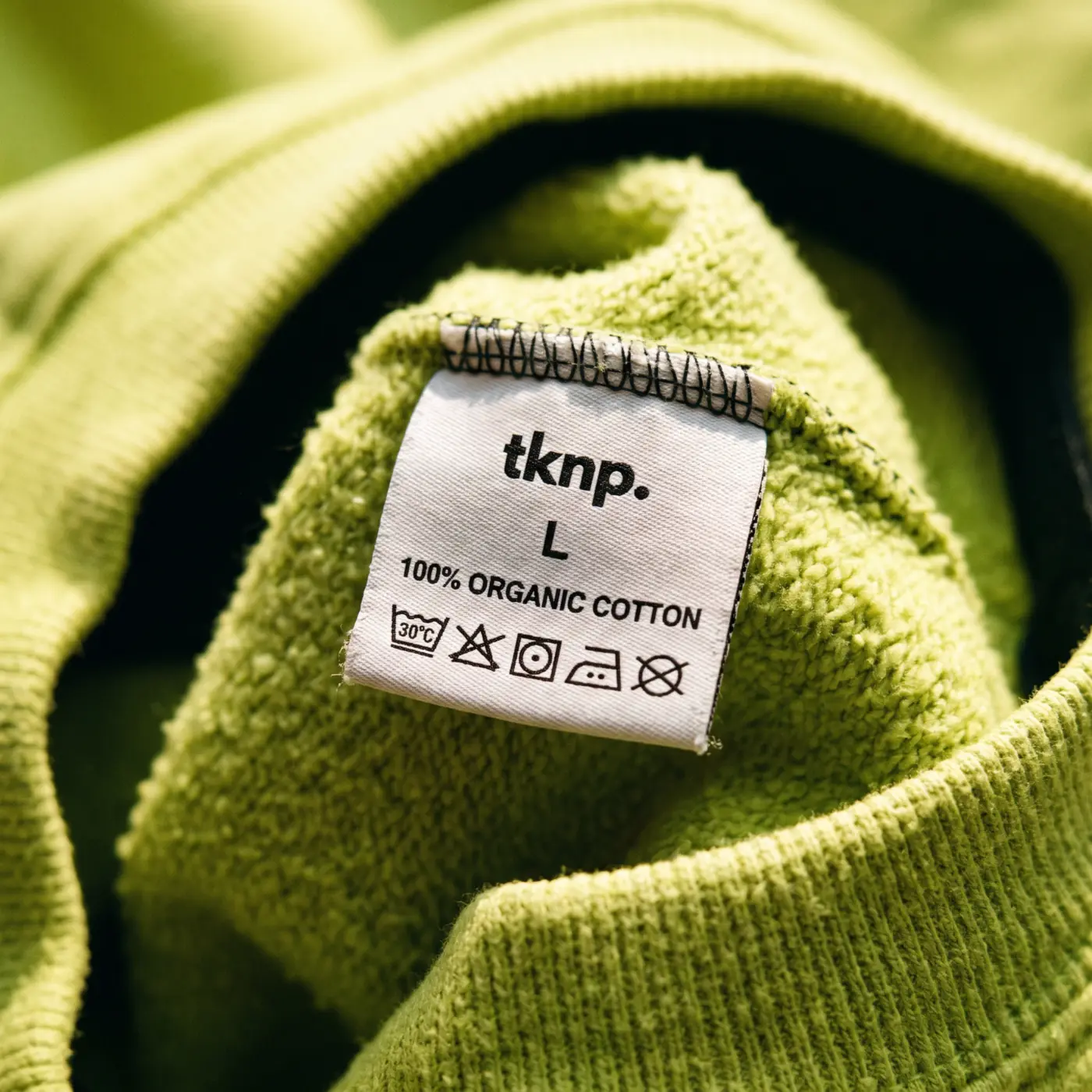
The textile composition label lists a garment's fibers as a percentage of their weight, in descending order. It is mandatory in Europe and, in France, written in French. The mentions organic cotton and recycled polyester are regulated: it is the most reliable benchmark for choosing the fabric of your merch.
The essentials in 4 points:
- The composition label is a European legal requirement: fibers as a percentage of weight, with no right to lie.
- Conventional cotton, organic cotton, virgin or recycled polyester: each mention has a precise meaning, and the GOTS and GRS labels certify them.
- The label says nothing about fabric weight, fiber quality or fit: always read it alongside the product page.
- On custom apparel, the manufacturer handles the regulatory label: your job is knowing how to read it to choose well.
Two nearly identical sweatshirts, two labels: "100% organic cotton" on one, "50% cotton, 50% polyester" on the other, and a few euros between them. If you are choosing the fabric for your merch, that little composition label sewn inside is the most honest document on the garment: it is not allowed to lie. You just have to know how to read it.
In eighteen years in textiles, I have watched hundreds of clients compare garments on the photo and the price, without ever turning the collar over. Yet that is where everything plays out. Here is the decoder.
What exactly is the composition label?
The composition label lists the textile fibers that make up the garment, as a percentage of their weight, from the most present to the least. "80% cotton, 20% polyester" means: in 100 grams of fabric, 80 grams of cotton and 20 of polyester.
It is also a legal requirement: European regulation makes this label mandatory on every textile item sold, and in France it must be written in French, as the official DGCCRF factsheet on garment labeling reminds. The manufacturer has no choice, and that is your advantage: it is the only information on the garment that is framed by law. Marketing can embellish; the composition label cannot.
Where to find it? Most often at the collar, or sewn into the inner side seam, hip side. On home linen and textile accessories, it slips into a hem. If a garment has none at all, be wary: it is mandatory.
Not to be confused with its neighbor: the care label, the one with the little washing symbols. That one is not mandatory in France, merely recommended. The two often live on the same strip of fabric.
Reading the percentages: what the numbers tell you
The composition first tells you which family you are in.
100% cotton: the natural fiber, breathable, soft, what you expect on a garment worn close to the skin. It is the standard on premium garments.
Cotton-polyester blend (the famous 50/50 or 80/20): polyester stabilizes the garment, limits shrinkage in the wash and brings the price down. It is not a trick, it is an engineering choice: the market's reliable basics are almost all blends.
Mostly polyester: light, quick-drying, holds bright colors. Its natural place is activewear, less the everyday sweatshirt.
The reflex to build: the higher the share of cotton, the more you pay for the fiber; the higher the share of polyester, the more you pay for stability and a tight price. Neither family is a trap; they serve different uses.
Organic, recycled, conventional: the real match of cottons and polyesters
This is where the label gets interesting, because "cotton" does not say it all. We are talking about the textile fiber here, not a grocery aisle.
Conventional cotton is the global standard: nothing wrong with it for comfort, but its cultivation is thirsty for water and treatments. It is the cotton of most basics: it explains their price.
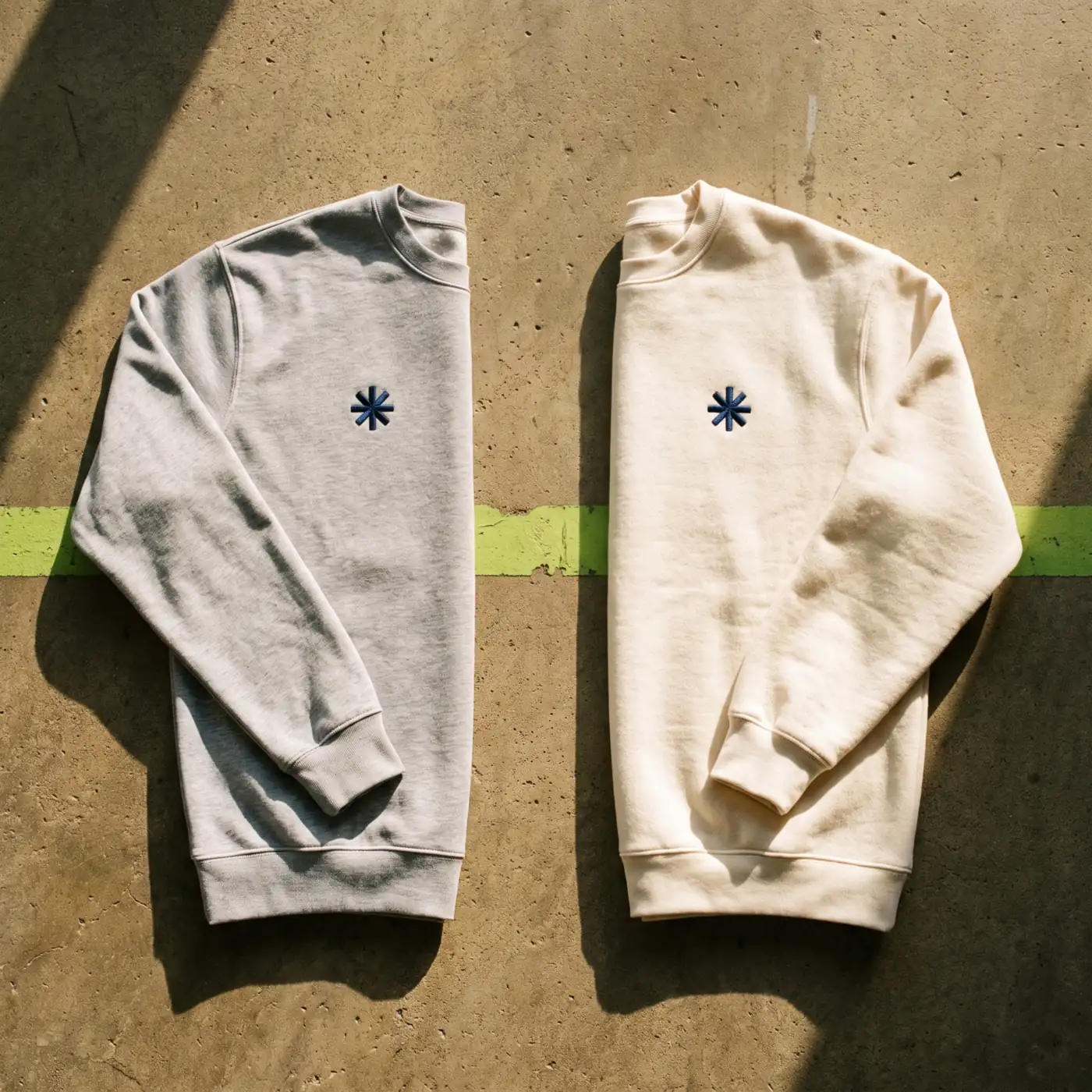
Organic cotton is grown without synthetic pesticides or fertilizers. On the label, it appears as "organic cotton". It costs more to produce, and that extra cost is what you find on the garment. What it changes for your merch: a solid answer to the question your community asks more and more, "is this sweatshirt clean?", and a real argument when it is time to sell on your Store. The Roller Crewneck, in 280 gsm organic cotton, is the textbook example of the sweatshirt that carries this argument.
Recycled polyester is generally made from plastic bottles or textile offcuts melted back into fiber. Same properties as virgin polyester, reduced footprint. You spot it on the label under the mention "recycled polyester", on activewear and stabilized basics. And keep the consistency rule: a premium garment that claims organic owns a "100% organic cotton"; mixing organic cotton with synthetic fiber blurs the message, the composition must tell the same story as the brand.
A trust benchmark: these mentions are regulated, and independent labels certify them, like GOTS for organic cotton or GRS for recycled materials. If a garment advertises itself as "organic" without organic cotton in its composition, turn the collar over twice.
What the label does not say
Let's be honest about the limits: composition is not the whole of quality.
It says nothing about fabric weight (the thickness of the fabric), nothing about fiber quality (a ring-spun combed cotton and an ordinary cotton both read "100% cotton"), nothing about fit or finishings. Nothing either about the printing: how an embroidery or a print holds up is judged on the product page and on the garment, not on the label. Two "100% cotton" t-shirts can be worlds apart: one thin as paper, the other dense and well finished.
That is why the label is read WITH the product page, never instead of it. On a serious catalog, like the sweats and hoodies section, every garment displays its composition, its fabric weight and its fit: the three together tell the real quality. The label gives you the family, the product page gives you the level.
How to use it to choose your custom apparel
The simple method, the one I have always applied:
- Start with the use: an event garment worn one weekend does not need the same fabric as a well-cut fashion sweatshirt worn for years.
- Choose the composition family: stable and economical blend for large runs, mostly cotton or organic for the garments people should want to wear.
- Check the full trio on the product page: composition, fabric weight, fit. That is what separates two garments with the same label.
- Keep your message consistent: if your community cares about the responsible argument, the organic cotton or recycled polyester on the label IS part of your communication. The garment speaks for you, down to its collar.
And one piece of good news to finish: you do not have to handle the label yourself. On custom apparel, the garment's manufacturer applies the regulatory composition; you choose with full knowledge. Your only job is knowing how to read it. Done.
Frequently asked questions
Is the composition label mandatory?
Yes. European regulation requires the composition label on every textile item sold, and in France it must be written in French, with the percentages of the fibers used. This is what the official DGCCRF factsheet on garment labeling states.
What does "50% cotton, 50% polyester" mean?
That the fabric contains as much cotton as polyester, by weight. It is the classic blend of basics: cotton brings the comfort, polyester the stability in the wash and a tighter price. Percentages always read from most present to least present.
How do you know if a garment is really organic cotton?
Check that the composition label explicitly says "organic cotton", not just an "organic" claim in the advertising. The GOTS label, when present, additionally certifies the fiber and its production chain.
Is recycled polyester lower quality than virgin polyester?
No. Once turned into fiber, recycled polyester offers the same properties in use: lightness, quick drying, color hold. The difference is upstream: it is produced from existing material, generally plastic bottles or textile offcuts.
Can you cut off the label that itches?
Yes, once the garment is yours, nothing forbids it: the labeling obligation weighs on the seller, not on you. The right reflex before cutting: photograph the composition and the care instructions, to wash the garment correctly for its whole life.
Your organization deserves its official store.
Create, buy and sell premium merch — the account is free, the store opens when you're ready.