Screen printing prints textile through a stencil screen, one color at a time: one color = one screen. That setup cost, amortized over volume, makes it the queen of very large runs of a single design; digital printing takes over for small runs.
The essentials in 4 points:
- The principle: one stencil screen per color, ink pushed through with a squeegee, a curing step to fix it: the mechanics have not changed in decades, because they are unbeatable on their turf.
- Its strengths: a cost per t-shirt that melts with volume, opaque and vibrant solids (even a pure white on black fabric), legendary wash durability.
- Its limits: small quantities priced out, every color adding a screen, gradients and photos off its turf.
- The choice rule: screen printing is the technique of the print run (800 identical t-shirts at once); in print-on-demand (POD), DTG is your technique: from one piece, no stock.
Screen printing is the elder of textile printing techniques, and it has not aged a bit on its territory: when a single design must go out on hundreds of custom t-shirts, nothing beats it. But it is also the most misunderstood technique: people credit it with everything and its opposite, and sometimes choose it for the wrong reasons.
In eighteen years in textiles, I have seen screen printing deliver wonders and disappointments, on a single criterion: the right project. And let's say it upfront, because it is probably your case: if your merch lives in print-on-demand (each garment produced when ordered), screen printing is not your technique, and that is good news: DTG is made for you. Here is how it really works, where it reigns, where it loses, and how to choose with full knowledge.
How screen printing really works
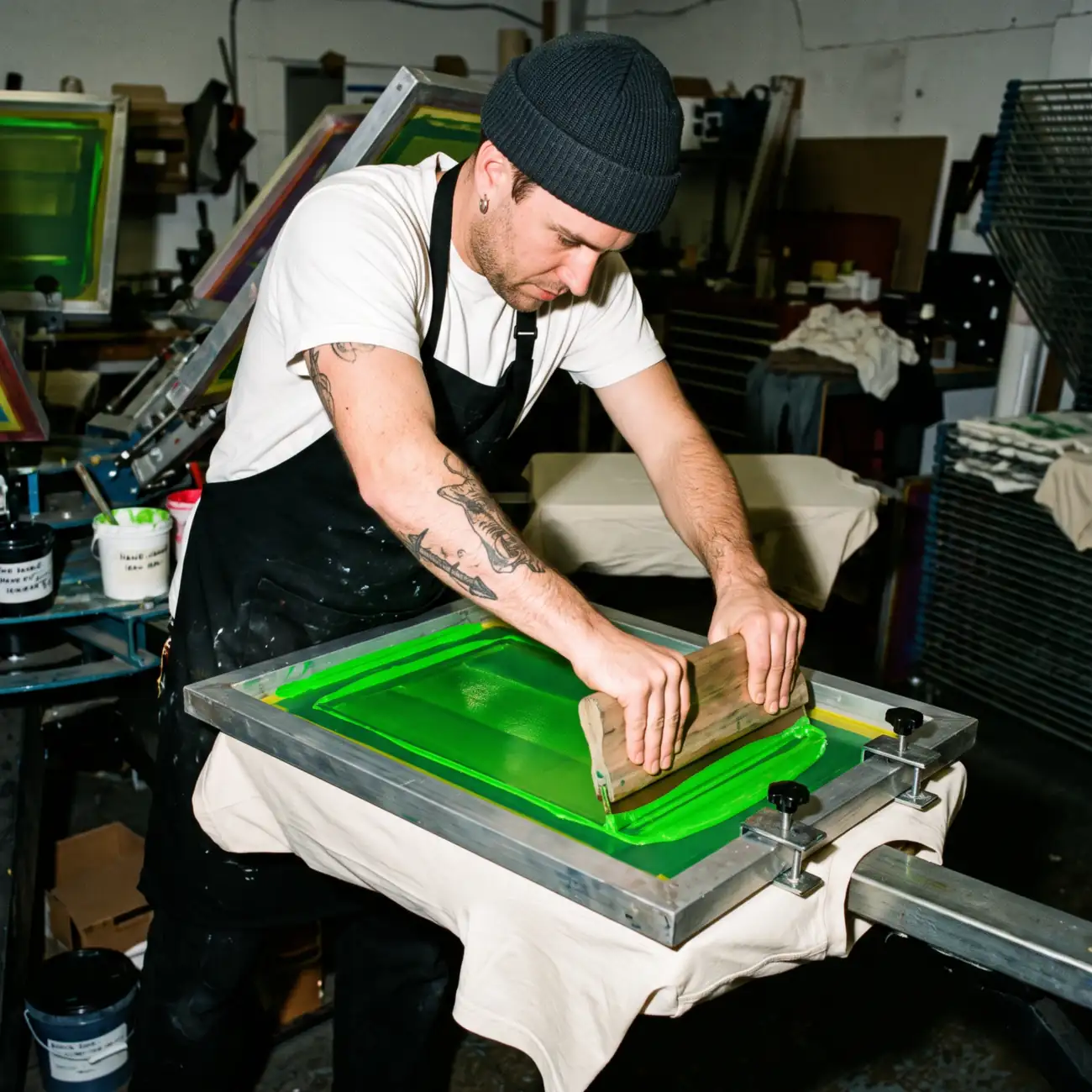
The principle of t-shirt screen printing has not changed in decades, and that is its strength. For each color of the design, a screen is made: a frame stretched with a fine mesh, prepared to let ink through only where the design lives: a precision stencil. The screen is placed on the t-shirt, ink is pushed through with a squeegee, then the garment is cured to fix the ink.
Remember the sentence that explains the whole economics of the technique: one color = one screen. A three-color logo requires three screens, prepared, registered on each other to the millimeter, cleaned after the run. It is real workshop labor, with an incompressible setup cost: before the first t-shirt is even printed.
Why it reigns over large runs
That setup cost, its handicap in small quantities, becomes its absolute weapon in volume:
- Economies of scale. The screens cost the same for 10 or 1,000 t-shirts. Once registered, the press chains prints at high speed: the longer the run, the more the cost of each garment melts.
- Ink quality. Screen printing ink (plastisol or water-based, depending on the desired finish) lays down in a generous, opaque layer: full, vibrant solids, matched to a precise Pantone color if your brand guidelines demand it, including a pure white on black fabric, which remains the hardest exercise in textile printing.
- Durability. Well executed and well cured, a screen print survives dozens and dozens of washes: it is the print of the event t-shirts you find intact years later.
- Special inks. Puff, metallic, fluorescent, glow-in-the-dark: screen printing has the widest palette of effects in the trade.
That is why it is the queen of large runs: concert tours, events with thousands of attendees, big brands' collections.
Its limits, with no detours
- Small quantities. The cost of the screens does not amortize over 10 or 15 t-shirts: the price per garment becomes unreasonable. That is mathematics, not a workshop quality issue.
- Every color adds a screen. A color-rich design drives up the setup; a gradient or a photo, with their thousands of shades, are simply not its turf.
- One design = one run. Changing the design means making new screens. Screen printing does not like variety: it likes repetition.
- Setup time. Preparing the screens and registering takes time: it is not the technique of urgency or the single piece.
Screen printing or digital printing: how to choose for your merch
Here is the honest advice, the one that avoids disappointments. The question is not "which is the best technique", it is "how will your merch live".
Screen printing wins when ONE design goes out in a very large run at once: hundreds of copies of the same design, in few colors, ordered together. If that is your project, a screen printing workshop is the right partner.
Digital printing wins as soon as variety or flexibility come into play, and that is the world of print-on-demand: each garment produced when ordered, from one piece sold, no minimum and no stock. The tknp catalog works in DTG (direct-to-garment printing, ideal for the detailed designs and gradients screen printing cannot do), DTF (the versatile digital transfer) and embroidery (the premium relief). On a Store, nobody knows in advance how many sweatshirts will sell or in which sizes: exactly the scenario where screen printing's "one design = one run" logic does not fit, and where digital shines.
The rule in one sentence: screen printing is the technique of the print run, digital is the technique of the flow. A festival printing 800 identical t-shirts is a run; a community ordering day by day is a flow.
Recognizing a good screen print
Since you will meet them all your life, you might as well know how to judge them. A good screen print shows three things: ink laid cleanly, with no bleeding on the edges; a regular layer that becomes one with the fabric instead of sitting as a thick plastic film that will crack; and dense, faithful colors, including on dark fabric. Run your hand over it: a good print feels supple, almost integrated into the knit.
And the test of time remains the final judge: a serious screen print goes through washes without cracking or fading. If an event t-shirt from 2015 still lives in your closet with its design intact, now you know why.
What to remember
Screen printing is a magnificent tool in the right role: the very large run of a single design, in bold colors, ordered at once. Its limits mirror its strengths: costly setup, no variety, small quantities priced out. For the merch of a community that lives order by order, print-on-demand is right, and its champion is called DTG: from one piece, no stock, with the freedom to change designs whenever the mood strikes. The right choice is never a religion of technique: it is a question of project, and for most Stores, the project says POD.
Frequently asked questions
What is the minimum number of t-shirts for screen printing?
There is no universal number, every workshop sets its own thresholds, but the logic is constant: the cost of the screens must amortize over the run. Below a few dozen copies, the price per t-shirt becomes unreasonable; the technique makes full sense in the hundreds.
Screen printing or DTG: which to choose?
By the project: screen printing for one design in few colors printed in one large run; DTG (direct digital printing) for detailed designs, gradients, and on-demand production from one piece, no minimum: the technique of Stores that sell day by day.
Does screen printing hold up in the wash?
It is one of the most durable prints in textile: well executed and well cured, it goes through dozens of washes without cracking or fading. The event t-shirts you find intact years later are almost always screen prints.
Why does each additional color cost more?
Because each color requires its own screen: prepared, registered to the millimeter with the others, cleaned after the run. A one-color logo uses one screen; the same in four colors uses four, with the workshop time to match.
Can you screen print a photo or a gradient?
Not its turf: screen printing excels in bold solid colors, not in the thousands of shades of a photo. For a photographic design or a gradient, digital printing (DTG or DTF) gives a far better result.
Your organization deserves its official store.
Create, buy and sell premium merch — the account is free, the store opens when you're ready.