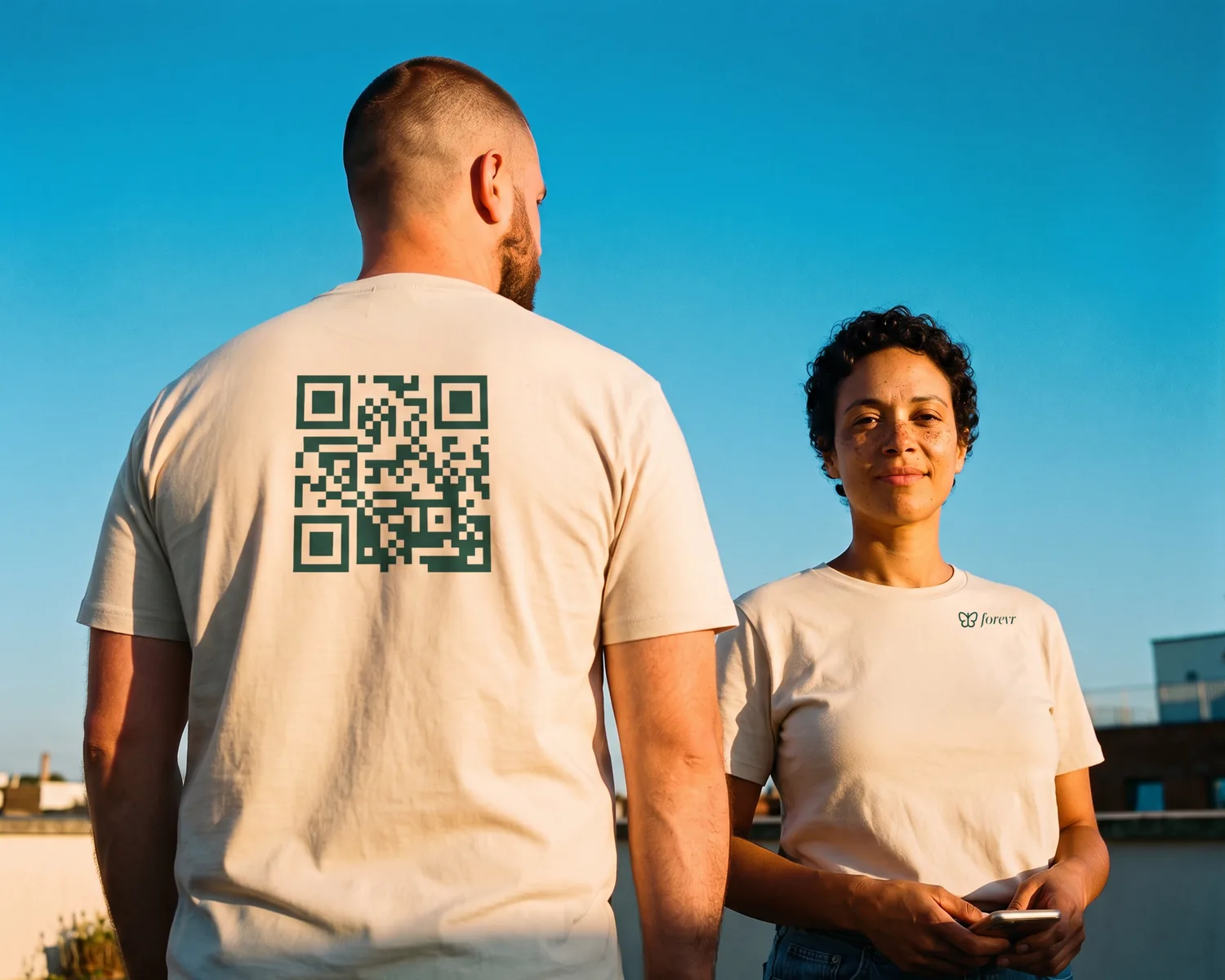
QR code on a t-shirt: size, placement and uses
A QR code prints well on a t-shirt under three conditions: a width of at least one tenth of the scanning distance (6 to 8 cm on the chest, up to 28 cm on the back), a dark code on a light background surrounded by an empty margin, and a short link that will keep working as long as the t-shirt is worn.
Done right, the QR code turns a custom t-shirt into a doorway: the club's page and its current pre-order, a festival programme, an association's membership page, or the remembrance page of a loved one honoured during a walk. Sized wrong, it is just a pattern nobody manages to scan. Here are the settings that make the difference, followed by an example close to our hearts: the t-shirt of a memorial walk, linked to a remembrance page created on forevr.
What size should a QR code be on a t-shirt?
A QR code scans from up to about ten times its width: that is the 10 to 1 ratio given by the printing guides of QR code generators. On a t-shirt, the code's width therefore follows from the reading distance: between 6 and 8 cm for the chest, between 20 and 28 cm for the back.
| Placement | QR code width | Scans from up to about | The situation |
|---|---|---|---|
| Left chest | 6 to 8 cm | 60 to 80 cm | talking face to face, holding out a phone |
| Back | 20 to 28 cm | 2 to 2.8 m | a queue, a stand, a procession |
These are also the widths of the two classic spots for a logo, which our article on logo placement details. Beyond 28 cm, you go past the maximum width the print accepts, and the cut makes no difference.
A short link makes a code easier to read
A QR code is a grid of small squares called modules. The longer the address, the more modules the grid holds, and the smaller each square gets at the same width: Denso Wave, the Japanese company that invented the QR code, explains that a code's size depends on the amount of data it carries and on the size of its modules. A short address, such as a club's home page rather than a long sharing link, gives bigger squares that print more sharply and scan faster.
Which error correction level should you choose?
For a t-shirt, choose error correction level Q when you generate the code: it stays readable with about 25% of its surface damaged. Error correction is a code's ability to be read even when damaged, and Denso Wave recommends levels Q or H wherever the code may get dirty, which is the case for a garment that is worn, washed and creased. A higher level makes the grid slightly bigger: that is the price of this sturdiness.
Where should a QR code go on a t-shirt?
The QR code goes on the left chest to be scanned up close, or on the back to be scanned from a distance, always on an area that stays flat while the t-shirt is worn. These are the two placements you set yourself in the tknp.io designer; the sleeve goes through a quote request.
Three habits prevent codes that will not scan:
- Away from seams and folds: the upper back, between the shoulder blades, is the flattest area. On the stomach, the fabric creases as soon as you sit down.
- Watch out for very fitted cuts: fabric stretched across the chest can pull the square out of shape. The back, or a straight cut, keeps the code square.
- Logo on one side, code on the other: a t-shirt takes two prints at most, in the same method. A logo on the chest and a QR code on the back make the most readable pair.
Which printing method suits a QR code?
For a black QR code on a light t-shirt, single-colour screen printing gives the cleanest flat finish, and, for a chest code on the Creator 2.0, its price matches DTF transfer at 50 t-shirts, then drops below it. Under 50, or as soon as the code shares the t-shirt with a photo, DTF transfer is the right choice.
- Single-colour screen printing lays the ink down flat through a screen prepared for your design. A QR code needs only one colour: this is exactly its territory. Our article on screen printing a t-shirt explains how it works and where it falls short.
- DTF transfer starts with the design printed onto a film, which is then heat-pressed onto the t-shirt. It reproduces fine details and every colour, and easily lays a light square under the code on a dark t-shirt. Our DTF or DTG comparison helps you choose between the two digital methods.
- Embroidery is a method we advise against for a QR code: the modules need sharp corners that thread rounds off, and the embroidered chest format (8 × 10 cm on our product pages) leaves little room.
Does a QR code work on a black t-shirt?
Yes, provided the code is printed dark inside a light square, never in white straight onto the black. Scanners expect a code darker than its background, and the generators' printing guides say it plainly: inverted colours are one of the reasons a code refuses to scan.
The light square must extend beyond the code. Denso Wave requires an empty margin four modules wide on every side, the quiet zone, where nothing is printed. On a navy t-shirt, a midnight blue code in an ecru square works; a grey code on a charcoal t-shirt does not. DTF transfer prints the square and the code in one go.
How much does a t-shirt with a QR code cost?
A QR code is priced like any other print. Take the Stanley/Stella Creator 2.0, in 180 g/m² organic cotton: at tknp.io, with a chest QR code as its only print, it comes to €8.52 excluding VAT per unit at 50 units, in A6 DTF transfer or in single-colour screen printing alike. That price, for guidance only and noted on 21 October 2026, applies at the standard lead time, excludes shipping and covers the base colour in standard sizes: the brand charges slightly more for some colours and for the larger sizes.
| Creator 2.0, chest QR code (unit price excluding VAT, 1 placement) | DTF transfer (A6 format) | Single-colour screen printing |
|---|---|---|
| 10 t-shirts | €11.38 | €19.03 |
| 25 t-shirts | €9.35 | €11.48 |
| 50 t-shirts | €8.52 | €8.52 |
| 100 t-shirts | €7.89 | €7.36 |
Our prices, from the tknp.io Creator 2.0 product page as checked on 21 October 2026: unit prices excluding VAT, t-shirt and print included, a single placement, in its base colour and standard sizes (a few colours and the larger sizes add an extra), at the standard lead time, shipping extra. These amounts are for guidance only, they may change, and only the quote is binding. The other price levers, from quantities to the chosen lead time, are set out in our step-by-step guide.
The table applies to a single chest QR code, which the A6 format (10.5 × 14.8 cm) covers. A 20 cm code on the back goes beyond the A6 format, and a logo on the chest adds a second placement: their price is not in this table, and only the quote is binding. Orders start at 10 printed t-shirts per model, sizes and colours mixed; a blank t-shirt can be ordered from a single unit.
Static or dynamic QR code: which one for a garment?
For a t-shirt worn for years, choose a static QR code pointing to an address you control: it will work as long as that address exists, with no subscription involved. A dynamic code is only worth it if the destination has to change after printing.
- A static code writes the address into the code itself. It is free to generate, costs nothing to use and can no longer be changed once printed.
- A dynamic code points to an intermediate address run by a service that redirects the phone. You can change the destination and count scans, but the code only works as long as that service runs and your account with it stays active.
forevr, a service whose QR codes are made to last on graves, makes the point in its article (in French) on what happens to funeral QR codes when the company closes: a link needs three things to keep working, a renewed domain name, a paid server and a company still in business. A t-shirt keeps its code long after a forgotten subscription has ended.
Where should your t-shirt's QR code lead?
A t-shirt's QR code leads to a single page, easy to read on a phone, that extends what the garment says. A few uses that work:
- A club: the club's own page, which points to its current pre-order. These pre-orders live on the tknp.io Store: nothing to pay to launch the campaign, which stays open 7 to 21 days. The printed code, meanwhile, leads to an address that never changes.
- A festival or an event: the programme, the site map or the ticket office, on the back of the volunteers' t-shirts, as in our guide to festival merch.
- An association: the membership or donation page.
- A brand or a company: the contact page, the catalogue, appointment booking at a trade show. For a clothing brand, a QR code may also carry the digital product passport that the European Union is preparing.
- A tribute: the remembrance page of a loved one who has passed away, the example we detail below.
Example: the t-shirt of a memorial walk, linked to a forevr remembrance page
On the t-shirt of a memorial walk, everything goes on the back, in a single design: the photo and the first name at the top, and below them the QR code of the remembrance page, 10 to 12 cm wide, readable from about one metre, the distance of the person walking behind. Photo and code are printed together in DTF transfer, since the photo needs colour and a t-shirt keeps a single printing method. During the walk, everyone can scan the back of the person ahead and leave a word in the guestbook; afterwards, every time the t-shirt is worn, the remembrance page stays one scan away.
Among the t-shirts we print, tribute t-shirts matter more than any others to the people who wear them: a "marche blanche" (a silent march held in tribute after a tragic death), a walk on the anniversary, a tournament or a race held in someone's memory. The QR code plays a precious role there for many families, and these t-shirts are as much a part of our job as a club's.
The French service forevr shows the idea well. A family creates an online remembrance space there: photos, a biography, and a guestbook where everyone can leave a message. The space is created without an account and shared through a link. Whoever opens it installs no app, and can leave a message or add a photo without creating an account. forevr is paid for once, €19, €39 or €89 including VAT depending on the plan (prices noted in October 2026), with no subscription, also supplies QR code stickers for a grave or an urn, and the whole space can be downloaded at any time.
Two points to settle with the family before printing:
- Who will be able to open the page: a forevr space can stay private, reachable only through its link or protected by a password. Printed on the back, the link becomes readable by anyone who crosses the walk. If the family wants to keep the space for close ones, a password, given out by word of mouth on the day, does the sorting.
- The lead time: a "marche blanche" is often organised within days of a death, while production takes at least a week, with a 10% surcharge, plus shipping. QR code t-shirts find their place in tributes that leave some time: the anniversary walk, the tournament or the race organised in someone's memory.
Scan the QR code on the proof before launching the run
On tknp.io, you approve online a proof (the "BAT", bon à tirer) that arrives almost straight away. Make the most of it by scanning the QR code straight off the screen with two or three phones, including the oldest one on the team: in one minute, you check that the link leads to the right page.
The screen does not tell you everything: the real size is tested on paper. Print the code at its final width, 7 cm or 25 cm, pin the sheet to a t-shirt someone is wearing and scan it from the planned distance, a conversation's for the chest, a procession's for the back. Our article on the proof lists the other checks to run before approving.
Frequently asked questions
Can you put a QR code on a t-shirt sleeve?
Yes, through a quote request: on tknp.io, the sleeve cannot be customised online. It takes a 6 to 8 cm print, which scans from up to about 60 to 80 cm: enough for a code read at arm's length, too small to be read from afar.
Can you change the link of a QR code that is already printed?
Only if the code is dynamic: it goes through a redirection service where you edit the destination. A static QR code contains the address itself and never changes. On a t-shirt, the safest option remains a static code pointing to a page you can update yourself.
Does a coloured QR code work on a t-shirt?
Yes, as long as the code stays clearly darker than its background: midnight blue or burgundy on a white or ecru t-shirt reads well. Avoid two similar colours and light codes on a dark background, which make many scans fail.
Which file should you supply to print a QR code on a t-shirt?
A vector file, in SVG or PDF, which most generators offer as a download: the code stays sharp at any size, from 6 cm on the chest to 28 cm on the back. An enlarged PNG blurs the edges of the modules. Our guide to logo file formats for textile printing details the accepted files.
Your project, quoted within 24 hours.
Describe your garments, your decoration and your quantities: you receive a detailed quote, decoration included, within one business day.