Custom trail t-shirt: design ideas that go beyond the logo
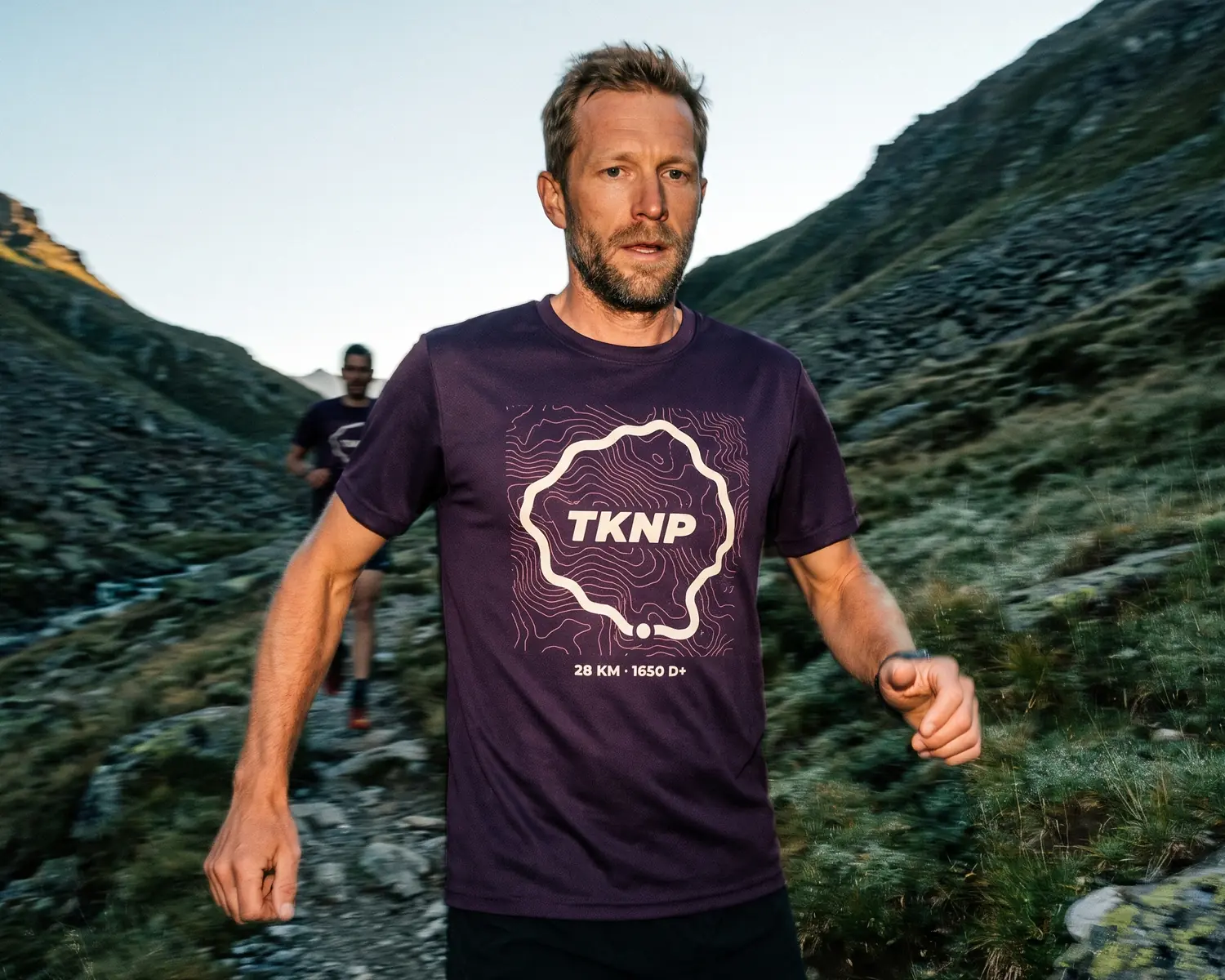
A custom trail t-shirt stands out when it tells the race's story: a fine elevation profile line, the route, the name, the date, the distance and the D+, the word finisher, a poster on the back. A single ink colour is usually enough, in screen printing or DTF transfer.
The essentials before you draw:
- The ideas: the elevation profile, the route seen from above, distance and D+ in big numbers, the word finisher, a poster on the back, an all-reflective design.
- Legibility: at 5 metres, the US road signage benchmark gives at least 1.4 cm of letter height; the race name is written much bigger.
- Colour: a t-shirt and an ink in strong contrast, a dark shade under a light ink or the other way round.
- The price: a Just Cool Contrast Cool T in Arctic White / Fire Red, decorated with DTF transfer on the chest (80 × 50 mm) and on the back (280 × 200 mm), one position each, comes to €13.13 excl. VAT per t-shirt for 50 units, garment included, standard lead time, shipping excluded, public price shown by tknp.io on 2 November 2026, for guidance only.
The t-shirt is part of what runners bring home from a trail race: the French Wikipedia article on trail running lists tee-shirts among the most common rewards for finishers, along with small gifts and souvenir medals. It is the race's merch. A logo on its own says nothing about the race; a t-shirt that carries the climb, the date and the distance tells the story of the event. The aim: a t-shirt people want to wear again for training, long after the finish.
This guide is for race organisers as well as for the committee of a trail running club: design ideas, the decoration technique that makes each one possible according to our pages, letter size, where sponsors go, and a test run in the designer.
Which design ideas for a custom trail t-shirt?
To move beyond the logo, the design of a custom trail t-shirt can take what makes the race: its elevation profile, its route, its numbers and the word finisher. The Wikipedia article on trail running points out that distance is only one of the three figures that define a trail course, alongside the cumulative elevation gain, written D+, and how technical the paths are.
| The design idea | What it tells | The technique that makes it possible, according to our pages |
|---|---|---|
| The elevation profile, as a fine line across the chest | the climbs and descents of the race | one-ink screen printing, or DTF transfer for fine detail |
| The race route seen from above, from start to finish | the ground covered | DTF transfer; sublimation, on quote, for an edge-to-edge pattern |
| Distance and D+ in big numbers | the effort, in two figures | one-ink screen printing |
| The word finisher | the finish line crossed | the same technique as the rest of the design |
| A poster on the back: name, edition, date, profile | the whole race, read from behind | DTF transfer for a multi-colour poster, screen printing for one or two inks |
| An all-reflective design: a ridge line, a name | starts by headlamp | reflective transfer, on quote, for the t-shirt's whole decoration |
For a trail running club, with no date and no race bib, the same ideas apply to the Sunday loop or to the climb the club is known for: its profile, its name, the altitude of its summit.
How do you draw the elevation profile on a t-shirt?
The elevation profile is drawn as one continuous line, from the start on the left to the finish on the right, rising and falling with the trail. On the t-shirt it reads like a silhouette: a few peaks, a baseline, and the race name sitting above or below it.
Start from the profile published with the course, keep only the line and remove the grid, the scale marks and the small bumps of the terrain. Name two or three summits or passes, no more: a profile covered in altitudes turns into a report chart. The race or club name can become part of the line, set under the highest point like a summit sign, or underlined by the baseline.
A fine line needs a precise technique: our DTF transfer page promises it "fine detail and crisp edges, no weeding".
Can you print the race map on a t-shirt?
The race map can be printed on a t-shirt, and the cleanest way is to redraw its route: one single line seen from above, a dot for the start, one for the finish, and a few place names. A full background map, with its roads, forests and contour lines, also brings its own rules of use.
OpenStreetMap data, for example, can be copied and adapted freely, provided you credit OpenStreetMap and its contributors and state that the data is available under the Open Database Licence; on a printed medium, the OpenStreetMap copyright and licence page asks you to include the full address of that page. The simplest option remains to draw the course yourself, from the race's GPS track, with no background map. In every case, our terms of sale have you warrant that you hold the rights to the logos and imagery you upload.
Contour lines, drawn as a free pattern rather than copied from a map, can cover the whole t-shirt. On light polyester, sublimation, priced on quote, prints edge to edge with the ink inside the fibre; it works neither on cotton nor on dark fabric, according to our page.
Name, date, distance, D+: what should the t-shirt say?
On the t-shirt of a trail race, write the race name, its year or edition number, the distance and the D+, the total of all the climbs in metres: those two figures say how hard it was. Wikipedia notes that announced distances in trail running are often approximate, so use the race's official figure, as it appears on the entry page. The race format can be written too: in France, the same article explains, trails are classed by distance, from discovery trails under 20 km to short trails, long trails and ultra-trails over 80 km.
Give these details an order: the name first and big, then the date, then distance and D+; the place and the named summits come smaller. For a club, the club name and its town replace the date.
If the race offers several distances on the same day, one design that lists them all dresses every runner, whatever their event.
A design you can read from 5 metres: what letter size?
For a race t-shirt to be read from 5 metres, allow at least 1.4 cm of letter height, and much more for the race name. That minimum comes from road signage: the US federal manual for traffic signs (MUTCD, 2009 edition) recommends at least 1 inch of letter height per 30 feet of reading distance. Made for road signs, this benchmark is a floor on a t-shirt, never a target.
The race name, the one people need to read at the start or at an aid station, deserves letters several centimetres high, in one or two words, in a heavy typeface. Our "XXL front type" inspiration says so for an event name: no sentences, because "beyond two words the type shrinks and loses its punch". Summit names, altitudes and the date, written smaller, are read up close.
Should a trail t-shirt say "finisher"?
The word finisher belongs on a trail t-shirt if it is handed out after the finish: in trail running, a finisher means someone who has crossed the finish line before the time limit, according to the French Wikipedia article on trail running. Handed out at bib collection, before the start, the same t-shirt cannot say it yet.
The organisers therefore have two options: a finisher t-shirt given after the line, or a race t-shirt given before the start, without the word. In the design, finisher works best kept simple, in capitals, next to the distance or under the profile, like a caption.
For a club whose members each pay for their t-shirt, how to run an order where everyone books their size is explained in our guide to organising a t-shirt pre-sale.
What goes on the back of a trail t-shirt?
On the back of a trail t-shirt, put the race poster: the name in large letters, the edition and date, the profile or the route, and why not the list of passes or villages along the way, like a tour poster. Place it high: our "poster artwork on the back" inspiration warns against artwork placed too low, because "below mid-back, the poster disappears when you sit".
During the race, the back has another occupant. The French Wikipedia article on trail running describes a modern runner's kit with a trail backpack, and mentions a bottle belt or a backpack with a water bladder, especially for trails longer than 21 km. A pack covers the upper back: whatever must be recognised during the effort, the name or the logo, also goes on the front.
Where do sponsor logos go on a race t-shirt without spoiling the design?
On a race t-shirt, place the logos of the race's partners and sponsors low on the back, under the race poster, on a single line and in the ink colour of the design: they then become part of the artwork instead of covering it. It is also how you keep to our advice of two decoration positions at most per garment: front and back, nothing more.
Ask each sponsor for a one-colour version of their logo: the strip then takes the race's ink, with no extra colour. If a main sponsor wants more room, give them a line above the others rather than a third position on the sleeve.
Before uploading their logos, keep each sponsor's agreement in writing: these are rights our terms of sale ask you to warrant.
Which t-shirt colour for a trail race, and how many inks?
For a trail race, choose a t-shirt colour in strong contrast with the ink of the design, a dark shade under a light ink or the other way round, and a single ink is usually enough. Our "XXL front type" inspiration asks for it with an event name, "one ink in clear contrast"; on the product pages read on 2 November 2026, Just Cool's Cool T comes in 50 colours, and the Contrast Cool T in 17 colourways that each combine two shades, such as Arctic White / Sapphire Blue, which gives the design a second colour with no extra ink.
One ink is our advice, as for a logo; the number of inks then decides the technique: a profile, a name and numbers in one or two colours stay in screen printing, where each colour goes through its own screen, while a sunrise-gradient poster goes to DTF transfer, which prints every shade at once. Which of the two costs less depending on the number of t-shirts is what our DTF or screen printing comparison works out.
A design meant for headlamp starts can also go entirely into reflective transfer: priced on quote from 25 units, it has a single colour, reflective silver, with a "premium silver look in daylight", and our page advises "fine designs" rather than large solids, such as a ridge line or a name. Since we advise a single technique per garment, the reflective transfer then carries the t-shirt's whole decoration, rather than a detail added to a screen print.
For the t-shirt itself, its decorations, its price and where the logo goes around the race bib, see our custom running t-shirt article; for the fabric, technical or cotton t-shirt; and for what polyester changes to the ink, dye migration included, printing on polyester fabric.
How much does a race design cost compared with a plain logo?
On Just Cool's Contrast Cool T, a design on the chest and large on the back comes to €13.13 excl. VAT per t-shirt for 50 units, against €9.60 excl. VAT for a single DTF transfer logo in A6 format. Unless stated otherwise, these prices apply to a single run of one model with the same design, at the public price with no discount, excluding VAT, garment and decoration included, standard lead time, shipping on top, as tknp.io displayed them on 2 November 2026, for guidance only.
| Units | Logo only: DTF transfer A6, one position | Chest and back design: DTF transfer 80 × 50 mm and 280 × 200 mm |
|---|---|---|
| 10 | €12.69 | €19.82 |
| 25 | €10.53 | €15.53 |
| 50 | €9.60 | €13.13 |
| 100 | €8.92 | €12.18 |
| 250 | €8.46 | €11.07 |
The first column comes from the Contrast Cool T product page, in the most accessible colourway; the second from our inspiration for a technical tee decorated on the chest and back, priced on the same t-shirt in Arctic White / Fire Red, sizes mixed, that is €656.50 excl. VAT for 50 t-shirts. The second column counts two positions, the first only one: why each position is charged separately is covered in logo placement on a t-shirt, our sizing and placement guide. Any other design, at another size or in several inks, is priced by placing it in the designer. The minimum for a decorated run: 10 units per reference, according to our FAQ.
Try the race design in the designer before the run
The design of a trail t-shirt is judged on the t-shirt, at its real size: the tknp.io designer shows it before any order, and trying it costs nothing. From the Cool T or Contrast Cool T product page, "Customise online" leads to the designer, set on that t-shirt; from our chest-and-back inspiration, it opens on the t-shirt and colour of the example.
Upload the complete design as a single file, profile, name and numbers, then set its position: according to our inspirations, the designer offers "Heart, Chest or Large, or the exact size in millimetres". Our FAQ explains that you set the position, the real size and the technique there; nothing is made before the order, and the account is free.
Try the same profile at two widths, then on two Cool T colours, Plum and Desert Sand for example, and keep the version where the race name reads best. The preview remains a simulation: our terms of sale point out that the screen does not show the exact colour of the fabric, and our article on printed colour that differs from the screen explains which reference to give to keep the race colour.
Frequently asked questions
Can you keep the same t-shirt design from one edition to the next?
The same design can be reused from one edition to the next for its layout, provided you check the route, the profile and the numbers again every year: according to the French Wikipedia article on trail running, the same race can have a slightly different route from one year to the next. Change the date or the edition number, and each edition keeps its own t-shirt.
How do you tell volunteers apart without changing the design?
To tell volunteers apart, keep the design and change the colour of the t-shirt. According to the Cool T and Contrast Cool T product pages, the price tier adds up every colour of the same t-shirt carrying the same print: the runners' t-shirts and the volunteers' t-shirts then count together.
Can the t-shirt design be carried over to a sweatshirt or a cap?
The design of a trail t-shirt can be carried over to the club sweatshirt or the volunteers' cap, as long as it is simplified: on a cap, keep the profile line and the name, and drop the numbers. Our DTF transfer page counts 353 compatible references among sweatshirts and hoodies, and 406 among caps and hats.
Your project, quoted within 24 hours.
Describe your garments, your decoration and your quantities: you receive a detailed quote, decoration included, within one business day.