Mandatory work uniform: what the employer must provide, pay for and clean
A shared uniform makes your team recognisable at first glance. When you make it mandatory in France, cleaning it is on you, and clothing required by dirty work must be supplied free of charge (French Labour Code, article R4323-95). For a front-of-house team, an allowance of three polos and two aprons embroidered with your logo costs €63.70 excl. VAT per employee, as a guide.
You are opening a restaurant, taking over a hotel, launching the third shop of a network: a shared uniform quickly becomes the obvious choice. It makes the team easy to spot and sets the tone of the place from the doorstep. One question many managers ask too late: once the uniform is mandatory, what is on you?
The articles quoted here were read on 9 November 2026 on the Code du travail numérique, the French labour ministry's site that reproduces the Labour Code (Code du travail), and on service-public.gouv.fr, the French government's information site. This article informs; it does not replace your collective agreement or a lawyer's advice. Prices are our prices, read the same day on the tknp.io product pages.
When does a work uniform become mandatory?
A work uniform becomes mandatory when a written rule imposes it: the law, your collective agreement, the company's internal rules (règlement intérieur) or the employment contract. Those are the four sources named in article L3121-3 of the French Labour Code, and every obligation in that article starts there.
Without such a rule, employees dress as they like, within one limit: article L1121-1 only allows a restriction on freedoms if it is justified by the nature of the task and proportionate to the aim. Service-public.gouv.fr lists hygiene, safety, decency and the company's brand image, notably when the employee deals directly with customers, among the accepted reasons. A dining room team, a hotel front desk or a shop counter often fall under that last one. And it applies to everyone: citing France's Defender of Rights, service-public.gouv.fr points out that a dress rule treats female and male staff alike. One polo offered in both a male and a female cut, in the same colour with the same logo, meets it. How to write the rule itself is another topic: here we look at what it costs you.
Work clothing, image uniform, PPE: what are we talking about?
Three different things go by the name of work uniform, and the Labour Code does not treat them the same way.
- Personal protective equipment (PPE) protects against a hazard: article R4323-91 requires it to be suited to the risks it prevents. tknp.io does not make or sell PPE: for that, see a specialist supplier and your risk assessment.
- Work clothing in the sense of article R4321-4 is what the employer provides when the work is particularly unhealthy or dirty: the kitchen, the workshop, cleaning.
- The image uniform is the one you impose so customers recognise the team: the embroidered polo in the dining room, the front desk shirt, the counter apron. That is what our product pages cover, and often what the manager is dealing with.
The same garment can move from one category to another depending on the job: a waiter's apron is an image uniform, a dishwasher's apron first protects their clothes from dirty work.
Who provides the work uniform?
The employer provides the uniform that dirty work or a hazard calls for. Article R4321-4 asks the employer to make suitable work clothing available when the work is particularly unhealthy or dirty, and to make sure it is actually worn. Service-public.gouv.fr adds that when a uniform is imposed because of the risks the employee faces, the employer must supply it.
For an image uniform, none of the texts read for this article says in so many words who buys it. What is written, on the other hand, is that cleaning it is on you as soon as it is mandatory (see below). In practice, supplying it yourself is the simplest way to get a team dressed alike, in the right colour, the logo always sitting at the same spot.
Who pays for a mandatory uniform?
For clothing that dirty work calls for, the employer pays. Article R4323-95 of the Labour Code states that PPE and the work clothing of article R4321-4 are supplied free of charge by the employer. Article L4122-2 says the same for anything related to health and safety: such measures must not cost employees anything.
For an image uniform with no hazard or dirt involved, those two articles do not spell out that the employer pays for the purchase. Your collective agreement may say more: it is the first document to open before you decide. And since cleaning is on you anyway, asking staff to pay for the garments is hard to defend in front of a team.
Who washes and maintains the work uniform?
Cleaning a mandatory uniform is the employer's responsibility. Service-public.gouv.fr puts it in one sentence: if the work uniform is imposed, its cleaning is paid for by the employer. For the clothing covered by article R4321-4, article R4323-95 adds that the employer keeps it in a satisfactory hygienic condition through the necessary cleaning, repairs and replacements.
The text says who pays, not how to organise it: a laundry service, a washing machine on site, a contractor or another arrangement set out in your collective agreement. For that clothing it also says replacements: a worn, stained or torn uniform is replaced at your expense, which counts in a year's budget.
Is changing time paid?
Changing time gives a right to compensation when two conditions are met, under article L3121-3: the uniform is imposed by law, the collective agreement, the internal rules or the contract, and changing must happen at the company or at the workplace. Compensation takes the form of time off or money.
Service-public.gouv.fr specifies that an agreement can also count those minutes as actual working time, and that without any agreement, the employment contract makes that choice. If your team already arrives in uniform and nothing requires them to change on site, the second condition is not met.
Do you need a changing room when the uniform is mandatory?
Yes, as a rule. Article R4228-1 asks employers to provide changing rooms, and article R4228-2 only allows a simple storage unit instead for employees who are not required to wear specific work clothing. Imposing a uniform therefore takes you out of that exception.
Article R4228-6 describes the changing room: seats, individual fire-resistant lockers that close, big enough for two sets of street clothes, with a separate compartment when the uniform may get soiled with dirty or smelly matter, as in a kitchen.
Clothing allowance: how many uniforms per employee?
The clothing allowance (dotation vestimentaire in French) is the set of garments the employer gives each employee for the job: for instance three polos and two aprons. None of the Labour Code articles read for this guide sets a number. Your collective agreement may do so, so check it.
To decide, think about the wash cycle. With three tops, one is worn, one is drying and one is waiting: nobody ends up without a clean uniform on a service day. Think about staff turnover too, very high in hospitality: a newcomer's allowance has to be ready on their first day, in their size.
How much does the mandatory uniform cost, employee by employee?
An allowance of three polos and two aprons, embroidered, costs €63.70 excl. VAT per employee, as a guide, on our product pages of 9 November 2026. The sum: 3 B&C Inspire polos at €11.56 and 2 Newgen Balthazar bib aprons at €14.51, each embroidered with your logo at 8 x 10 cm, at the first price tier of 10.
These are the prices the product page shows before any payment, embroidery included: unit price excluding VAT, one position, the most affordable colour, before shipping, at the standard lead time, and the quote is what counts. According to the product page, the brand charges slightly more for some shades and for the biggest sizes. Shipping is paid once per order (€15.00 excl. VAT in France).
| Garment (tknp.io page) | 10 embroidered | 25 embroidered | 100 embroidered |
|---|---|---|---|
| Inspire polo, men, B&C, 180 g/m² | €11.56 | €10.85 | €9.26 |
| Inspire polo, women, B&C, 180 g/m² | €11.56 | €10.85 | €9.26 |
| Men's long-sleeve poplin shirt, Russell | €25.18 | €24.05 | €21.60 |
| Balthazar bib apron, Newgen | €14.51 | €13.71 | €11.93 |
| Ristreto short bar apron, Newgen | €11.17 | €10.48 | €8.91 |
Price per garment excl. VAT, 8 x 10 cm embroidery on one position, read on 9 November 2026, as a guide.
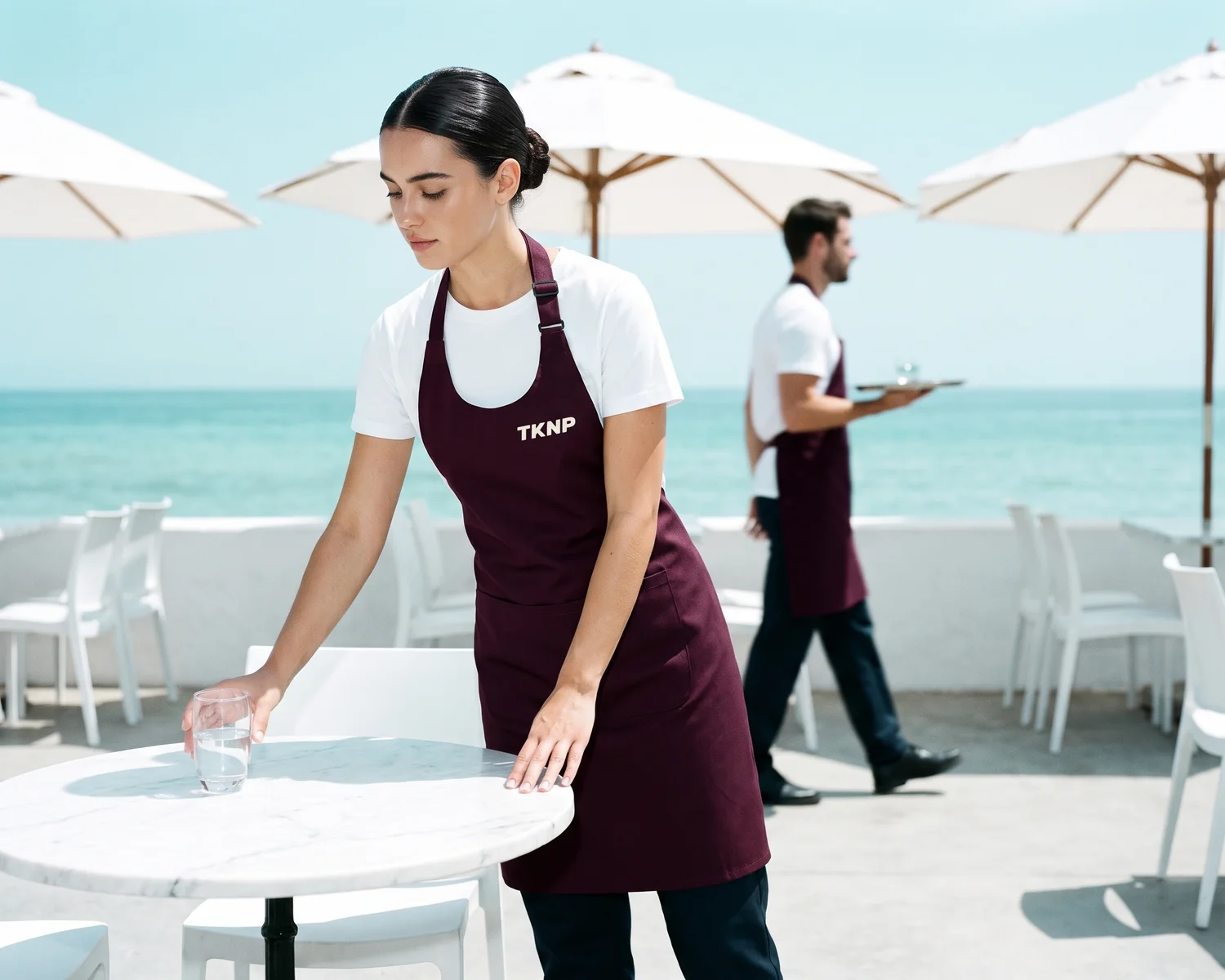
Two details change the bill, which we apply to a whole company wardrobe in the guide to custom clothing for companies. Price tiers count per product reference: the men's and women's cuts of the polo are two references, so 15 of each stay at the tier of 10. On the other hand, one model in several colours adds up its quantities provided the logo does not change, the product page explains. And a tier can cost less than the exact quantity: 24 Balthazar aprons at the tier of 10 come to €348.24 excl. VAT, 25 at the tier of 25 come to €342.75. The 25th apron, in the burgundy of our photo for example, becomes the spare.
Which uniform stands up to the washing you pay for?
A mandatory uniform that copes with the machine costs the employer less, since cleaning and replacements are on them. Newgen's Balthazar bib apron and Ristreto short apron go in the machine at 60 °C, their pages say; Russell's polyester and cotton poplin shirt needs little ironing; B&C's Inspire polo is made of pre-shrunk ringspun cotton.
To go further job by job: the waiter uniform, the receptionist uniform, the hostess uniform, and for the kitchen, the workshop or the building site, our guide to custom workwear.
How long does it take to equip the team?
To dress a team in embroidered uniforms, the tknp.io FAQ counts 10 working days to customise on the standard option, plus shipping, with a minimum of 10 per reference. For an opening, start from the date and work back: our guides on how to collect sizes and on production lead times go through each step.
A well-cut uniform the team actually wants to wear does more for your image than one they put up with: it is the same logic as a brand's merch, applied to service.
Frequently asked questions
Can you ask employees to wash their uniform at home?
The text does not forbid it in those words, but it puts the cost on the employer: service-public.gouv.fr states that if the work uniform is imposed, its cleaning is paid for by the employer. If washing happens at the employee's home, the cost remains yours; how to compensate it is settled within the company, so start with your collective agreement.
Who pays to replace a worn-out work uniform?
For clothing that dirty work calls for, the employer: article R4323-95 puts the necessary cleaning, repairs and replacements on them. Budgeting a few spare uniforms a year from the start avoids leaving an employee working in a damaged one.
Your project, quoted within 24 hours.
Describe your garments, your decoration and your quantities: you receive a detailed quote, decoration included, within one business day.