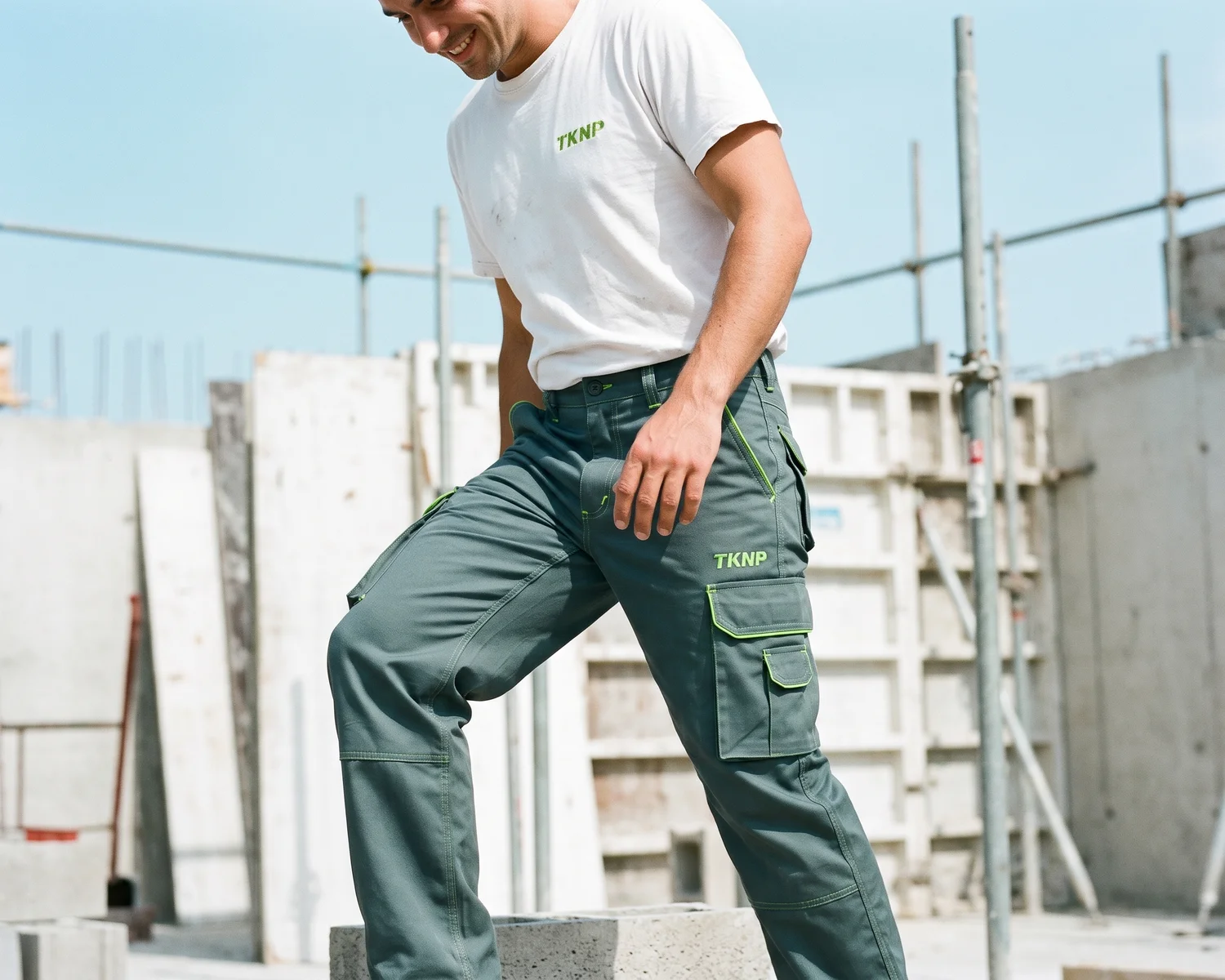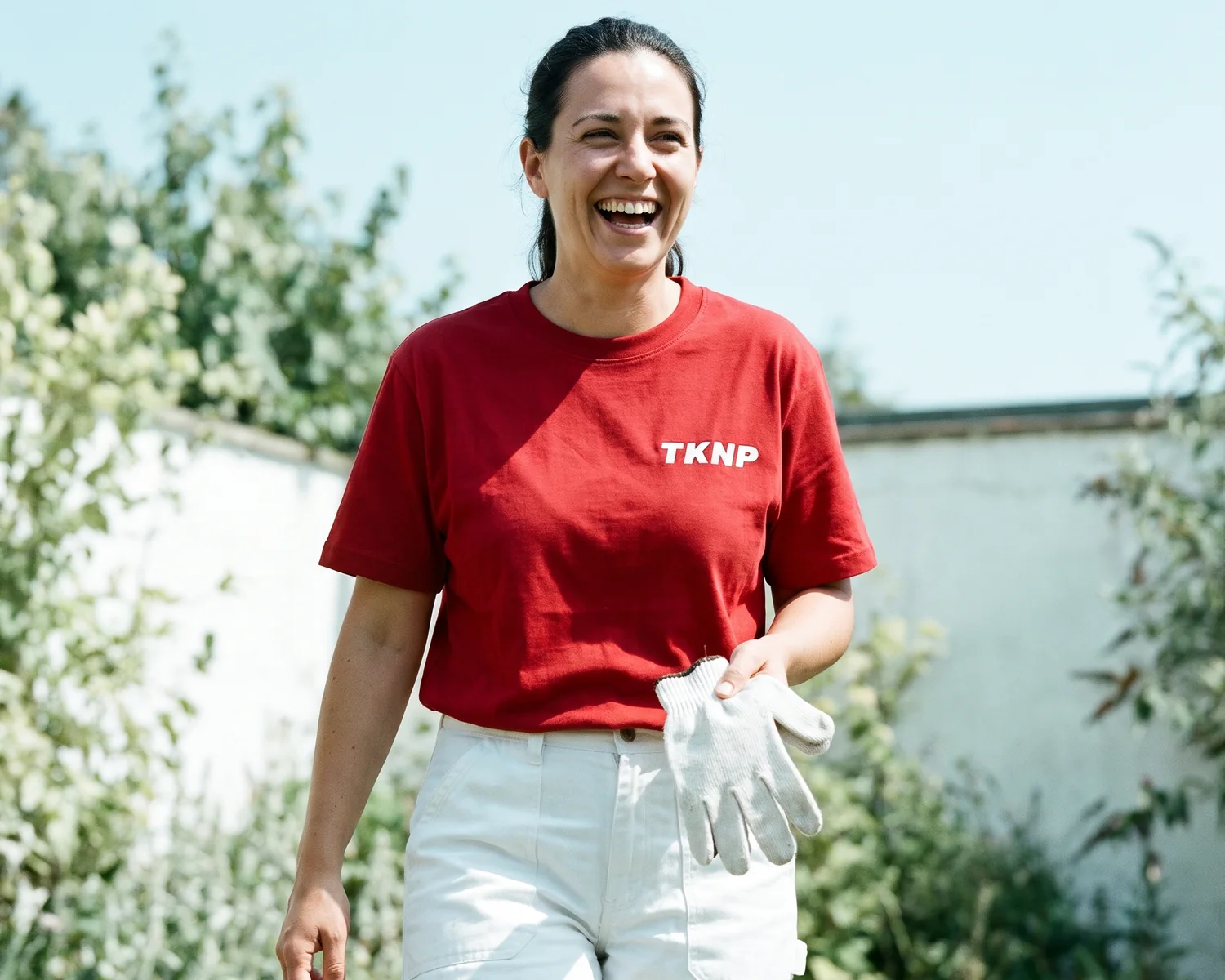
Embroidered workwear outlasts transfer-printed workwear in the wash: embroidery stands up to industrial laundering, a DTF transfer holds well at 30-40 °C. The Skill Pro polo, in cotton washable at 60 °C, costs €21.17 excl. VAT per polo embroidered at 50 units, €2.00 more than printed.
Key points before you choose:
- At 60 °C: in our comparison, embroidery and screen printing score 3 out of 3 for wash resistance, DTF transfer and DTG printing 2 out of 3. Both of those prints are said to hold well at 30-40 °C.
- In the tumble dryer: the garment's care label decides. The B&C Perfect Pro t-shirt can be tumble dried, according to its product page; a transfer, for its part, calls for a low temperature.
- By logo: a simple logo in flat colours can be embroidered; a gradient or a photo has to be printed; text under 5 mm loses legibility once stitched.
- The price: on the Skill Pro polo, €21.17 excl. VAT embroidered against €19.17 printed, for 50 units (indicative prices read on its product page on 13 November 2026).
A plumber's polo, a kitchen apron or the t-shirt of a car workshop do not live the life of a conference t-shirt. They go back into the machine week after week, on a hot programme when grease or flour demand it, and sometimes end up in the tumble dryer or at a laundry service. So start with this question, before you even look at garments: how will the clothes be washed? The answer points to the marking, and the marking then narrows down the garment.
Two markers guide this choice: the wash-resistance rating our technique pages give each marking, and the manufacturer's care instructions, repeated on each model's product page. Both are quoted as they stood on 13 November 2026. To put the outfit itself together, from t-shirt to softshell, our guide to custom workwear goes through the garments.
Embroidered or printed workwear: what each marking can take
Embroidered workwear is the kind whose logo lasts longest; printed workwear does just as well if it is screen printed, and one notch lower if it carries a transfer. That is the ranking in our embroidery versus printing comparison, which rates wash resistance out of 3.
| Marking | Wash resistance as rated by tknp.io | What our pages add | Workwear it suits |
|---|---|---|---|
| Embroidery | 3 out of 3 | said to withstand industrial laundering; no gradients, no text under 5 mm | from a thick t-shirt to a softshell |
| Screen printing | 3 out of 3 | dozens of washes without losing sharpness, like embroidery; gradients are difficult | t-shirt, polo, apron, chef jacket |
| DTF transfer | 2 out of 3 | holds well at 30-40 °C, less so under repeated industrial laundering | the same |
| Softshell printing | "Excellent" | holds on water-repellent fabrics | softshell, bodywarmer, winter jacket |
| DTG printing, on quote | 2 out of 3 | holds well at 30-40 °C; for mostly cotton fabrics | t-shirt, polo |
| Patch, on quote | "Excellent" | sewn or heat-applied, placed where direct embroidery is impossible | jackets, caps |
The scores out of 3 come from the comparison, the quoted ratings from our markings page, which also rates embroidery and screen printing "Excellent".
At 60 °C, which marking holds on workwear?
For workwear washed at 60 °C, go for embroidery or screen printing, the two markings our pages rate highest in the wash; DTF and DTG are rated there for 30 to 40 °C. None of these pages sets a maximum temperature for embroidery, screen printing or softshell printing: our advice is to keep to the one on the garment's care label. Here is the detail, technique by technique.
Embroidery: the thread goes where the garment goes
An embroidered logo copes with hot washes because the thread is stitched into the fabric: nothing is glued on, so nothing can peel off. Our comparison states that an embroidered logo withstands industrial laundering, and our workwear page recommends embroidery on cotton and polycotton, where it says the stitching lasts as long as the garment.
One thread maker points the same way. The German manufacturer Gunold describes its Poly 40 polyester thread as robust and chlorine-resistant, and lists workwear among its uses. That is a manufacturer's statement about its own thread, not a promise from us about a temperature.
Screen printing: an ink cured with heat
Screen-printed workwear does as well as embroidered workwear in our comparison: 3 out of 3. The ink, laid down colour by colour and then heat-cured, bonds with the fibre, and our pages say both techniques get through dozens of washes while staying sharp. Here again, keep to the temperature on the label.
DTF transfer: rated for 30 to 40 °C
A DTF transfer is rated to hold well from 30 to 40 °C, and repeated industrial washing suits it less: that is what our comparison says. The Skill Pro polo may be washable at 60 °C, but that temperature applies to its cotton, not to a film pressed onto it. If your clothes are washed at 60 °C, rule the transfer out; if you want it for its colours, set the machine to 40 °C at most and wash the garment inside out. The care routine for each marking, once the clothes are delivered, is in our guide to washing a marked garment without damaging it.
Softshell printing: the answer for jackets
On a softshell, a bodywarmer or a winter jacket, softshell printing is rated "Excellent" for wash resistance on our markings page, like embroidery. It holds on fabrics that shed water, where an ink applied directly does not grip. For these jackets, the washing temperature is read on the sewn-in label, model by model.
Can embroidered or printed workwear go in the tumble dryer?
Embroidered workwear can go in the tumble dryer if its label allows it; with a transfer print, it is better left to dry on the line. The garment comes first: at B&C, the page of the Perfect Pro work t-shirt describes it as tumble-dryer safe, on top of washing at 60 °C. The pages for the Skill Pro polo and the Karlowsky Bib Apron Basic stop at 60 °C. For these models as for the others, the square on the sewn-in label settles it, and our guide to laundry symbols shows how to read it.
As for the marking, our technique pages do not mention the tumble dryer. Our markings page does say that embroidered thread "is part of the garment and cannot peel", and that transfers hold very well as long as the wash stays at a low temperature. Our advice follows from that. An embroidered logo goes in the dryer whenever the garment's label allows it. A transfer, heat-pressed and meant for a gentle wash, dries on the line.
Which marking for workwear sent to an industrial laundry?
For clothes handed to a laundry service, embroidery is the only marking our pages expressly rate as withstanding industrial laundering. They say the opposite of DTF and DTG, which hold less well when such washes are repeated; and digital transfer, offered on quote, is described as less durable than screen printing under intensive use.
The garment has to keep up. Among our product pages, the one for the Karlowsky Jeans-Style chef jacket states that its pre-shrunk polyester and cotton fabric withstands industrial laundering. For any other model, ask your laundry for its programme, then check it against the label before ordering the run.
Which marking for which workwear fabric?
The marking of a work garment follows its fabric: on cotton and polyester-cotton washed hot, embroider; on fleece, embroider too; on water-repellent jackets, choose between embroidery and softshell printing. The table lists, model by model, what the product page says about washing and the marking that goes with it.
| Fabric and model | What the product page says about washing | If the clothes are washed hot | If they are washed at 30-40 °C |
|---|---|---|---|
| Cotton: Perfect Pro t-shirt (185 g/m²) | 60 °C and tumble dryer | embroidery, or screen printing if the marking is large | DTF transfer possible |
| Cotton: Skill Pro polo (230 g/m²) | 60 °C | embroidery on the chest | DTF transfer possible |
| Polyester-cotton: Bib Apron Basic | up to 60 °C | embroidery or screen printing | DTF transfer possible |
| Polyester-cotton: Jeans-Style chef jacket | withstands industrial laundering | embroidery | screen printing or DTF transfer |
| 100% polyester fleece: Result Polartherm | to be read on the label | embroidery, the only technique online, once the label has been read | embroidery |
| Pen Duick Atlantic softshell, B&C Reset bodywarmer | to be read on the label | embroidery or softshell printing, once the label has been read | embroidery or softshell printing |
Two details. A t-shirt only embroiders well if it is thick enough, 180 g/m² and above: the Perfect Pro, at 185 g/m², qualifies, and its red colourway is the one in our photo. And the Skill Pro polo has a chest pocket that its page describes as suited to a left-chest marking: a good candidate for an embroidered logo.
Which marking for your company logo?
On workwear washed hot, a company logo in flat colours is embroidered, and a logo with a gradient is redrawn or printed. Embroidery renders flat colours, not gradients, and it loses text under 5 mm: our article on embroidering a logo shows what a design becomes once translated into thread.
| Your logo | Clothes washed at 60 °C | Clothes washed at 30-40 °C |
|---|---|---|
| Flat colours, one to three, on the chest | embroidery | embroidery or DTF transfer |
| Small text under the logo, less than 5 mm high | embroider the logo without that text, or screen print | DTF transfer |
| Gradient or photo | logo redrawn in flat colours, then embroidered or screen printed | DTF transfer |
| Company name in large letters on the back, one colour | screen printing on cotton | screen printing or DTF transfer |
| Full-colour logo on a softshell | softshell printing, once the label has been read | softshell printing |
Screen printing becomes worthwhile from 50 units in one or two colours, according to our comparison: below that, for a large back on clothes washed hot, embroidery remains the safe choice, at a smaller size.
If the same garment carries a chest logo plus the business name across the back, we advise the same technique in both places: the two markings then age at the same pace.
Printed workwear: which print should you choose?
For printed workwear, choose screen printing if the logo fits in one or two colours, DTF transfer if it has a gradient or a photo, and softshell printing on a technical jacket. Screen printing is the print rated highest in the wash in our comparison, 3 out of 3, against 2 out of 3 for DTF transfer. To decide between two prints on other grounds, our guide to textile printing techniques starts from the artwork, the fabric and the quantity.
Embroidered or printed: what does a logo that survives the wash cost?
On a work polo washable at 60 °C, an embroidered logo costs €2.00 excl. VAT more per polo than a printed one at 50 units, or €100.00 over the run. The table gives the price of the B&C Skill Pro polo, marking included, for the three techniques offered online on its page.
| Skill Pro polo, price excl. VAT per polo | 10 | 25 | 50 | 100 | 250 |
|---|---|---|---|---|---|
| Embroidery 8 × 10 cm | €22.90 | €21.84 | €21.17 | €19.54 | €18.19 |
| DTF transfer 10 × 15 cm | €22.89 | €20.41 | €19.17 | €18.17 | €17.26 |
| Screen printing, 1 colour | €31.37 | €22.77 | €19.17 | €17.58 | €16.51 |
For ten polos, thread and film cost the same to within a cent; the gap peaks at €2.00 at 50 units, then narrows. Screen printing, expensive at ten units, drops below embroidery from 50 upwards.
On the apron, the order is reversed for a small run: ten embroidered aprons cost €1.71 excl. VAT less per apron than ten aprons with a DTF transfer.
| Bib Apron Basic, price excl. VAT per apron | 10 | 25 | 50 | 100 | 250 |
|---|---|---|---|---|---|
| Embroidery 8 × 10 cm | €15.53 | €14.69 | €14.25 | €12.85 | €11.83 |
| DTF transfer 10 × 15 cm | €17.24 | €14.32 | €13.07 | €12.14 | €11.53 |
| Screen printing, 1 colour | €28.73 | €17.51 | €13.07 | €11.35 | €10.52 |
The amounts in both tables were read on 13 November 2026 on the polo's page and on the apron's, and are indicative only. VAT and shipping come on top; each price covers one marking per garment, in each model's base colour, on the two-week production time. What embroidery adds to the bare garment, and why, is broken down in our article on embroidery pricing.
Let us settle embroidery versus printing before you order
On tknp.io, you can ask for advice on the marking of your workwear before you order. Our embroidery versus printing comparison spells it out: you send the artwork and the quantity, we reply within 24 hours with the recommended finish and the price. For workwear, add one line to your message: how the clothes will be washed. The temperature, tumble dryer or not, the workshop's machine or a laundry service. That line is what tips the answer towards thread or towards ink, and the Request a quote form accepts your logo file.
Workwear with a company logo: in what order should you decide?
For professional workwear carrying your company logo, decide in this order: the wash, the marking, then the model.
- The wash. Who washes, at what temperature, with or without a tumble dryer. In France, when the outfit is compulsory, its upkeep falls to the employer: our article on compulsory workwear quotes the legal texts.
- The marking. Hot wash: embroidery, or screen printing for a large marking on cotton. Laundry service: embroidery. Wash at 30-40 °C: every technique stays open, and the logo makes the choice.
- The model. A garment whose label matches your wash, then the online order: at least 10 garments of one model, whatever the sizes and colours, customised in 10 working days on the standard lead time.
A logo that is still sharp after months in the machine is also what makes people want to wear the outfit away from the site: that is when workwear becomes the company's merch. Our construction and industry page gathers the models to customise for field teams.
Frequently asked questions
Can you wash workwear printed with a DTF transfer at 60 °C?
Better not. Our pages rate DTF transfer as holding well at 30-40 °C, and less well under repeated industrial laundering. Even if the garment's label allows 60 °C, set the machine to 40 °C at most, or choose embroidery or screen printing when you order.
Does screen printing hold on workwear washed every week?
Yes: our comparison rates screen printing 3 out of 3 for wash resistance, level with embroidery, and says it gets through dozens of washes without losing sharpness. It can be ordered online, in one colour, on the Perfect Pro t-shirt, the Skill Pro polo, the Bib Apron Basic and the Jeans-Style jacket.
Does a patch hold on workwear washed hot?
Our markings page rates the patch "Excellent" for wash resistance. A patch is made on quote, and is either sewn on or heat-applied: say in your request that the clothes are washed at 60 °C, so the fixing is chosen accordingly.
How many washes does a printed logo last on workwear?
For a screen-printed logo, our pages speak of dozens of washes with no loss of sharpness. For a DTF transfer or a DTG print, they give no number: only a temperature range, 30 to 40 °C, and a score of 2 out of 3.
Your project, quoted within 24 hours.
Describe your garments, your decoration and your quantities: you receive a detailed quote, decoration included, within one business day.