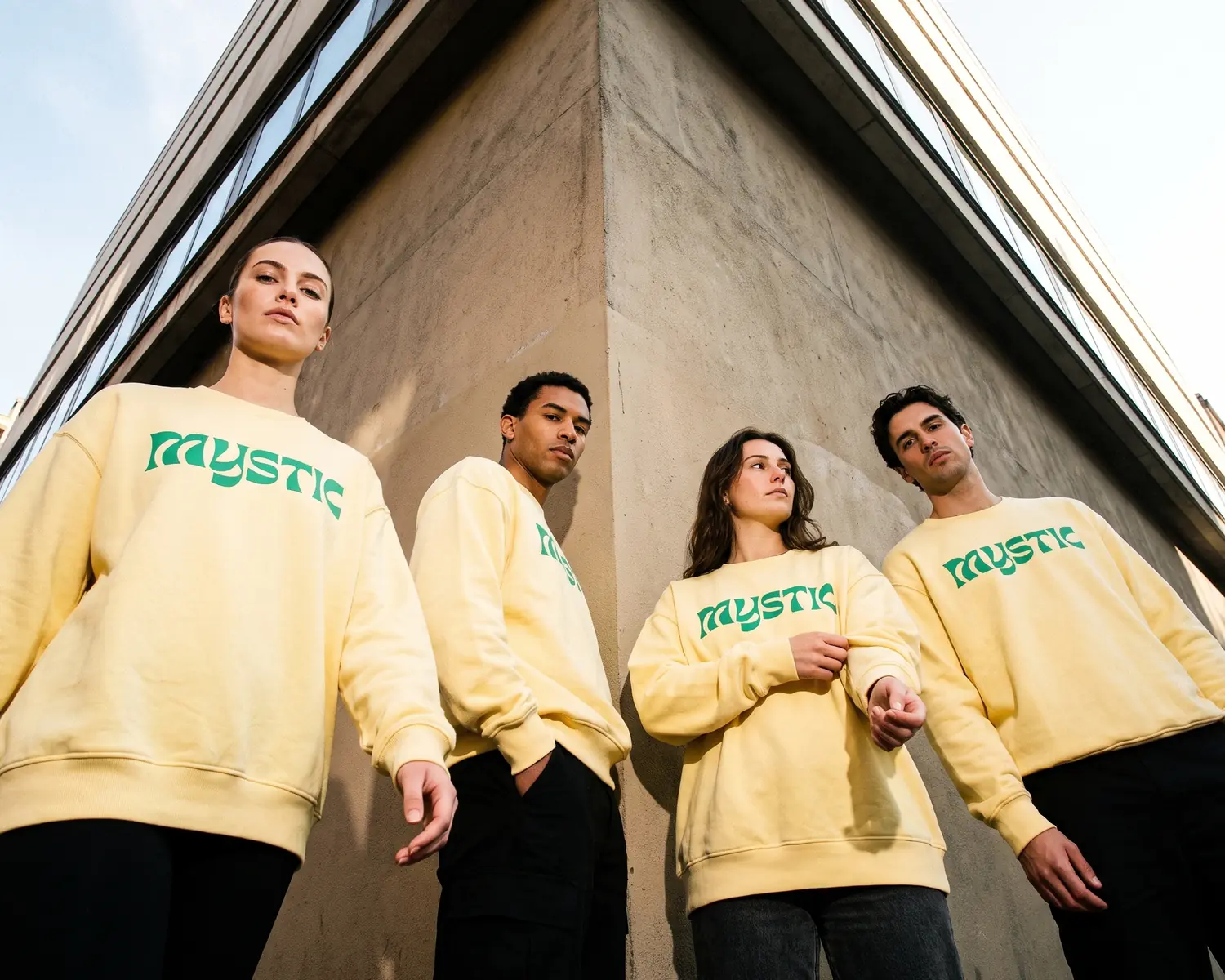
A company welcome pack, or welcome kit, gathers the custom apparel and useful items handed to a new employee: hoodie, t-shirt, water bottle. The simplest method: an internal Store where each employee picks their own size, with every piece produced on demand, no stock and no minimum.
The essentials in 5 points:
- Three great pieces people actually wear beat seven objects they forget: the right question is "would they use it without a logo on it?".
- A welcome pack should be designed like fashion apparel: well cut, great fabric, and a logo that travels because your employees wear it in the street.
- The internal Store removes the admin: each employee picks their own size, every piece is produced one at a time, zero stock in the HR closet.
- Hires throughout the year are handled with the same link: the fiftieth new joiner gets the exact same pack as the first.
- Fabric and cut speak culture: organic cotton, serious labels and dedicated fits turn an HR expense into proof of values.
On a new employee's first day, everything counts. The desk is ready, the team has been told, and there is that detail that is anything but a detail: the welcome pack waiting on the desk. A hoodie in their size, a water bottle, a welcome note. In ten seconds, the person understands they were expected.
A welcome pack, also called a welcome kit or onboarding kit, is the set of pieces handed to a new employee on arrival: custom apparel in the company's colors, plus a few useful everyday items. And then there is the other side of the story, which HR teams and office managers know all too well: quotes to compare, order minimums, a box of sizes stored in a closet, and the stress at every new arrival because only XXL is left. Putting together an onboarding pack for your employees should not be a project in itself.
This guide covers what makes a good company welcome pack (and what ends up in a drawer), the classic organizational traps, and the modern method that makes every arrival handle itself, from the first employee to the fiftieth. With one assumed stance: a welcome pack should be designed like a wardrobe, not like promotional merchandise.
What to put in a welcome pack (and what ends up in a drawer)
Let's start with the content, because that is where everything plays out. The rule fits in one question: would the employee use it if there were no logo on it?
What works, year after year:
- The company hoodie or sweatshirt, the centerpiece of the pack, logo embroidered on the chest. Well cut, in a beautiful fabric, it gets worn at the office, working from home, on weekends. It is the piece teams actually ask for.
- The t-shirt, the natural everyday companion, lighter and easy to wear daily.
- The water bottle or mug, useful from day one at the desk.
- The tote bag, which carries the rest of the pack and lives on long after.
What ends up in a drawer: gadget items, pens by the threes, notebooks nobody opens. A welcome pack is not a trade-show booth: three great pieces that get used beat seven objects that get forgotten.
The typical pack, at a glance:
| Piece | Its role in the pack |
|---|---|
| Hoodie | The centerpiece, the one people actually wear, at the office and around town |
| Crewneck sweatshirt | The hoodless alternative, dressier: the piece for meetings and team photos |
| T-shirt | The everyday companion, easy to wear daily |
| Water bottle or mug | The useful one from day one, visible on every desk |
| Tote bag | The pack's packaging, which keeps on living afterwards |
| The welcome note | The only thing money cannot buy, and the most remembered |
One principle guides the apparel choice: aim for a fashion-grade welcome pack. Well-cut pieces, in beautiful fabrics, that could pass for a ready-to-wear brand: the kind of hoodie an employee picks on a Saturday morning, not the one they wear out of politeness. To set the bar: the Stanley/Stella Cruiser Hoodie, thick organic cotton, the benchmark of premium hoodies. A hoodie that pills after the third wash sends exactly the wrong message to someone who just signed. A desirable piece, on the other hand, gets worn in the street, on the subway, at the gym: your logo travels beyond the office walls, worn by your best ambassadors, and every outing is free visibility for the brand. That is the difference between an HR expense and a brand investment.
Ethics and fit: what the pack says about your culture
A welcome pack speaks on the company's behalf, and it does so in the two languages everyone reads: fabric and fit.
Fabric is consistency. A company that displays CSR commitments and hands out disposable apparel produced on the other side of the world sends a contradictory message from day one. Conversely: organic cotton, serious labels (GOTS, OEKO-TEX) on the tag, and on-demand production that only makes what actually gets worn: the pack becomes proof of culture, not a speech. It is also the HR version of zero waste: no box of unsold sizes sleeping in a closet.
Fit is respect. Company apparel only gets worn if it fits well. Providing real cuts, including dedicated women's fits rather than a default unisex, and letting everyone pick their own size, means treating workwear with the same care as clothes people buy. The result shows: a well-cut pack gets worn, an approximate one gets stored.
Both choices are made when composing the collection, and they often cost only a few extra euros per piece. Set against what they say about company culture, it is probably the best image-to-price ratio of the entire onboarding journey.
The 3 traps of the classic onboarding pack
If welcome packs remain a headache in so many companies, it is rarely a budget problem. It is the organization that fails, always in the same three places.
The project that drags on
Comparing quotes, choosing items, approving designs, following up: putting together the first pack can eat up weeks on and off. It is nobody's actual job, so the project slips month after month, and new joiners arrive to nothing.
The size inventory
Ordering in advance means betting on the sizes of future hires. The result: an HR closet full of boxes, missing S sizes, leftover XXLs, and money locked in sleeping apparel. The welcome pack becomes an inventory to manage.
Hires trickling in all year
The pack orders fine by 50 at launch. But hires arrive one by one, all year long. Re-ordering 3 hoodies urgently for the March arrivals means going through the quote, the order minimum, the lead time all over again. Many companies give up right there: the first joiners got their pack, the next ones got an excuse.
The method: the company's internal Store
The modern method flips the logic: instead of ordering packs, the company opens its Store, its internal shop generated from its logo, and every employee serves themselves.
- Create the company Store. Once the logo is uploaded, a collection is ready: hoodie, t-shirt, cap, water bottle, in the brand's colors. You adjust it freely, with no paperwork or quote, in a few minutes. To see what it looks like before you start, browse the company Stores already live.
- Compose your onboarding pack. Select the pieces of the standard welcome pack: for example a hoodie, a t-shirt and a water bottle. Every piece is produced on demand, from a single unit, with no minimum.
- Each new employee picks their own size. This is the game changer: nobody collects sizes or bets on stock anymore. The Store link goes into the welcome email, everyone orders their size and color, delivery follows.
- The next arrivals handle themselves. A hire in March? Same link. The fiftieth employee's pack is identical to the first one's, with no restocking to organize: every piece is produced one at a time, on demand, and the delivery date is announced before payment.
Zero stock in the closet, zero size spreadsheet, zero quote to chase. The welcome pack stops being a project: it is one link in the onboarding email.
A pack that lives all year round
The internal Store is not just for arrivals. Once in place, it becomes the company's wardrobe, available continuously.
- Friction-free replacement: the worn-out hoodie or stained t-shirt gets re-ordered by the unit, without going through anyone.
- Team moments: offsite, trade show, end-of-year party: the same collection serves as the base, possibly enriched with an event piece.
- The growing team: every hire triggers the same ritual, the same quality, the same experience. Onboarding becomes repeatable, which is exactly what you ask of an HR process.
The Store also comes into its own during the holidays: our 5 year-end gift ideas show how the December gift becomes the first rendezvous of the company wardrobe.
And for client-facing teams, the stakes go beyond comfort: the outfit is the company's image. An internal Store guarantees everyone wears the same thing, in the same condition, without anyone playing warehouse manager.
What budget for a company welcome pack?
The last reflex to change: think in cost per equipped employee rather than in order volume.
As an indication, a quality apparel pack (a hoodie, a t-shirt) comes together at around 30 to 45 euros per person depending on the range, plus accessories. Set against the overall cost of a hire, it is one of the most visible and most durable spends of the onboarding journey: it is the one in the first-day photo, and the one still worn a year later.
Two benchmarks to decide:
- Quality over quantity. One hoodie people love beats a pack of five average items at the same price. The employee will judge the piece, not the list.
- Price drops with volume. If a big event or a hiring wave justifies a group order, quantity tiers apply, and the Store remains there for the next arrivals, one unit at a time.
When to hand over the welcome pack
Content matters, timing too. Two schools work:
- On the desk on day one, the classic: the pack waits at the workstation, the team is there, the photo takes itself.
- At home, before day one, the memorable one: the pack arrives a few days before the start date, and the new hire shows up already wearing the team's colors. Instant belonging, before the badge.
In both cases, one simple ritual anchors the moment: the new joiner's photo with their pack, shared on the internal channel. It is good for the welcome, and those photos naturally become your best employer-brand showcase.
The final word
A great welcome pack is not about gadgets: it is company merch people want to wear, handed over at the right moment, with an organization that fits in one link. The company opens its Store, composes its onboarding pack, and every employee, from the first to the fiftieth, gets the same polished arrival: they pick their size, receive their pieces, and wear your colors well beyond the office.
The first day only happens once. Make it count.
Frequently asked questions
What should a company welcome pack include?
Three to five useful, desirable pieces: a well-cut hoodie or crewneck sweatshirt (the centerpiece), a t-shirt, a water bottle or mug, a tote bag, and a welcome note. The sorting rule: if the employee would not use it without a logo on it, the item leaves the pack.
What budget should you plan for a welcome pack?
As an indication, plan 30 to 45 euros per employee for a quality apparel pack (hoodie and t-shirt), accessories on top. Set against the cost of a hire, it is one of the most visible and durable spends of the onboarding journey.
How do you manage welcome pack sizes?
By not managing them: with an internal Store, each new employee receives a link in their welcome email and picks their own size and color. Nobody collects sizes, nobody stores boxes, and everyone receives a piece that fits.
How do you equip hires throughout the year?
With the same link: every piece in the Store is produced on demand, from a single unit, with no order minimum. The March hire receives exactly the same pack as the September cohort, with no quote and no restocking.
Should the pack be handed over before or on the first day?
Both work: on the desk on day one for the team moment, or delivered at home a few days early so the new hire arrives already wearing the company's colors. Either way, the photo with the pack, shared internally, anchors the ritual.
Your project, quoted within 24 hours.
Describe your garments, your decoration and your quantities: you receive a detailed quote, decoration included, within one business day.