A company dress code policy fits on one page: who it applies to, the uniform provided, how to wear it and when to renew it. It works best when it names the exact garment: a B&C Inspire polo embroidered on the chest costs €10.54 excl. VAT for 50 on tknp.io, an indicative price read on 9 November 2026.
In short, four markers:
- The law: in France, an employee can in principle dress as they wish, but the employer can require a uniform if it is justified by the task and proportionate to the aim (article L1121-1 of the French Labour Code). Hygiene, safety, decency and image in front of customers are the accepted reasons.
- Where to write it: in the internal rules (règlement intérieur), compulsory from 50 employees, or in a staff memo, which follows the same rules whatever the headcount.
- The template: seven sections, ready to copy below, from who is covered to the start date.
- The uniform: each job written into the policy matches a named garment, from €10.54 excl. VAT for an embroidered polo to €21.15 excl. VAT for an embroidered shirt, for 50 (our product pages on 9 November 2026, excl. VAT, one embroidered logo, shipping not included, indicative prices).
You are opening a third shop or a second restaurant, or taking over a network where every address dresses its own way: a white shirt here, a black t-shirt there, no logo elsewhere. Before ordering a single uniform, a written rule ends the debates at the counter and gives customers the same image from one door to the next. That rule is the dress code policy, which French companies call a "charte vestimentaire".
This guide stays on what you write and on the uniform that applies it. Who supplies the uniform, who pays for it and who washes it has a guide of its own, on the uniform an employer makes mandatory: it is not covered here. The legal texts quoted here are French and were read at their official source on 9 November 2026; they do not replace a lawyer's advice for your own case, and other countries have their own rules.
What is a company dress code policy?
A company dress code policy is the written document that sets the expected work outfit: who wears it, which garments, how to wear them, and what is ruled out. In France, it belongs in the internal rules, in a staff memo, or for a specific job in the employment contract, as detailed below.
It is sometimes confused with a brand style guide, which sets the logo, colours and fonts. The two work together: the style guide says what colour the logo is, the dress code says which garment carries it, and where.
Can an employer impose a uniform on employees?
Yes, an employer can impose a uniform, as long as it is justified by the job and kept reasonable. Service Public sets the principle: an employee is in principle free to dress as they wish at work. The limit comes from article L1121-1 of the French Labour Code, which bars any restriction of personal rights and freedoms that is not justified by the nature of the task or not proportionate to the aim.
France's highest court set the scope of that freedom in the Bermuda shorts case: an employee who came to work in Bermuda shorts despite instructions had been dismissed, and the court dismissed his appeal, ruling that the freedom to dress as one pleases at work is not one of the fundamental freedoms (Cass. soc., 28 May 2003, no. 02-40.273). A dress rule is therefore possible, provided it can be explained.
On what grounds can a uniform be required?
Four grounds come back in the case law summarised by Service Public: hygiene, safety, decency, and concern for the brand image, above all for jobs where staff serve or advise customers face to face. For a shop, a restaurant or a hotel, that last ground carries the image uniform: the sales assistant, the waiter or the receptionist represents the house in front of the customer.
France's Defender of Rights, quoted on the same page, sums up the rule: dress codes must be justified by the nature of the jobs concerned, legitimate, and proportionate to the aim. So write down, for each job, the reason for the rule: a kitchen job is about hygiene, a dining-room job about image. Safety, for its part, relies on protective equipment, a different subject from the image uniform that we do not cover here.
What a dress code policy cannot impose
A dress code policy can neither discriminate nor restrict a freedom without a reason tied to the job. Article L1321-3 of the French Labour Code bars from the internal rules any unjustified restriction and any provision that discriminates against employees, in particular on grounds of sex or physical appearance; article L1132-1 also lists physical appearance among the prohibited grounds of discrimination.
An example from the restaurant trade: a head waiter dismissed for wearing earrings during service had his dismissal declared void, the court finding discrimination based on his physical appearance in relation to his sex (Cass. soc., 11 January 2012, no. 10-28.213). The Defender of Rights adds that the rules must be the same for women and men. In practice: one uniform for one job, cut for women and cut for men, rather than a skirt imposed on some and trousers on others.
For religious symbols, article L1321-2-1 allows the internal rules to set a neutrality principle, only if the restriction is justified by other fundamental rights and freedoms or by the proper running of the business, and proportionate. This is where a lawyer's advice matters most.
Where to write the policy: internal rules or staff memo?
In France, the dress code goes into the internal rules when the company has them, or into a staff memo. According to Service Public's page on internal rules, they become compulsory in a company or site with 50 or more employees, once that headcount has been reached for 12 consecutive months; below that, they remain possible, under the same conditions.
Staff memos that set general and permanent obligations on health, safety or discipline follow the same rules as the internal rules, whatever the headcount (article L1321-5). In both cases, the steps are the same:
- Consult the works council (CSE), if there is one.
- File the text with the clerk of the local employment tribunal (conseil de prud'hommes).
- Post it up or publish it on the intranet for everyone with access to the workplace.
- Send two copies to the labour inspector, with the works council's opinion.
- Set a start date at least one month after it has been made public.
The text is written in French. For a specific job, a clause in the employment contract can also describe the expected outfit.
What should a dress code policy include?
A good dress code policy answers seven questions, in this order: who it applies to, why, which uniform, how to wear it, what is ruled out, how the uniform is handed out and renewed, and from when. Each rule carries its reason, tied to the job: that is what makes it defensible.
Be precise about the garment. "Smart clothing" says nothing; "the house polo, lilac, logo embroidered on the chest" can be checked at a glance. Be very careful, on the other hand, with anything touching physical appearance: for the Defender of Rights, quoted by Service Public, it may only be restricted if the restriction is decisive for carrying out the job. A rule on appearance belongs in the policy only if the job truly requires it.
A dress code policy template you can reuse
Copy this text as it is, then fill in each passage in square brackets with what applies in your business. It is written for a network of shops or restaurants; adapt the jobs to your business. For a construction or industrial company, section 3 would instead name the t-shirt, the polo and the work trousers gathered on our page for dressing a site or workshop team.
Dress code policy of [company name], in force from [date, at least one month after posting]
1. Who is covered. This policy applies to employees in contact with customers at the following sites: [list of addresses]. It also applies to interns and temporary staff working in these jobs.
2. Reason for the rule. Our customers recognise [brand name] at the front desk, in the dining room and at the till. The shared uniform reflects the house's image with customers and, in the kitchen, hygiene rules.
3. The uniform provided. Dining room and sales: [polo, reference, colour, logo embroidered on the chest]. Front desk: [shirt, reference, colour, logo embroidered on the chest]. Table service: [apron, reference, colour, logo]. Women and men get the same uniform, each in a cut designed for them, on the same terms.
4. How to wear it. The uniform is worn clean and complete during service. Trousers or skirt are [dark and plain, provided or not]. Shoes are [closed, for example].
5. What is ruled out during service. [Example: another brand's clothing worn over the uniform.] Every exclusion is tied to the job and applies in the same way to women and men.
6. Handing out and renewal. Each employee receives [number] uniforms on arrival. A damaged uniform is replaced on request from [manager].
7. Questions and review. For any question: [contact]. This policy is reviewed every year, after the works council's opinion if there is one.
Two tips to get it adopted. Have section 5 reviewed by a lawyer before posting it: it is the one that touches freedoms the most. And involve a few team members in writing it, as the Defender of Rights recommends: a uniform chosen together is worn more willingly than an order handed down from above.
A dress code for a network of shops or restaurants
For a network, the policy is written once, then each employer in the network adopts it on its side, in its internal rules or by a staff memo. Service Public specifies that a company with several sites of 50 or more employees in principle sets internal rules for each, or a single set at company level.
The benefit of a shared version shows at the order: if section 3 names the model, the colour and the logo position, every address dresses its team identically, without reinterpreting "dark polo" its own way. Keep the same reference from one shop to the next: on tknp.io, within a single order, two colours of the same polo with the same logo count as one quantity in the price grid.
Which uniform puts the policy into practice?
The uniform that applies a network's dress code comes down to three garments named by their reference: an embroidered polo for the dining room and sales, an embroidered shirt for the front desk, an apron for table service. Here is what each costs on our product pages, embroidered with the logo (8 x 10 cm, one position), for 50:
| What the policy says | The garment | Embroidered, for 50 (excl. VAT) |
|---|---|---|
| Dining room and sales, men's cut | B&C's men's polo, Inspire Polo/Men: 180 g/m² cotton, 20 colours, sizes S to 3XL | €10.54 |
| Dining room and sales, women's cut | its women's version, Inspire Polo/Women: same cotton, same 20 colours, sizes XS to XXL | €10.54 |
| Front desk, men's cut | Russell Collection's poplin shirt, Tailored Poplin Shirt: 6 colours, sizes S to 4XL | €21.15 |
| Front desk, women's cut | its fitted counterpart, Ladies' Fitted Poplin Shirt: 5 colours, sizes XS to 4XL | €20.70 |
| Table service | SG Clothing ROME bistro apron, 100 x 78 cm, 8 colours, washable at 60 °C | €13.24 |
We read these amounts on our product pages on 9 November 2026: excl. VAT, embroidery in one spot included, in each grid's base colour and in standard sizes, at the grid's base lead time (two weeks of production). Shipping is added (€15.00 excl. VAT per order delivered in France). The product pages warn that the brand may charge extra for some colours and for larger sizes; the amount appears as soon as you select them. These figures remain indicative: only the quote is binding.
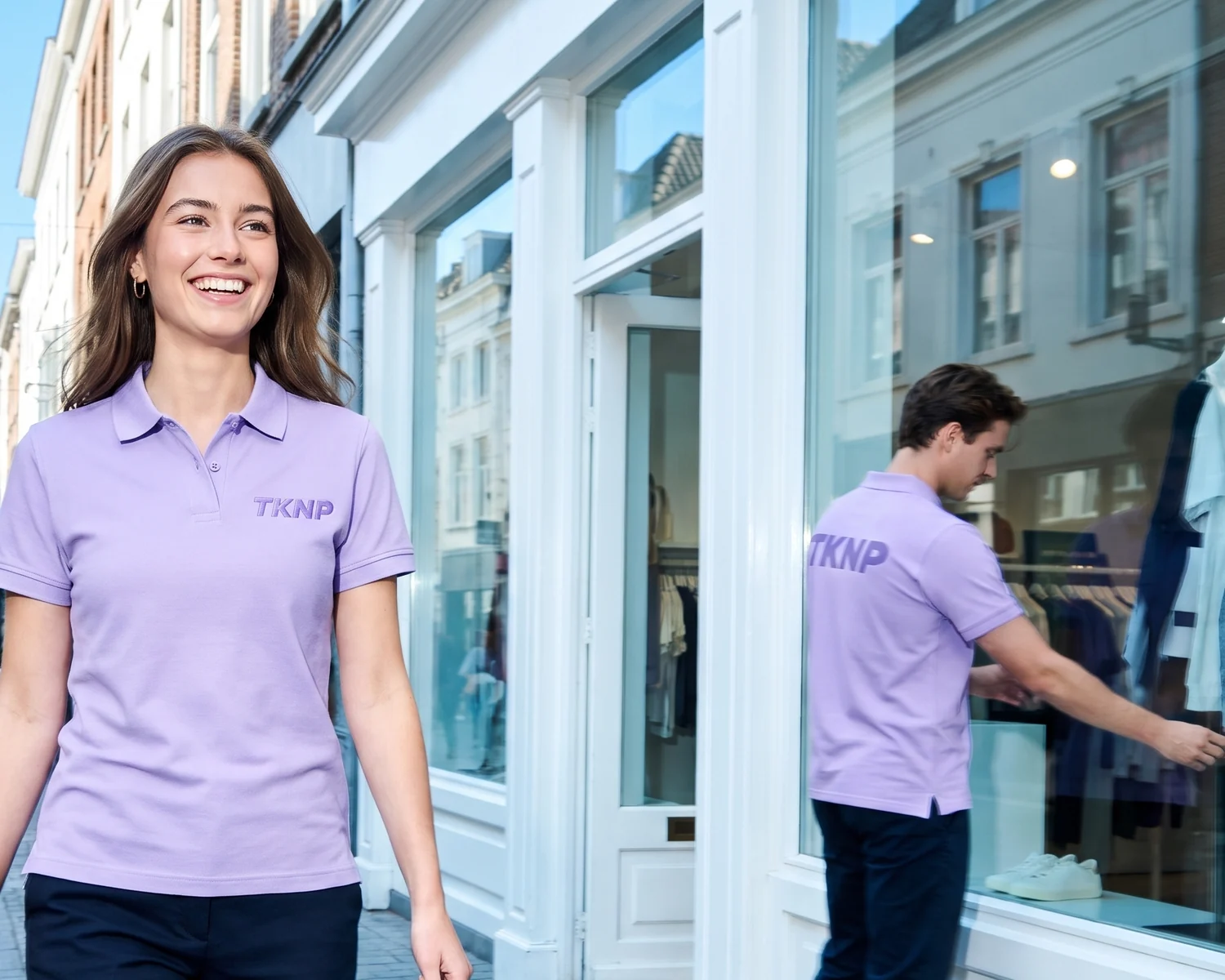
The Inspire polo in our photo is lilac (Millennial Lilac on the product page). A uniform the team actually likes wearing also becomes the house's first merch: customers see the logo every time someone crosses the room. To choose each garment job by job, see our guides to the waiter uniform, the receptionist uniform and the hostess outfit; for the logo height to the centimetre, our article on logo placement. If your policy also covers the kitchen or the workshop, the chef jacket, the bib apron and the work trousers are priced in our guide to workwear with your logo.
In the policy, stick to a logo embroidered on the chest: it is often enough to sign the uniform, and we advise never mixing two techniques on one garment, nor adding more than two prints. Allow at least 10 embroidered units per model; minimums and lead times are detailed on our page about custom clothing for companies.
One reference for all your addresses
On tknp.io, the uniform described in your policy is kept in your pro account: it is free, and our FAQ specifies that it gathers in one place, for the entire team, your printed garments, your quotes and your past orders. The reference, the colour and the logo stay there exactly as you approved them: the shop that opens next year reorders precisely the uniform written in section 3, without starting from scratch.
The policy does the work: it names the garment, the account keeps it, and each new address's order starts again from the same line, from 10 units. For a network that wants to talk before getting started, our team answers here.
Frequently asked questions
Is a dress code policy compulsory?
The compulsory document is the internal rules, from 50 employees: the dress code policy is only one possible part of it. Without internal rules, a staff memo can carry the uniform, under the same rules. In every case, the required uniform must be justified by the task and proportionate to the aim (article L1121-1 of the French Labour Code).
Does the dress code policy apply to interns and temporary staff?
Yes, for hygiene, safety and general discipline rules: according to Service Public, interns and temporary workers follow the internal rules of the company where they work. They are not, however, subject to its scale of sanctions or its disciplinary procedure.
Can you ban Bermuda shorts at work?
Yes, when the outfit is incompatible with the job: in 2003, France's highest court upheld the dismissal of an employee who came in Bermuda shorts despite instructions, ruling that the freedom to dress as one pleases is not a fundamental freedom (Cass. soc., 28 May 2003, no. 02-40.273). The rule must stay tied to the job.
Your project, quoted within 24 hours.
Describe your garments, your decoration and your quantities: you receive a detailed quote, decoration included, within one business day.