Clothing packaging: how does a brand prepare its parcels?
Well-packed clothing comes in three layers: folded in tissue paper or a bag, slipped into a soft mailer for a light shipment or into a cardboard box for a heavier parcel, then signed at the unboxing by a sticker, a card and a tag.
Your first drop is ready, orders are coming in, and the same question comes back with every parcel: mailer or box, how to fold, what to slip inside so that the customer recognises your brand before even putting the garment on. Here are the choices that matter, with the rules of La Poste, the French postal service, and its public 2026 rates.
The essentials before your first shipment:
- One or two light garments: a soft mailer or a padded envelope is enough; under 2 kg and 3 cm thick, La Poste accepts the parcel at letter rate, with no compensation if it is lost.
- A heavier or more valuable parcel: a rigid cardboard box of the right size, sent with Colissimo, La Poste's parcel service, which gives a right to compensation.
- The garment: neatly folded, slipped into tissue paper or a bag, and wedged so it does not move.
- The brand at the unboxing: a sticker with your logo sealing the paper, a thank-you card, a brand tag.
Mailer or cardboard box: which packaging for clothing?
For clothing packaging, a soft mailer suits one or two light garments, and a cardboard box suits a heavier or more fragile parcel. La Poste puts it simply in its guide on sending clothes: whether you use a padded envelope, a soft mailer or a flat box, a shipment that weighs no more than 2 kg and is no thicker than 3 cm can go as a tracked letter (Lettre Services Plus, Lettre verte suivie or Lettre suivie internationale).
That letter rate has a limit that La Poste states in black and white: no compensation in case of loss or damage. For several garments, a parcel thicker than 3 cm or an order you cannot afford to lose, the same guide points to a cardboard box sent with Colissimo, which gives a right to compensation. Colissimo carries parcels up to 30 kg (20 kg for some destinations), as long as length, width and height added together do not exceed 2 metres; some countries set lower limits.
Which cardboard box should you choose?
A cardboard box for clothing must first be sturdy: La Poste recommends a box rigid enough not to tear in transit, and the right size for what it holds. Pick it to the size of the folded garment: the less empty space, the less padding you need.
How much does it cost to ship a parcel of clothing?
The cost of shipping a parcel of clothing depends mainly on its weight and its destination. Here are the 2026 Colissimo rates shown by La Poste for a parcel sent within mainland France, read on 30 October 2026:
| Weight up to | Home delivery | Pick-up point delivery |
|---|---|---|
| 250 g | €5.49 | €4.79 |
| 500 g | €7.59 | €6.89 |
| 1 kg | €9.59 | €8.89 |
| 2 kg | €11.19 | €10.49 |
To a country of the European Union or to Switzerland, the same Colissimo grid rises to €14.99 up to 500 g and €19.39 up to 1 kg. If you have no boxes yet, La Poste also sells prepaid packaging, called Prêt-à-Envoyer: €10.99 for the soft format up to 1 kg, €10.49 for the M box up to 3 kg, within mainland France. Weigh your parcel once it is closed, paper and card included: that weight sets the price band. La Poste also publishes a grid for professional senders, worth comparing as soon as your shipments become regular. Outside France, check the rates of your own national postal service.
How do you fold and protect a garment in its parcel?
A garment arrives looking sharp when it is neatly folded, wrapped, then wedged. Fold a t-shirt or a sweatshirt with the back facing you, sleeves folded behind, into a rectangle roughly the size of the bottom of the box: the front, with its print or embroidery, stays flat and visible at the opening.
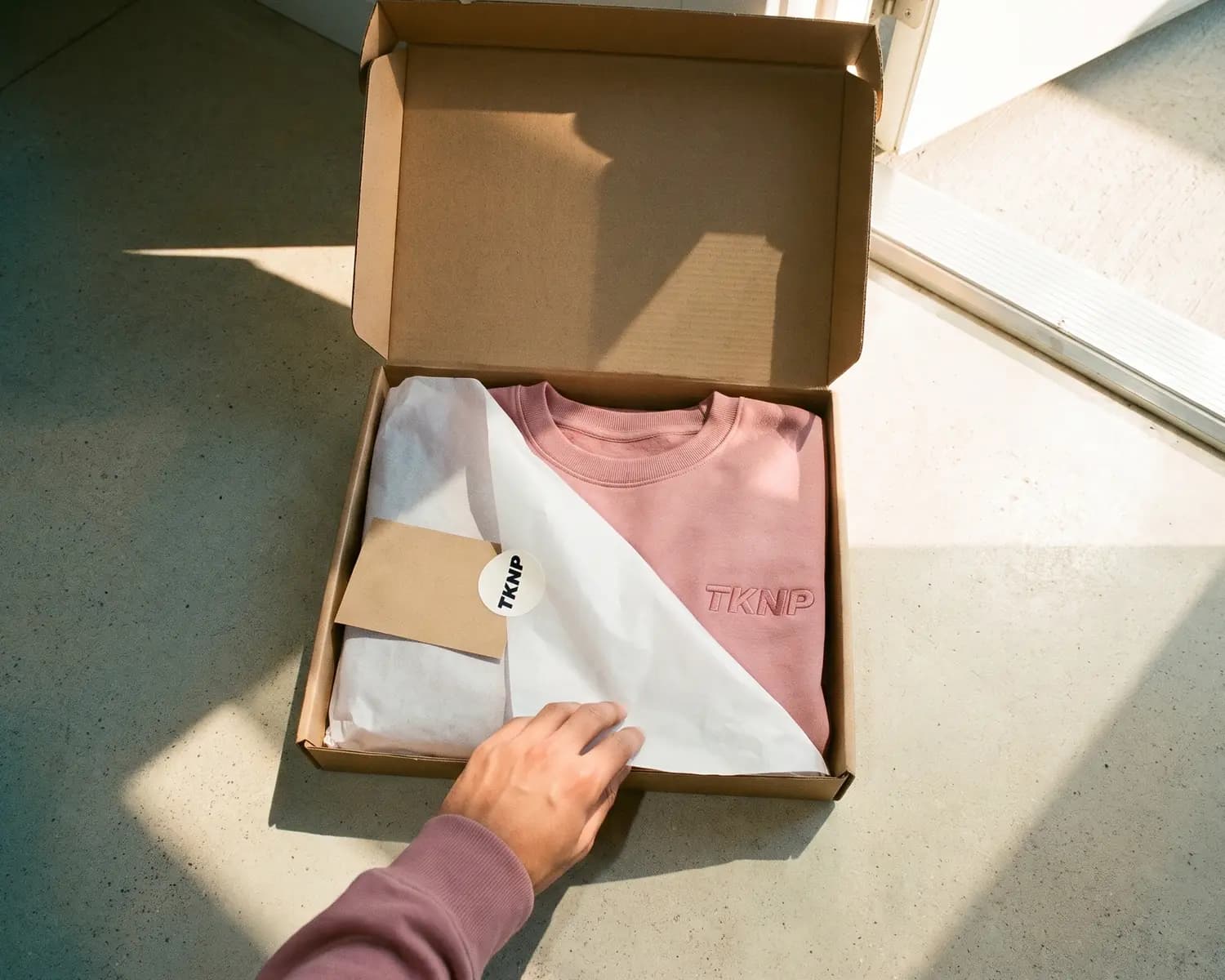
Then wrap the folded garment in tissue paper or slip it into a bag: it is what your customer finds on opening the box. All that is left is to wedge it. La Poste asks that the contents move as little as possible in transit, and lists among padding materials kraft paper, bubble wrap, foam paper and even fabric. For a garment, tuck crumpled paper into the remaining gaps.
Some brands replace the paper and the box with a cotton drawstring pouch printed with their logo, which the customer then keeps to store things: our guide to the custom drawstring pouch covers the right size and the marking.
What should go in a clothing parcel so the brand shows?
For your brand to show as soon as the parcel is opened, three things are enough: a sticker with your logo, a card and a tag. The sticker seals the tissue paper around the garment: it is what signs the parcel at the moment it is opened. Picture a pink t-shirt folded in white tissue paper, sealed with a round sticker bearing your logo: your brand is seen before the garment itself.
The thank-you card gives the customer what they will look for next: how to wash the garment, where to find the brand, how to make a return. The brand tag, attached to the garment, carries your name and the model; it does not replace the sewn-in composition label, which is mandatory in Europe. If your logo exists in several versions, keep for the sticker the one that stays legible at a small size: our guide to clothing brand logos helps you choose it.
Opening the parcel, a moment worth preparing
The unboxing experience plays out in a few seconds: the box that opens, the paper that tears in the right place, the folded garment that appears. Keep the same order, the same paper colour and the same sticker from one shipment to the next: a customer who orders a second time finds the same ritual.
Where can you get stickers for your parcels printed?
The stickers for your parcels are printed by a sticker maker, from your logo file. Sticker en Ligne prints stickers and decals, roll labels and large-format adhesives in its own workshop in Nantes, France, with no subcontracting, and delivers across Europe, with free shipping to mainland France and Belgium (checked on 30 October 2026).
Reusable packaging and returns: what to plan for
Reusable packaging only works if it comes back to the sender. According to La Poste, 1.7 billion parcels are shipped every year in France, and reusing their packaging depends above all on collecting it after use; this market is still struggling to grow, held back by costs and logistics.
Solutions do exist: since 2022, La Poste has offered so-called scattered returns in France, where the customer drops the reusable packaging into a street postbox. If your brand opts for reusable packaging, explain on the card in the parcel what to do to send it back.
Who packs when your clothing is made on tknp.io?
On tknp.io, packaging depends on how your run is sold. With a pre-sale campaign on the Store, reserved for verified organisations, each garment arrives at the club or organisation, slipped into a bag that carries the member's name, or directly at the member's home if the organisation offers home delivery (/vendre page and terms of sale, checked on 30 October 2026). Both ways of handing them over are explained step by step in the article on t-shirt pre-sales.
For a standard order of custom clothing, without a pre-sale, the run goes to the address you give, anywhere in the 32 European countries we deliver to. On receipt, the tissue paper, the sticker and the card that will make up your customer's parcel remain your brand's own touch, like the rest of your merch. If the brand itself is still to be built, the six steps are laid out in the article on starting a clothing brand, and the capsule collection shows how to launch a few models without stock.
Frequently asked questions
Can you close a parcel with a sticker?
No, not the cardboard itself: La Poste asks for wide, strong adhesive tape to close a parcel, and forbids anything that sticks out, such as a handle, string or kraft paper wrapped around it. The sticker with your logo belongs inside, on the tissue paper or on a box slipped into the parcel.
Who pays for the return of clothing bought online?
In France, the customer, as a rule: according to Service-public.fr, the official French public service website, the customer pays the direct cost of sending the item back, unless the seller covers it or did not inform the customer that it was theirs to pay. The customer has 14 days to withdraw, then 14 days to send the garment back. Write your rule on the card in the parcel.
Does the right of withdrawal apply to a custom garment?
Not always. Service-public.fr excludes goods made to order or clearly personalised, such as a made-to-measure garment, but states that simply choosing a colour or a finish from a standard range is not enough to rule that right out.
What should you do if a parcel arrives damaged?
Report the problem to the carrier on receipt: that is the rule set by the tknp.io terms of sale for the runs we deliver. For your own shipments, compensation depends on the service chosen: La Poste offers none for a garment sent at letter rate.
Your project, quoted within 24 hours.
Describe your garments, your decoration and your quantities: you receive a detailed quote, decoration included, within one business day.