Fleece: the fabric, its weights and what to embroider or print on it
Fleece is a brushed polyester knit: its pile holds a layer of air and keeps you warm without weighing you down. In our catalog it weighs from 200 to 450 g/m², and the model embroidered on the chest comes to between 15.02 and 62.48 euros excluding VAT, for 50 units (indicative prices read on 10 November 2026).
The essentials in 4 points:
- The fabric: polyester, recycled on 4 of the 11 fleeces in our catalog, knitted then brushed on one face or both.
- The weights: 200, 280, 300 and 450 g/m² on our product pages; the heavier the fleece, the warmer it is.
- The marking: embroidery can be ordered online on all 11 fleeces, softshell printing on 3 of them, patches on quote; no product page offers screen printing.
- The price: from 15.02 to 62.48 euros excluding VAT per fleece embroidered on the chest for 50 units, with a run from 10 fleeces per model.
A fleece in the team's colours gets worn from autumn to spring, at the side of the pitch, on an outdoor stand or under a rain jacket. For it to look good all season, three things are settled before the logo: the fabric, the weight of the material and the marking technique. Here they are, product pages in hand.
What is fleece made of?
Fleece is an insulating synthetic textile, made of polyethylene terephthalate (PET, in other words polyester) and other synthetic fibres, according to the "Laine polaire" article on French Wikipedia. The knit is brushed to raise a dense pile whose length and direction vary at random: that pile holds a layer of still air, and that air is what insulates. One of the first fleece fabrics came out in 1979 at Malden Mills, the company now called Polartec, to match wool with much lighter fibres. It is therefore one of the forms of polyester; English Wikipedia adds that it is machine washable and dries quickly.
Of the 11 fleeces in our catalog reread on 10 November 2026, all are polyester, and 4 are 100% recycled polyester: the three Stanley/Stella models (Stanley Quester, Trekker and Brooker) and B&C's Reset Polar Fleece. English Wikipedia points out that fleece can be made from recycled PET bottles; our article on recycled polyester explains what that choice changes for merch.
The pile can be brushed on one face or both. The three Stanley/Stella models state a fabric "brushed on both sides"; Tee Jays' Outdoor Fleece, a "brushed inside"; the other product pages do not say. English Wikipedia notes that fleece used to always have pile on both faces, and that the name now also covers garments with pile on one side only.
Fleece weights: from 200 to 450 g/m²
The weight, the mass of the fabric in grams per square metre, tells you how thick a fleece is. The "Polar fleece" article on English Wikipedia traditionally sorts fleece into four weights, micro, 100, 200 and 300 g/m², and adds that the heavier ones are the warmer ones. Our page of custom fleece jackets turns it into use: a thick fleece, around 300 g/m², becomes a jacket in its own right.
Here are the 11 fleeces in our catalog, from the lightest to the thickest:
| Fleece | Brand | Style | Weight | Polyester | Embroidered on the chest, 50 units |
|---|---|---|---|---|---|
| Baltic Men | Pen Duick | zip jacket | 200 g/m² | 100% polyester | 15.02 euros excl. VAT |
| Nordic | Pen Duick | zip neck | 200 g/m² | 100% polyester | 16.34 euros excl. VAT |
| Bcid.501 Men Fleece | B&C | zip jacket | 280 g/m² | 100% polyester | 15.97 euros excl. VAT |
| Outdoor Fleece | Tee Jays | zip jacket | 280 g/m² | 100% polyester | 54.14 euros excl. VAT |
| Grizzly Men | Pen Duick | zip jacket | 300 g/m² | 100% polyester | 18.14 euros excl. VAT |
| Polar Fleece Man | JHK | zip jacket | 300 g/m² | 100% polyester | 18.50 euros excl. VAT |
| Men's zip microfleece jacket | Kariban | zip jacket | 300 g/m² | 100% polyester | 22.44 euros excl. VAT |
| Stanley Quester | Stanley/Stella | sleeveless | 300 g/m² | 100% recycled | 29.56 euros excl. VAT |
| Trekker | Stanley/Stella | zip jacket | 300 g/m² | 100% recycled | 53.03 euros excl. VAT |
| Brooker | Stanley/Stella | sherpa jacket | 450 g/m² | 100% recycled | 62.48 euros excl. VAT |
| Reset Polar Fleece | B&C | zip microfleece | not shown | 100% recycled | 16.12 euros excl. VAT |
Prices per fleece excluding VAT, with one 8 × 10 cm embroidery in a single spot, in the base colour, without shipping or VAT; read from each product page's price grid on 10 November 2026, these prices are indicative, and only the quote binds. The Reset Polar Fleece product page shows no weight.
At 300 g/m², the price runs from 18.14 euros (Grizzly Men) to 53.03 euros (Trekker): weight does not set the price. What changes is the brand, the recycled polyester and the finish; the Trekker, for instance, is reinforced with softshell at the collar and yoke and has zipped piped pockets.
Fleece or microfleece: the name does not tell you the weight
In the scale Wikipedia reports, microfleece opens the list, before 100 g/m²: it is the finest fleece. Our fleece page gives its use: a light microfleece is worn all year round and slips under a rain jacket.
On the product pages, though, the word does not follow that rule. Kariban's K911 zip microfleece jacket and Pen Duick's Grizzly Men, described as "microfleece", both weigh 300 g/m², as much as the Trekker. B&C's Reset Polar Fleece presents itself as a "micro fleece" knitted "at high density", with no weight shown. To choose, read the weight on the product page rather than the model's name.
Which fleece should you choose for the use?
The 200 g/m² fleeces, like Pen Duick's Baltic Men and Nordic, are the lightest in our catalog: the layer you put on under a jacket or keep in a bag. Between 280 and 300 g/m², fleece becomes the autumn jacket, worn on its own in dry weather. Stanley/Stella's Brooker, a 450 g/m² sherpa jacket, is the thickest: the winter one.
None of them blocks the wind: Wikipedia notes it for regular fleece, and our fleece page calls it its limit, which is why it is worn under a jacket or a gilet. That is the place it holds in a site or workshop outfit, between the t-shirt and the softshell: our workwear guide prices the full three-layer outfit per person. And if you are still choosing between a fleece, a softshell and a puffer jacket for the team, our comparison softshell, fleece or puffer jacket sets the three side by side on wind, showers and warmth.
Fleece or sweatshirt fleece: two different fabrics
The two feel alike, but they are not made the same way. Sweatshirt fleece is the knit of sweatshirts and hoodies, brushed inside or not; polar fleece is a synthetic knit brushed to raise a pile. A team hoodie is made in sweatshirt fleece; a zip jacket worn outdoors in winter, in polar fleece. To place fleece among all the fabrics used for merch, from cotton to linen, see our comparison of textile materials.
Pilling: the point to check on the product page
Wikipedia points out that lower-quality fleece tends to pill. Our fleece page goes further: without an anti-pilling treatment, a fleece loses its good looks within a single season of rubbing. On our 11 product pages, 10 state an anti-pilling or anti-fuzz treatment. Why those little balls form, and how to limit them in the wash: our article on pilling.
What can be embroidered or printed on a fleece
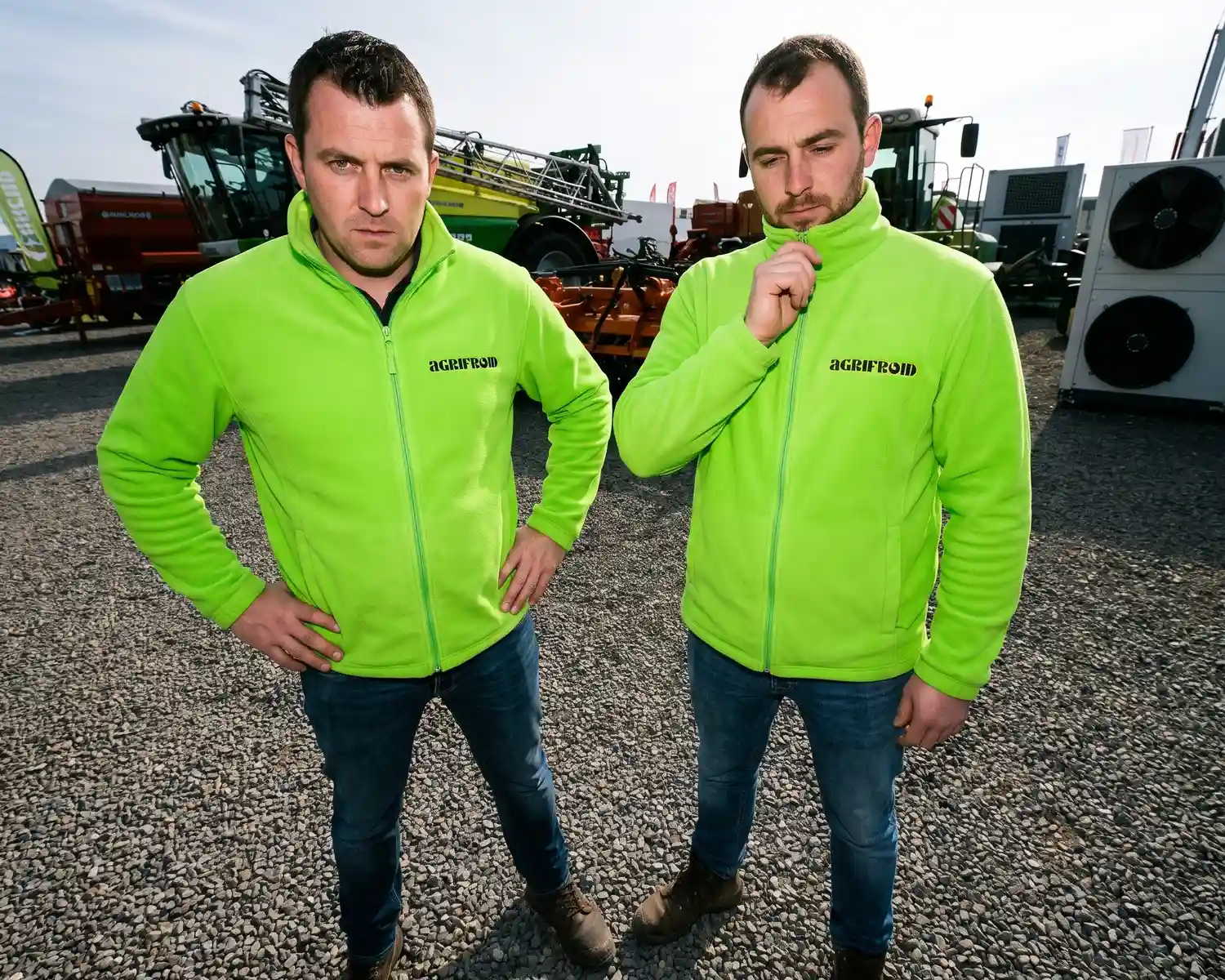
Embroidery remains the technique of choice for this fabric: it can be ordered online, price shown, on all 11 product pages, at 8 × 10 cm. A pile several millimetres deep tends to cover the thread; to keep the logo sharp, our fleece page explains that a film that dissolves in water lays the pile flat while the logo is stitched, then goes away in the first wash. So plan a simplified logo and fairly large text: fleece is not made for millimetre details.
Softshell printing is added on three fleeces, Stanley/Stella's Stanley Quester, Trekker and Brooker, in A5 format. It is a transfer: the design is printed in four-colour process on a film, then heat-pressed away from the seams, as our softshell printing page explains. It renders every colour, gradients included, where embroidery gives the relief of the thread. On the Stanley Quester, at 50 units, A5 printing comes to 30.56 euros excluding VAT per fleece and chest embroidery to 29.56 euros excluding VAT.
Patches are priced on quote on all 11 product pages. Our fleece page adds, also on quote, DTG printing, digital transfer, 3D embroidery and terry loop embroidery.
Screen printing does not appear on any of the 11 product pages, nor in the list of on-quote techniques on the fleece page. And as on every garment at tknp.io, two markings on the same fleece stay in the same technique: an embroidered chest and an embroidered back, not a mix of embroidery and print.
The run can be ordered from 10 fleeces per model, sizes and colours mixed.
What to remember
Fleece is a brushed polyester knit, often recycled, whose pile holds the air. Its weight, from 200 to 450 g/m² in our catalog, tells you its warmth far better than the word "microfleece". For the logo, embroidery is the safe choice and can be ordered online on all our fleeces; softshell printing serves full-colour designs on three Stanley/Stella models.
Frequently asked questions
What is fleece made of?
Polyester, PET, knitted then brushed to raise a pile that holds the air. Of the 11 fleeces in our catalog reread on 10 November 2026, all are polyester, and 4 are 100% recycled polyester.
What is the difference between fleece and microfleece?
In principle, the weight: microfleece is the finest fleece. On the product pages, the name does not always follow: two jackets sold as microfleece weigh 300 g/m², as much as a classic fleece. The weight on the product page remains the right guide.
Which fleece is the warmest?
The heaviest: English Wikipedia notes that the heavier fleeces are the warmer ones, and our fleece page adds that a pile brushed on both faces is warmer. In our catalog, the thickest is Stanley/Stella's Brooker, a 450 g/m² sherpa jacket.
Can you screen print a fleece jacket?
Not in our catalog: none of the 11 fleece product pages offers screen printing on 10 November 2026. Embroidery can be ordered online on all of them, softshell printing on three Stanley/Stella models, and patches are priced on quote.
Your project, quoted within 24 hours.
Describe your garments, your decoration and your quantities: you receive a detailed quote, decoration included, within one business day.